MCA reverse consolidation strategy: alternative refinance framework 2026.
MCA reverse consolidation is a tactical alternative refinance strategy where a new advance funds daily or weekly holdback payments on existing stacked MCA positions rather than paying off the underlying principals. Framework foundation encompasses traditional consolidation vs reverse consolidation distinction (traditional consolidation requires strong credit, collateral, and business performance metrics that most stacked-position borrowers cannot demonstrate to pay off underlying MCA principals at lower rate; reverse consolidation does not require traditional underwriting since the provider is essentially advancing capital against the borrower's ongoing revenue stream to fund daily or weekly holdback obligations on existing positions freeing 40 to 60 percent of daily merchant cash flow), five MCA reverse consolidation framework elements (daily and weekly holdback payment coverage mechanism providing reverse consolidation provider funding for existing MCA obligation payments through direct provider-to-MCA-funder payment or borrower reimbursement structure, no credit requirement framework supporting distressed stacked-position borrower access without traditional underwriting requirements, 40 to 60 percent cash flow restoration analysis for merchant operations supporting operational viability with typical merchant with 3 to 5 stacked positions facing 60 to 80 percent aggregate holdback restored to 30 to 40 percent single reverse consolidation payment, strategic runway framework for settlement negotiations 90 to 180 day runway and Subchapter V bankruptcy preparation 60 to 90 day runway and refinance qualification build 6 to 12 month runway, cost structure analysis with factor rate 1.35 to 1.55 range framework creating substantial cost premium with 35 to 55 percent implied APR range), four operational tactical elements (coordinated MCA position analysis and reverse consolidation sizing with position-by-position payment analysis including daily/weekly holdback percentage and remaining balance and factor rate and contract reconciliation clause, reverse consolidation provider selection with non-predatory sourcing and comparison across multiple providers for optimal factor rate and payment structure, coordinated cash flow management during reverse consolidation period with disciplined runway utilization preventing operational spending expansion beyond restored capacity, exit strategy coordination for settlement or bankruptcy pathway transition supporting coordinated exit execution before reverse consolidation runway expires), and three structural risk framework consequences (debt stack compounding risk with additional reverse consolidation adding to existing MCA obligations creating compounded debt burden since reverse consolidation does not pay off underlying MCA principals leaving all original obligations outstanding, provider predatory practice risk with reverse consolidation provider exploitation of distressed borrower vulnerability including excessive factor rates and hidden fees and aggressive default triggers, exit strategy failure risk with reverse consolidation period expiring without coordinated settlement or bankruptcy pathway execution leaving borrower facing original MCA obligations plus reverse consolidation obligation). Coordinated MCA reverse consolidation strategy integration with Subchapter V bankruptcy pathway April 2026 $3,424,000 eligibility ceiling and Section 548 constructive fraudulent transfer framework analysis (Black Pearl Vision LLC v G&G Funding Group LLC June 2026 ruling) supports comprehensive MCA workout strategy framework across settlement coordination and bankruptcy pathway preparation and refinance qualification build. Reverse consolidation is a tactical bridge, not a permanent solution — the underlying MCA obligations remain outstanding while the reverse consolidation creates strategic runway for coordinated exit strategy execution.
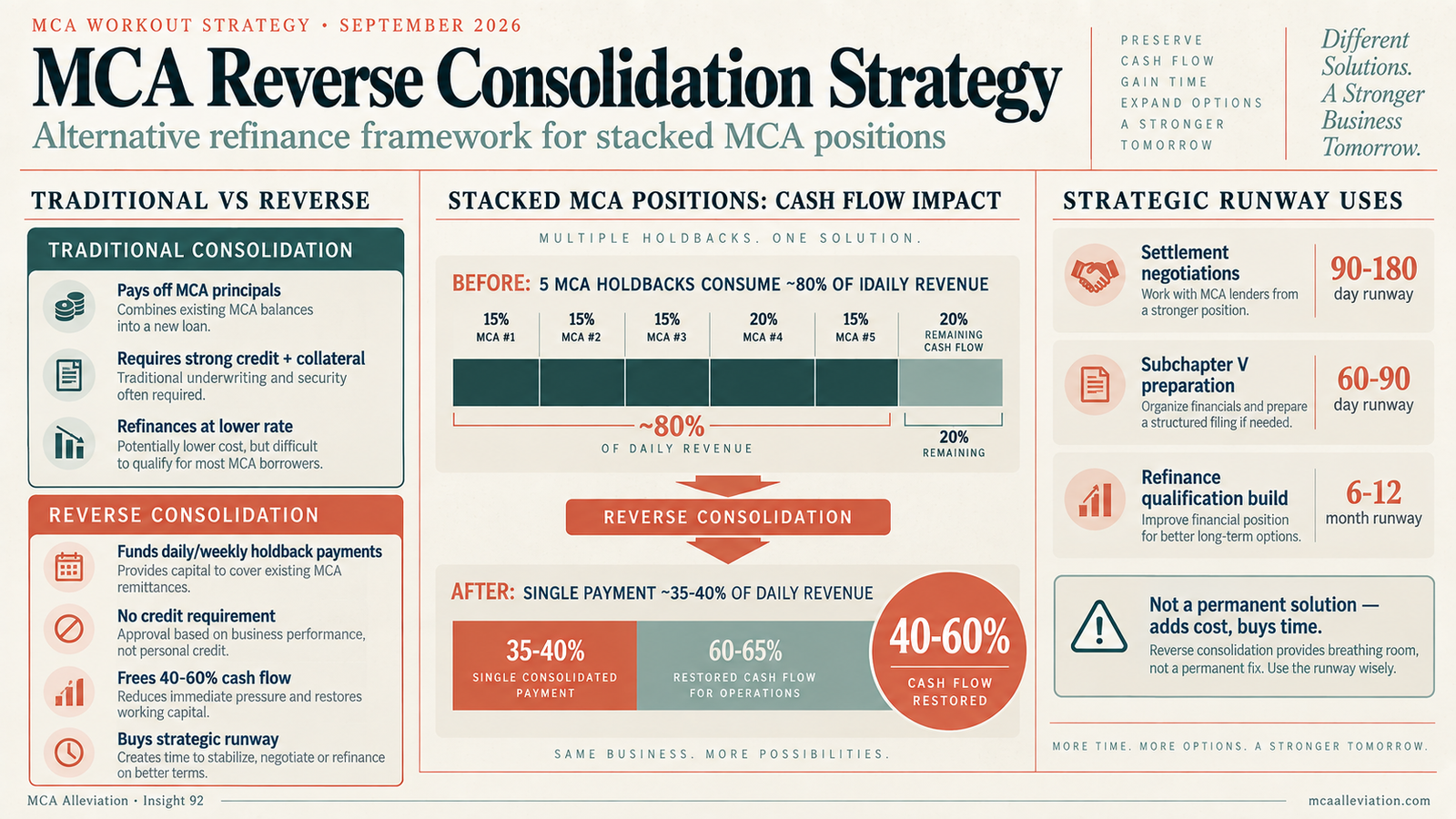
If you are a small business operator with stacked MCA positions where aggregate daily holdback is consuming 60 to 80 percent of daily revenue and traditional consolidation is unavailable due to credit or business performance limitations, MCA reverse consolidation is a tactical alternative refinance framework that can restore 40 to 60 percent of daily cash flow — but only as a bridge to coordinated exit strategy execution through settlement negotiations, Subchapter V bankruptcy preparation, or refinance qualification build.
Key MCA reverse consolidation framework dynamics include: traditional vs reverse consolidation distinction (traditional pays off principals requiring strong credit; reverse funds daily holdback payments requiring no traditional underwriting), five framework elements (daily/weekly holdback payment coverage mechanism, no credit requirement framework, 40-60% cash flow restoration analysis, strategic runway framework, factor rate 1.35-1.55 cost structure), four operational tactics (position analysis and sizing, non-predatory provider selection, coordinated cash flow management during runway, exit strategy coordination), and three structural risks (debt stack compounding, provider predatory practices, exit strategy failure).
This guide is a comprehensive MCA reverse consolidation framework analysis with strategic operational focus for stacked-position merchants navigating cash flow restoration alongside coordinated exit strategy execution across settlement pathway coordination, Subchapter V bankruptcy pathway with April 2026 $3,424,000 eligibility ceiling, or refinance qualification build coordination.
MCA reverse consolidation is a tactical alternative refinance strategy where a new advance funds daily or weekly holdback payments on existing stacked MCA positions rather than paying off the underlying principals. Framework restores 40 to 60 percent of daily merchant cash flow at factor rate 1.35 to 1.55 range creating 35 to 55 percent implied APR cost premium, requiring no traditional underwriting, and providing strategic runway for settlement negotiations (90-180 day), Subchapter V bankruptcy preparation (60-90 day), or refinance qualification build (6-12 month). Five framework elements: daily/weekly holdback payment coverage mechanism, no credit requirement framework, 40-60% cash flow restoration analysis, strategic runway framework, factor rate 1.35-1.55 cost structure. Four operational tactics: position analysis and sizing, non-predatory provider selection, coordinated cash flow management during runway, exit strategy coordination. Three structural risks: debt stack compounding (reverse consolidation does not pay off underlying principals), provider predatory practices, exit strategy failure (runway expires without coordinated settlement or bankruptcy execution). Reverse consolidation is a tactical bridge, not a permanent solution.
Traditional vs reverse consolidation: the operational distinction.
Understanding MCA reverse consolidation strategy requires familiarity with the operational distinction between traditional MCA consolidation and reverse consolidation frameworks. Both are refinance strategies for stacked-position MCA merchants, but they solve different problems, require different qualifications, and produce different structural outcomes. Confusing the two — which most SERP content does — routinely leads merchants to pursue the wrong strategy for their actual circumstances.
Traditional MCA consolidation: pays off principals, requires strong credit
Traditional MCA consolidation is a refinance product that pays off the existing MCA principals in full and replaces multiple obligations with a single lower-cost obligation. Framework mechanics: (1) borrower obtains a new financing product (bank loan, SBA 7(a) refinance, or coordinated MCA payoff facility) providing capital sufficient to pay off all outstanding MCA balances at par or negotiated payoff amount, (2) new consolidation product operates at substantially lower cost than underlying MCAs — typical bank loan at 8 to 15 percent APR, SBA 7(a) at prime plus spread, coordinated MCA payoff at reduced factor rate 1.15 to 1.25, (3) merchant now has single monthly or weekly payment on consolidation product replacing multiple daily/weekly MCA holdbacks, (4) traditional consolidation is a permanent solution — the underlying MCA obligations are extinguished at closing. Qualification requirements: (a) strong credit profile with personal credit scores typically 680 or higher for bank loans and SBA 7(a) refinance, (b) business performance metrics including positive cash flow trajectory and 12 to 24 month operating history, (c) collateral availability for secured consolidation products including real estate, equipment, or coordinated business assets, (d) coordinated documentation package including tax returns, bank statements, P&L statements, and business plan. Framework fit: traditional consolidation fits merchants with strong underlying business fundamentals who took MCAs during temporary distress and can demonstrate qualification for lower-cost financing. Cross-reference our MCA settlement vs bankruptcy guide.
Reverse consolidation: funds holdback payments, requires no credit
MCA reverse consolidation is a tactical alternative refinance strategy where a new advance funds the daily or weekly holdback payment obligations on existing MCA positions rather than paying off the underlying principals. Framework mechanics: (1) reverse consolidation provider funds the daily or weekly holdback obligations on all covered MCA positions through direct provider-to-MCA-funder payment or through borrower reimbursement structure, (2) reverse consolidation product operates at substantial cost premium relative to traditional consolidation — typical factor rate 1.35 to 1.55 with 35 to 55 percent implied APR range, (3) merchant now has single reverse consolidation payment replacing aggregate daily/weekly MCA holdbacks — typical single payment 30 to 40 percent of daily revenue vs 60 to 80 percent aggregate pre-consolidation holdback, (4) reverse consolidation is a tactical bridge — the underlying MCA principals remain outstanding while the reverse consolidation creates strategic runway for coordinated exit strategy execution. Qualification framework: (a) no traditional underwriting since provider is advancing capital against ongoing revenue stream, (b) reverse consolidation available to distressed stacked-position borrowers who cannot qualify for traditional consolidation, (c) coordinated evaluation of revenue stability and position count and aggregate holdback percentage rather than credit score or collateral, (d) reverse consolidation provider due diligence focuses on merchant revenue trajectory and coordinated exit strategy viability. Framework fit: reverse consolidation fits stacked-position merchants where daily holdback burden is destroying operational viability and traditional consolidation is unavailable due to credit or performance limitations AND merchant has coordinated exit strategy pathway (settlement, Subchapter V, or refinance qualification build) requiring 60 to 365 day execution runway.
The honest inflection point: bridge vs permanent solution
The critical operational distinction is that traditional consolidation is a permanent solution (underlying MCA obligations extinguished) while reverse consolidation is a tactical bridge (underlying MCA obligations remain outstanding). Merchants who pursue reverse consolidation without coordinated exit strategy face the compounded scenario where the reverse consolidation runway expires and they now owe both the original MCA obligations plus the reverse consolidation obligation — a worse structural position than before the reverse consolidation. Reverse consolidation is not a substitute for coordinated exit strategy through settlement, Subchapter V bankruptcy, or refinance qualification build; it is a bridge that supports coordinated exit strategy execution. The intake framework analyzes which pathway fits the specific case circumstances and coordinates reverse consolidation only when it supports coordinated exit strategy execution. Cross-reference our multiple MCA stacked positions framework guide for the coordinated framework analysis.
Stacked MCA positions with daily holdback consuming 60-80% of revenue and traditional consolidation unavailable?
The intake walks the reverse consolidation framework analysis: traditional consolidation vs reverse consolidation distinction analysis with underlying MCA obligation payoff vs daily/weekly holdback payment coverage mechanism, five MCA reverse consolidation framework elements (daily/weekly holdback payment coverage, no credit requirement framework, 40-60% cash flow restoration analysis, strategic runway framework for settlement/Subchapter V/refinance qualification build, cost structure with factor rate 1.35-1.55 range), four operational tactical elements (coordinated MCA position analysis and reverse consolidation sizing, non-predatory provider selection with comparison across multiple providers, coordinated cash flow management during runway period, exit strategy coordination for settlement or bankruptcy pathway transition), three structural risk framework consequences (debt stack compounding risk, provider predatory practice risk, exit strategy failure risk), and coordinated exit strategy analysis for settlement pathway coordination or Subchapter V bankruptcy pathway with April 2026 $3,424,000 eligibility ceiling or refinance qualification build coordination. Reverse consolidation is a tactical bridge, not a permanent solution — the intake analyzes whether reverse consolidation fits your specific case circumstances. No documents required to begin the call. Placement organization — not legal representation.
Five MCA reverse consolidation framework elements.
Five MCA reverse consolidation framework elements define the operational structure for coordinated MCA workout strategy through reverse consolidation execution. Each element addresses specific structural framework component requiring integrated analysis approach and coordinated framework development supporting comprehensive reverse consolidation strategic analysis for stacked-position merchants navigating cash flow restoration alongside coordinated exit strategy execution.
Daily and weekly holdback payment coverage mechanism provides the operational foundation for reverse consolidation strategy through direct provider funding of existing MCA obligation payments. Mechanism framework: (1) reverse consolidation provider funds daily or weekly holdback obligations on existing MCA positions through direct provider-to-MCA-funder payment or through borrower reimbursement structure, (2) direct payment mechanism operates through coordinated ACH authorization where reverse consolidation provider makes payments directly to underlying MCA funders on scheduled holdback dates, (3) reimbursement structure operates through borrower receiving daily reverse consolidation advance and forwarding coordinated payment to underlying MCA funders, (4) coordinated coverage mechanism supporting comprehensive MCA obligation payment management for stacked-position merchants. Coverage scope analysis: (a) reverse consolidation coverage typically includes all daily/weekly holdback obligations on covered MCA positions during runway period, (b) coverage does not include principal reduction — underlying MCA principals remain outstanding, (c) coordinated coverage analysis for position-by-position scope determination, (d) coordinated reverse consolidation sizing based on aggregate covered holdback obligations. Provider mechanism variations: (1) full-coverage reverse consolidation providers covering all daily/weekly holdback obligations across all stacked positions, (2) partial-coverage reverse consolidation providers covering selected positions or reduced coverage percentage, (3) coordinated hybrid coverage models combining reverse consolidation with negotiated MCA payment modification, (4) coordinated provider selection based on coverage mechanism fit with specific case circumstances. Strategic framework implications: (a) coverage mechanism determines cash flow restoration magnitude and reverse consolidation sizing, (b) coordinated coverage analysis supporting comprehensive workout framework development, (c) coordinated provider due diligence for coverage mechanism verification, (d) coordinated legal counsel engagement for coverage mechanism analysis. Cross-reference our multiple MCA stacked positions framework guide.
No credit requirement framework supports distressed stacked-position borrower access to reverse consolidation without traditional underwriting requirements creating pathway accessibility unavailable through traditional consolidation. Framework accessibility mechanics: (1) reverse consolidation does not require traditional credit underwriting since the provider is advancing capital against the borrower's ongoing revenue stream, (2) framework accessibility for distressed stacked-position borrowers who cannot qualify for traditional consolidation due to credit or performance limitations, (3) coordinated evaluation focuses on revenue stability and position count and aggregate holdback percentage rather than credit score or collateral, (4) coordinated framework supporting distressed borrower workout pathway. Provider due diligence framework: (a) reverse consolidation provider due diligence focuses on merchant revenue trajectory rather than credit score, (b) coordinated evaluation of coordinated exit strategy viability supporting reverse consolidation approval, (c) coordinated provider assessment of coordinated position stack complexity and reverse consolidation sizing viability, (d) coordinated provider due diligence for revenue verification through bank statements and processor statements. Framework accessibility implications: (1) reverse consolidation available to distressed borrowers with damaged credit profiles unable to qualify for bank loans or SBA 7(a) refinance, (2) framework accessibility for merchants with recent MCA defaults or coordinated MCA workout activity, (3) coordinated framework accessibility for merchants with active enforcement action supporting emergency workout pathway, (4) coordinated framework fit with distressed borrower workout scenarios. Coordinated risk framework: (a) no credit requirement framework creates provider risk offset through higher factor rate cost structure (1.35 to 1.55 range), (b) coordinated provider risk offset through daily/weekly payment collection structure, (c) coordinated framework risk offset through revenue stream collateralization, (d) coordinated risk framework analysis for coordinated reverse consolidation strategic development. Strategic framework implications: (1) no credit requirement framework enables reverse consolidation strategic pathway for distressed borrowers, (2) coordinated framework accessibility supports comprehensive workout strategy development, (3) coordinated provider selection for coordinated risk framework fit, (4) coordinated legal counsel engagement for coordinated workout framework analysis. Cross-reference our MCA relief buyer guide 2026.
40 to 60 percent cash flow restoration analysis for merchant operations provides quantitative framework for reverse consolidation sizing and strategic operational viability assessment supporting comprehensive workout framework development. Cash flow restoration mechanics: (1) merchant with 3 to 5 stacked MCA positions frequently faces aggregate daily holdback consuming 60 to 80 percent of daily revenue leaving 20 to 40 percent for operational expenses, (2) reverse consolidation provider funds the daily holdback obligations on all covered positions and replaces them with a single reverse consolidation payment typically at 30 to 40 percent of daily revenue, (3) net cash flow restoration is the difference between aggregate pre-consolidation holdback and single reverse consolidation payment, (4) typical restoration in 40 to 60 percent of daily revenue range supporting operational viability. Example calculation framework: (a) merchant with $10,000 daily revenue and 5 stacked MCA positions consuming $7,000 daily (70 percent aggregate holdback) has $3,000 daily for operations, (b) after reverse consolidation at 35 percent daily revenue, merchant pays $3,500 daily on reverse consolidation and has $6,500 for operations, (c) net cash flow restoration is $3,500 daily or 35 percent of gross daily revenue, (d) coordinated cash flow analysis supporting comprehensive reverse consolidation sizing framework. Restoration variability factors: (1) reverse consolidation provider factor rate (1.35 to 1.55 range) affecting daily payment size, (2) reverse consolidation payment percentage (30 to 40 percent typical range) affecting cash flow restoration, (3) number and structure of positions consolidated affecting aggregate coverage scope, (4) merchant revenue stability affecting reverse consolidation sizing viability. Operational viability framework: (a) 40 to 60 percent cash flow restoration typically restores operational viability for stacked-position merchants, (b) coordinated cash flow analysis for coordinated payroll, rent, inventory, and vendor payment restoration, (c) coordinated operational viability assessment supporting strategic exit pathway execution, (d) coordinated financial management framework for disciplined runway utilization. Strategic framework implications: (1) cash flow restoration analysis determines reverse consolidation strategic viability, (2) coordinated cash flow analysis for coordinated exit strategy pathway execution, (3) coordinated financial management framework for coordinated runway utilization, (4) coordinated professional engagement for coordinated cash flow framework development.
Strategic runway framework for settlement negotiations and Subchapter V bankruptcy preparation and refinance qualification build supports coordinated exit strategy execution during reverse consolidation runway period. Runway framework mechanics: (1) reverse consolidation creates strategic runway for coordinated exit strategy execution during runway period, (2) runway period supports coordinated professional engagement (legal counsel, MCA workout advisor, accountant) for coordinated exit strategy development, (3) coordinated runway framework supporting comprehensive workout pathway execution, (4) runway framework strategic value dependent on coordinated exit strategy execution success. Runway period analysis by exit pathway: (a) settlement negotiations pathway typically requires 90 to 180 day runway for coordinated settlement execution across covered MCA positions and coordinated creditor negotiation framework, (b) Subchapter V bankruptcy preparation pathway typically requires 60 to 90 day runway for coordinated bankruptcy counsel engagement and coordinated bankruptcy documentation preparation with April 2026 $3,424,000 eligibility ceiling analysis, (c) refinance qualification build pathway typically requires 6 to 12 month runway for coordinated credit profile rebuild and coordinated business performance metric development, (d) coordinated runway analysis for coordinated exit pathway execution. Coordinated runway strategic framework development: (1) coordinated runway period utilization requiring disciplined financial management preventing operational spending expansion beyond restored capacity, (2) coordinated professional engagement during runway period for coordinated exit strategy development, (3) coordinated runway period milestone tracking for coordinated exit strategy execution monitoring, (4) coordinated runway period contingency planning for coordinated exit strategy adjustment. Strategic runway framework implications: (a) runway framework strategic value dependent on coordinated exit strategy execution success, (b) coordinated runway framework failure risk if exit strategy execution delays beyond runway period, (c) coordinated runway framework analysis for coordinated exit strategy pathway selection, (d) coordinated professional engagement for coordinated runway framework development. Cross-reference our MCA settlement vs bankruptcy guide.
Cost structure analysis with factor rate 1.35 to 1.55 range framework supports comprehensive cost analysis for reverse consolidation strategic framework development creating substantial cost premium relative to traditional consolidation. Cost structure mechanics: (1) reverse consolidation typically operates with factor rate in 1.35 to 1.55 range creating substantial cost premium relative to traditional consolidation, (2) factor rate 1.35 to 1.55 corresponding to 35 to 55 percent total repayment premium above advance amount, (3) implied APR range depending on repayment period structure — typical 6 to 12 month repayment period producing 35 to 55 percent implied APR range, (4) coordinated cost analysis for reverse consolidation strategic framework development. Comparative cost analysis: (a) traditional bank loan consolidation at 8 to 15 percent APR representing 20 to 40 percent cost reduction versus reverse consolidation, (b) SBA 7(a) refinance at prime plus spread representing coordinated cost reduction versus reverse consolidation, (c) coordinated MCA payoff at reduced factor rate 1.15 to 1.25 representing coordinated cost positioning versus reverse consolidation, (d) reverse consolidation cost premium reflecting no-credit-requirement framework and coordinated distressed borrower risk premium. Cost structure strategic analysis: (1) reverse consolidation cost premium justified when coordinated exit strategy execution produces coordinated MCA obligation resolution offsetting reverse consolidation cost, (2) coordinated exit strategy success producing settlement of underlying MCA obligations at 40 to 60 percent discount, (3) coordinated Subchapter V bankruptcy pathway producing coordinated MCA obligation restructuring or discharge, (4) coordinated refinance qualification build producing coordinated long-term financing framework replacement. Cost structure risk analysis: (a) reverse consolidation cost premium creates coordinated risk framework requiring coordinated exit strategy execution success, (b) coordinated cost premium risk offset through coordinated exit strategy pathway execution, (c) coordinated cost analysis for coordinated risk framework development, (d) coordinated professional engagement for coordinated cost framework analysis. Strategic framework implications: (1) cost structure analysis determines reverse consolidation strategic viability, (2) coordinated cost analysis for coordinated exit strategy pathway execution, (3) coordinated cost framework analysis supporting comprehensive strategic development, (4) coordinated legal counsel and MCA workout advisor engagement for coordinated cost framework analysis.
Combined across the five reverse consolidation framework elements, MCA reverse consolidation strategy establishes coordinated operational framework for stacked-position merchants navigating cash flow restoration alongside coordinated exit strategy execution. Three features distinguish reverse consolidation framework operation from traditional consolidation framework: distressed borrower accessibility through no-credit-requirement framework, tactical bridge structure requiring coordinated exit strategy execution, and cost premium framework justified through coordinated exit strategy pathway execution success. Cross-reference our state MCA regulation 2026 CFDL frameworks guide.
Want the six fit questions walked for your specific creditors?
The intake call answers each of the six questions, identifies which creditors fit settlement and which do not, and routes the rest to the appropriate pathway — modification, refinance, SBA mechanism, or Subchapter V. No documents required to begin.
Four operational tactical elements.
Four operational tactical elements define the coordinated execution framework for MCA reverse consolidation strategy supporting comprehensive workout pathway execution. Each tactic addresses specific operational framework component requiring integrated execution approach and coordinated tactical development supporting comprehensive reverse consolidation strategic execution for stacked-position merchants navigating coordinated exit strategy pathway.
Execution mechanics: coordinated MCA position analysis and reverse consolidation sizing provides foundational tactical framework for reverse consolidation strategic execution through comprehensive position-by-position analysis and coordinated aggregate analysis for optimal reverse consolidation sizing. Position-by-position analysis framework: (1) individual MCA position analysis including daily/weekly holdback percentage, remaining balance, factor rate, and contract reconciliation clause, (2) individual position payment timing analysis for coordinated coverage scheduling, (3) individual position provider identification and coordinated provider relationship analysis, (4) individual position UCC filing analysis and coordinated senior lien framework analysis. Aggregate analysis framework: (a) aggregate daily/weekly holdback percentage across all stacked positions supporting coordinated cash flow burden analysis, (b) aggregate remaining balance across all stacked positions supporting coordinated exit strategy sizing, (c) aggregate factor rate analysis supporting coordinated cost framework analysis, (d) coordinated aggregate analysis for coordinated reverse consolidation sizing determination. Reverse consolidation sizing framework: (1) reverse consolidation sizing based on aggregate covered holdback obligations during runway period, (2) coordinated sizing analysis for coordinated cash flow restoration target, (3) coordinated sizing analysis for coordinated exit strategy runway period support, (4) coordinated sizing analysis for coordinated cost framework fit. Coordinated professional engagement: (a) coordinated MCA workout advisor engagement for position analysis expertise, (b) coordinated legal counsel engagement for contract analysis and coordinated framework review, (c) coordinated accountant engagement for coordinated financial analysis, (d) coordinated professional team engagement for coordinated tactical execution. Strategic tactical implications: (1) coordinated position analysis foundational for coordinated reverse consolidation strategic execution, (2) coordinated sizing framework foundational for coordinated cash flow restoration, (3) coordinated tactical framework foundational for coordinated exit strategy pathway execution, (4) coordinated professional engagement foundational for coordinated tactical framework development. Cross-reference our multiple MCA stacked positions framework guide.
Execution mechanics: reverse consolidation provider selection with non-predatory sourcing provides critical tactical framework for reverse consolidation strategic execution through coordinated multi-provider comparison and coordinated due diligence for coordinated provider selection avoiding predatory practices. Multi-provider comparison framework: (1) coordinated comparison across multiple reverse consolidation providers for optimal factor rate and payment structure, (2) coordinated provider comparison for coordinated contract terms analysis including default triggers and coordinated collection framework, (3) coordinated provider comparison for coordinated coverage mechanism analysis and coordinated payment structure fit, (4) coordinated provider comparison for coordinated reverse consolidation sizing capacity and coordinated professional relationship framework. Non-predatory due diligence framework: (a) coordinated provider due diligence for coordinated business practice analysis avoiding predatory practices, (b) coordinated provider background research including BBB rating, coordinated litigation history, and coordinated regulatory action analysis, (c) coordinated provider reference framework including coordinated professional network engagement, (d) coordinated provider due diligence for coordinated defensive framework fit. Predatory practice red flags: (1) excessive factor rate above 1.55 range indicating coordinated predatory positioning, (2) hidden fees and coordinated undisclosed cost structure indicating coordinated predatory framework, (3) aggressive default triggers and coordinated exploitative collection framework indicating coordinated predatory positioning, (4) unauthorized ACH withdrawals and coordinated abusive collection tactics indicating coordinated predatory framework. Contract review framework: (a) coordinated legal counsel engagement for coordinated contract review across all provider proposals, (b) coordinated contract term analysis including default triggers and coordinated collection framework, (c) coordinated contract term analysis including coordinated reconciliation clause and coordinated payment modification framework, (d) coordinated contract review supporting coordinated defensive framework development. Strategic tactical implications: (1) coordinated provider selection foundational for coordinated defensive framework development, (2) coordinated non-predatory framework foundational for coordinated risk mitigation, (3) coordinated multi-provider comparison foundational for coordinated cost framework optimization, (4) coordinated legal counsel engagement foundational for coordinated contract review framework. Cross-reference our MCA relief buyer guide 2026.
Execution mechanics: coordinated cash flow management during reverse consolidation period provides operational tactical framework for reverse consolidation strategic execution through coordinated disciplined runway utilization preventing operational spending expansion beyond restored capacity. Runway utilization discipline framework: (1) disciplined runway utilization for coordinated exit strategy execution during runway period, (2) coordinated financial management preventing operational spending expansion beyond restored capacity, (3) coordinated professional engagement for coordinated cash flow management, (4) coordinated runway period milestone tracking for coordinated exit strategy execution monitoring. Coordinated cash flow management framework: (a) coordinated cash flow analysis for coordinated operational spending framework, (b) coordinated financial management for coordinated professional fee framework (legal counsel, MCA workout advisor, accountant), (c) coordinated reserve building for coordinated exit strategy execution funding, (d) coordinated cash flow management for coordinated runway period support. Operational spending expansion prevention: (1) coordinated discipline preventing operational spending expansion beyond pre-consolidation baseline, (2) coordinated management preventing coordinated expansion of coordinated business operations creating additional cash flow burden, (3) coordinated financial management preventing coordinated expansion of coordinated personnel costs, (4) coordinated management preventing coordinated business expansion creating coordinated cash flow burden. Professional coordination framework: (a) coordinated legal counsel engagement for coordinated exit strategy pathway development, (b) coordinated MCA workout advisor engagement for coordinated settlement framework development, (c) coordinated accountant engagement for coordinated financial framework development, (d) coordinated professional team engagement for coordinated tactical execution. Strategic tactical implications: (1) coordinated cash flow management foundational for coordinated exit strategy execution success, (2) coordinated discipline framework foundational for coordinated runway period utilization, (3) coordinated professional engagement foundational for coordinated tactical framework development, (4) coordinated runway period milestone tracking foundational for coordinated exit strategy execution monitoring. Cross-reference our MCA settlement vs bankruptcy guide.
Execution mechanics: exit strategy coordination for settlement or bankruptcy pathway transition provides critical tactical framework for reverse consolidation strategic execution through coordinated exit strategy execution before reverse consolidation runway expires supporting comprehensive workout pathway completion. Settlement pathway coordination: (1) settlement pathway coordination for underlying MCA obligations during reverse consolidation runway period, (2) coordinated settlement execution across covered MCA positions supporting coordinated MCA obligation resolution, (3) coordinated creditor negotiation framework supporting coordinated settlement pathway execution, (4) coordinated settlement pathway timing coordinated with reverse consolidation runway period. Subchapter V bankruptcy pathway coordination: (a) Subchapter V bankruptcy pathway coordination with April 2026 $3,424,000 eligibility ceiling supporting comprehensive bankruptcy framework navigation, (b) coordinated bankruptcy counsel engagement for coordinated bankruptcy pathway development during reverse consolidation runway period, (c) coordinated bankruptcy documentation preparation supporting coordinated bankruptcy filing execution before runway expires, (d) coordinated Section 548 constructive fraudulent transfer framework leverage (Black Pearl Vision LLC v G&G Funding Group LLC June 2026 ruling) supporting coordinated bankruptcy pathway framework analysis. Refinance qualification build coordination: (1) coordinated credit profile rebuild during reverse consolidation runway period, (2) coordinated business performance metric development supporting coordinated refinance qualification, (3) coordinated coordinated financial documentation preparation supporting coordinated refinance qualification framework, (4) coordinated refinance provider engagement during reverse consolidation runway period supporting coordinated refinance pathway execution. Coordinated exit strategy execution framework: (a) coordinated exit strategy execution before reverse consolidation runway expires, (b) coordinated exit strategy pathway selection based on coordinated case circumstances analysis, (c) coordinated exit strategy execution monitoring during reverse consolidation runway period, (d) coordinated exit strategy contingency planning for coordinated pathway adjustment. Strategic tactical implications: (1) coordinated exit strategy foundational for coordinated reverse consolidation strategic execution success, (2) coordinated pathway selection foundational for coordinated exit strategy execution, (3) coordinated professional engagement foundational for coordinated exit strategy development, (4) coordinated framework integration foundational for coordinated comprehensive workout pathway completion.
The four operational tactical elements operate together to create comprehensive reverse consolidation execution framework requiring integrated approach supporting MCA reverse consolidation strategic execution. Integrated approach — coordinated MCA position analysis and reverse consolidation sizing + reverse consolidation provider selection with non-predatory sourcing + coordinated cash flow management during reverse consolidation period + exit strategy coordination for settlement or bankruptcy pathway transition — produces case-specific reverse consolidation tactical framework supporting comprehensive strategic execution across coordinated exit strategy pathway completion.
Three structural risk framework consequences.
Three structural risk framework consequences define the MCA reverse consolidation risk framework requiring coordinated risk management for successful strategic execution across coordinated exit strategy pathway. Each risk consequence addresses specific structural framework risk requiring integrated risk management approach and coordinated risk mitigation supporting comprehensive reverse consolidation strategic execution for stacked-position merchants navigating coordinated exit strategy pathway.
Risk 1: Debt stack compounding risk
Debt stack compounding risk represents the most fundamental structural risk of MCA reverse consolidation strategy — additional reverse consolidation adds to existing MCA obligations creating compounded debt burden that requires disciplined exit strategy execution for coordinated risk mitigation. Risk framework mechanics: (1) reverse consolidation does not pay off underlying MCA principals leaving all original obligations outstanding, (2) borrower now faces original MCA obligations plus reverse consolidation obligation creating compounded debt burden, (3) reverse consolidation provider payment obligations run concurrently with underlying MCA obligation coordinated framework during runway period, (4) coordinated debt stack compounding creates coordinated risk framework requiring disciplined exit strategy execution. Compounding scenarios: (a) merchant with 5 stacked MCA positions totaling $500K in outstanding principal plus $250K reverse consolidation obligation creates $750K total debt stack, (b) coordinated debt stack compounding scenario where reverse consolidation runway expires without coordinated exit strategy execution, (c) coordinated post-runway scenario where borrower faces original MCA obligations plus expired reverse consolidation obligation, (d) coordinated compounded debt burden scenario requiring coordinated bankruptcy pathway execution. Risk mitigation framework: (1) disciplined exit strategy execution before reverse consolidation runway expires supporting coordinated debt burden resolution, (2) coordinated settlement pathway execution for underlying MCA obligations supporting coordinated debt stack reduction, (3) coordinated Subchapter V bankruptcy pathway execution with April 2026 $3,424,000 eligibility ceiling supporting coordinated comprehensive debt stack resolution, (4) coordinated refinance qualification build execution supporting coordinated long-term financing framework replacement. Coordinated risk framework analysis: (a) coordinated risk analysis for coordinated debt stack compounding scenario, (b) coordinated risk analysis for coordinated exit strategy execution timing, (c) coordinated risk analysis for coordinated bankruptcy pathway contingency framework, (d) coordinated risk analysis supporting coordinated strategic framework development. Strategic risk framework implications: (1) debt stack compounding risk foundational risk framework requiring disciplined execution, (2) coordinated exit strategy execution foundational for coordinated risk mitigation, (3) coordinated bankruptcy pathway contingency framework foundational for coordinated risk framework, (4) coordinated professional engagement foundational for coordinated risk framework analysis.
Risk 2: Provider predatory practice risk
Provider predatory practice risk represents the operational risk of MCA reverse consolidation strategy — reverse consolidation provider exploitation of distressed borrower vulnerability requires coordinated non-predatory provider sourcing and coordinated contract review for coordinated risk mitigation. Risk framework mechanics: (1) reverse consolidation provider exploitation of distressed borrower vulnerability through coordinated predatory practices, (2) predatory practices including excessive factor rates above 1.55 range, hidden fees, aggressive default triggers, unauthorized ACH withdrawals, and coordinated abusive collection tactics, (3) coordinated provider exploitation supported by distressed borrower limited alternative options and coordinated urgency framework, (4) coordinated predatory risk framework requiring coordinated risk management. Predatory practice red flags: (a) excessive factor rates above 1.55 range indicating coordinated predatory positioning above market standard, (b) hidden fees and coordinated undisclosed cost structure indicating coordinated predatory framework beyond disclosed factor rate, (c) aggressive default triggers activating coordinated collection framework on minor payment delays, (d) unauthorized ACH withdrawals and coordinated abusive collection tactics indicating coordinated predatory framework, (e) coordinated contract terms with coordinated exploitative reconciliation clause limitations, (f) coordinated provider background including negative BBB rating and coordinated litigation history. Risk mitigation framework: (1) coordinated non-predatory provider sourcing through coordinated multi-provider comparison, (2) coordinated provider due diligence framework including background research and coordinated reference framework, (3) coordinated legal counsel engagement for coordinated contract review across all provider proposals, (4) coordinated professional network engagement for coordinated provider verification framework. Coordinated risk framework analysis: (a) coordinated risk analysis for coordinated provider predatory framework identification, (b) coordinated risk analysis for coordinated contract terms review, (c) coordinated risk analysis for coordinated provider background verification, (d) coordinated risk analysis supporting coordinated non-predatory framework development. Strategic risk framework implications: (1) provider predatory practice risk foundational operational risk framework requiring coordinated provider selection discipline, (2) coordinated non-predatory sourcing foundational for coordinated risk mitigation, (3) coordinated legal counsel engagement foundational for coordinated contract review framework, (4) coordinated professional engagement foundational for coordinated provider verification. Cross-reference our FTC MCA enforcement 2026 guide.
Risk 3: Exit strategy failure risk
Exit strategy failure risk represents the strategic risk of MCA reverse consolidation strategy — reverse consolidation period expiring without coordinated settlement or bankruptcy pathway execution creates coordinated compounded debt burden scenario requiring coordinated risk mitigation through disciplined exit strategy execution. Risk framework mechanics: (1) reverse consolidation period expires without coordinated settlement or bankruptcy pathway execution, (2) borrower faces original MCA obligations plus reverse consolidation obligation with no coordinated exit, (3) coordinated post-runway scenario requiring coordinated emergency workout framework, (4) coordinated exit strategy failure risk framework requiring coordinated disciplined execution. Failure scenarios: (a) settlement pathway failure scenario where coordinated creditor negotiation fails during runway period, (b) Subchapter V bankruptcy pathway failure scenario where coordinated bankruptcy documentation preparation delays beyond runway period, (c) refinance qualification build failure scenario where coordinated credit profile rebuild extends beyond runway period, (d) coordinated multiple pathway failure scenario requiring coordinated emergency workout framework. Risk mitigation framework: (1) coordinated exit strategy execution during runway period including coordinated settlement pathway coordination, (2) coordinated Subchapter V bankruptcy pathway coordination with April 2026 $3,424,000 eligibility ceiling supporting coordinated bankruptcy execution before runway expires, (3) coordinated Section 548 constructive fraudulent transfer framework leverage (Black Pearl Vision LLC v G&G Funding Group LLC June 2026 ruling) supporting coordinated bankruptcy pathway framework analysis, (4) coordinated refinance qualification build coordination supporting coordinated long-term financing framework. Coordinated contingency framework: (a) coordinated contingency planning for coordinated exit strategy pathway adjustment, (b) coordinated professional engagement continuity for coordinated exit strategy execution monitoring, (c) coordinated milestone tracking for coordinated exit strategy execution progress, (d) coordinated contingency framework supporting coordinated risk mitigation. Coordinated legal counsel and MCA workout advisor engagement: (1) coordinated professional team engagement for coordinated exit strategy pathway development, (2) coordinated professional continuity for coordinated runway period execution monitoring, (3) coordinated professional coordination for coordinated exit strategy execution success, (4) coordinated professional network engagement for coordinated pathway execution support. Strategic risk framework implications: (a) exit strategy failure risk foundational strategic risk framework requiring coordinated disciplined execution, (b) coordinated exit strategy execution foundational for coordinated risk mitigation, (c) coordinated professional engagement foundational for coordinated exit strategy framework development, (d) coordinated contingency framework foundational for coordinated risk framework analysis.
MCA reverse consolidation contemplating stacked position workout or coordinated exit strategy pathway?
The intake walks the three structural risk framework consequences with case-specific analysis: debt stack compounding risk with additional reverse consolidation adding to existing MCA obligations creating compounded debt burden requiring coordinated exit strategy execution for coordinated risk mitigation; provider predatory practice risk with reverse consolidation provider exploitation of distressed borrower vulnerability requiring coordinated non-predatory provider sourcing and coordinated contract review through legal counsel engagement; exit strategy failure risk with reverse consolidation period expiring without coordinated settlement or bankruptcy pathway execution requiring coordinated disciplined execution and coordinated contingency framework development. Coordinated risk framework analysis supporting comprehensive strategic execution across coordinated exit strategy pathway completion. No documents required to begin. Placement organization — not legal representation.
Three things worth remembering from this guide.
Traditional vs reverse consolidation: pays off principals vs funds holdback payments.
Traditional MCA consolidation pays off underlying MCA principals requiring strong credit, collateral, and business performance metrics. Reverse consolidation does not pay off underlying MCA principals — it funds the daily or weekly holdback payment obligations on existing positions freeing 40 to 60 percent of daily merchant cash flow while requiring no traditional underwriting since the provider is essentially advancing capital against the borrower's ongoing revenue stream. Reverse consolidation operates at factor rate 1.35 to 1.55 range creating substantial cost premium (35 to 55 percent implied APR) relative to traditional consolidation. Framework fit: reverse consolidation is a tactical bridge for stacked-position merchants with distressed profile unable to qualify for traditional consolidation but with coordinated exit strategy pathway.
Five framework elements + four operational tactics: coverage mechanism, no credit, cash flow restoration, runway, cost structure.
Five MCA reverse consolidation framework elements define the operational structure. Daily/weekly holdback payment coverage mechanism; no credit requirement framework for distressed borrower access; 40-60% cash flow restoration analysis; strategic runway framework (90-180 day settlement, 60-90 day Subchapter V, 6-12 month refinance qualification); cost structure with factor rate 1.35-1.55 range. Four operational tactical elements: coordinated MCA position analysis and reverse consolidation sizing; reverse consolidation provider selection with non-predatory sourcing through multi-provider comparison; coordinated cash flow management during runway period with disciplined utilization; exit strategy coordination for settlement or bankruptcy pathway transition before runway expires.
Three structural risks: debt stack compounding, provider predatory practices, exit strategy failure.
Three structural risk framework consequences define MCA reverse consolidation risk framework. Debt stack compounding risk (reverse consolidation does not pay off underlying MCA principals — original obligations plus reverse consolidation obligation creates compounded burden); provider predatory practice risk (excessive factor rates above 1.55, hidden fees, aggressive default triggers, unauthorized ACH withdrawals); exit strategy failure risk (runway expires without coordinated settlement or bankruptcy pathway execution). Risk mitigation requires disciplined exit strategy execution before runway expires, coordinated non-predatory provider sourcing with contract review by legal counsel, and coordinated Section 548 constructive fraudulent transfer framework leverage (Black Pearl v G&G June 2026 ruling) plus Subchapter V bankruptcy pathway with April 2026 $3,424,000 eligibility ceiling.
Frequently asked questions.
What is MCA reverse consolidation and how does it differ from traditional MCA consolidation?
MCA reverse consolidation is an alternative refinance strategy where a new MCA-style advance funds the daily or weekly holdback payments on existing stacked MCA positions rather than paying off the underlying principals. Traditional consolidation vs reverse consolidation distinction: traditional MCA consolidation requires the borrower to obtain a new financing product (bank loan, SBA 7(a) refinance, or coordinated MCA payoff) that pays off the existing MCA principals in full and replaces multiple obligations with a single lower-cost obligation; traditional consolidation requires strong credit, collateral, and business performance metrics that most stacked-position borrowers cannot demonstrate; reverse consolidation does not pay off the underlying MCA principals — it funds the daily or weekly holdback payment obligations on the existing positions, freeing 40 to 60 percent of daily merchant cash flow; reverse consolidation does not require traditional underwriting since the reverse consolidation provider is essentially advancing capital against the borrower's ongoing revenue stream; reverse consolidation is a tactical bridge, not a permanent solution — the underlying MCA obligations remain outstanding while the reverse consolidation creates strategic runway for settlement negotiations, Subchapter V bankruptcy preparation, or refinance qualification build.
How much cash flow can MCA reverse consolidation actually restore?
MCA reverse consolidation typically restores 40 to 60 percent of daily merchant cash flow depending on the number of stacked positions, the aggregate daily holdback percentage across those positions, and the reverse consolidation product structure. Framework mechanics: merchant with 3 to 5 stacked MCA positions frequently faces aggregate daily holdback consuming 60 to 80 percent of daily revenue, leaving 20 to 40 percent for operational expenses; reverse consolidation provider funds the daily holdback obligations on all covered positions and replaces them with a single reverse consolidation payment typically at 30 to 40 percent of daily revenue; net cash flow restoration is the difference between aggregate pre-consolidation holdback and single reverse consolidation payment — typically 40 to 60 percent of daily revenue. Example: merchant with $10,000 daily revenue and 5 stacked MCA positions consuming $7,000 daily has $3,000 daily for operations; after reverse consolidation at 35 percent, the merchant pays $3,500 daily and has $6,500 for operations — a $3,500 daily cash flow restoration or 35 percent of gross daily revenue.
What are the five MCA reverse consolidation framework elements?
Five MCA reverse consolidation framework elements define the operational structure. Element 1 — Daily and weekly holdback payment coverage mechanism: reverse consolidation provider funds daily or weekly holdback obligations on existing MCA positions through direct provider-to-MCA-funder payment or borrower reimbursement structure. Element 2 — No credit requirement framework: reverse consolidation does not require traditional underwriting since the provider is advancing capital against the borrower's ongoing revenue stream. Element 3 — 40 to 60 percent cash flow restoration analysis: quantitative cash flow restoration analysis based on aggregate pre-consolidation holdback vs single reverse consolidation payment; typical restoration in 40 to 60 percent range supporting operational viability. Element 4 — Strategic runway framework: reverse consolidation creates strategic runway for settlement negotiations (90 to 180 day runway), Subchapter V bankruptcy preparation (60 to 90 day runway), or refinance qualification build (6 to 12 month runway). Element 5 — Cost structure analysis with factor rate 1.35 to 1.55 range: reverse consolidation typically operates with factor rate in 1.35 to 1.55 range creating substantial cost premium; 35 to 55 percent implied APR range depending on repayment period structure.
What are the four operational tactical elements for executing MCA reverse consolidation?
Four operational tactical elements define the coordinated execution framework. Tactic 1 — Coordinated MCA position analysis and reverse consolidation sizing: position-by-position analysis of existing MCA obligations including daily/weekly holdback percentage, remaining balance, factor rate, and contract reconciliation clause; aggregate holdback analysis for comprehensive reverse consolidation sizing. Tactic 2 — Reverse consolidation provider selection with non-predatory sourcing: comparison across multiple reverse consolidation providers for optimal factor rate and payment structure; non-predatory provider sourcing avoiding providers with exploitative practices targeting distressed borrowers. Tactic 3 — Coordinated cash flow management during reverse consolidation period: disciplined runway utilization for settlement negotiations, bankruptcy preparation, or refinance qualification build; coordinated financial management preventing operational spending expansion beyond restored capacity. Tactic 4 — Exit strategy coordination for settlement or bankruptcy pathway transition: coordinated exit strategy execution before reverse consolidation runway expires; settlement pathway coordination for underlying MCA obligations; Subchapter V bankruptcy pathway coordination with April 2026 $3,424,000 eligibility ceiling.
What are the three structural risks of MCA reverse consolidation strategy?
Three structural risks define the MCA reverse consolidation risk framework. Risk 1 — Debt stack compounding risk: additional reverse consolidation adds to existing MCA obligations creating compounded debt burden; reverse consolidation does not pay off underlying MCA principals leaving all original obligations outstanding; borrower now faces original MCA obligations plus reverse consolidation obligation; risk mitigation requires disciplined exit strategy execution before reverse consolidation runway expires. Risk 2 — Provider predatory practice risk: reverse consolidation provider exploitation of distressed borrower vulnerability; predatory practices including excessive factor rates, hidden fees, aggressive default triggers, unauthorized ACH withdrawals, and abusive collection tactics; risk mitigation requires non-predatory provider sourcing, contract review by legal counsel, and coordinated due diligence across multiple providers. Risk 3 — Exit strategy failure risk: reverse consolidation period expires without coordinated settlement or bankruptcy pathway execution; borrower faces original MCA obligations plus reverse consolidation obligation with no coordinated exit; risk mitigation requires coordinated exit strategy execution during runway period including settlement pathway coordination, Subchapter V bankruptcy pathway coordination with April 2026 $3,424,000 eligibility ceiling, or refinance qualification build coordination.
When should MCA reverse consolidation be considered vs settlement or Subchapter V bankruptcy?
MCA reverse consolidation fits specific structural situations where cash flow restoration is the immediate operational priority and coordinated settlement or bankruptcy pathway execution requires strategic runway. Reverse consolidation fits: merchant with stacked MCA positions where daily holdback burden is destroying operational viability (aggregate holdback 60 percent or higher of daily revenue); merchant unable to qualify for traditional consolidation due to credit or performance limitations; merchant with coordinated exit strategy pathway (settlement, Subchapter V, or refinance qualification build) requiring 60 to 365 day execution runway. Settlement pathway fits: merchant with lump-sum funding availability for settlement execution; creditor mix with rational settlement incentive structure; documented hardship supporting settlement negotiation leverage. Subchapter V pathway fits: merchant with $3,424,000 or less in noncontingent liquidated debts (April 2026 ceiling); merchant unable to execute coordinated settlement due to creditor refusal or complexity; merchant with automatic stay requirement due to enforcement action; coordinated bankruptcy pathway execution with Section 548 constructive fraudulent transfer framework leverage. Reverse consolidation is a bridge to one of the other two pathways, not a substitute for them.
Stacked MCA positions destroying operational cash flow with traditional consolidation unavailable? The next conversation is the reverse consolidation framework diagnostic.
The fifteen-minute confidential intake walks the traditional vs reverse consolidation distinction analysis, five MCA reverse consolidation framework elements (daily/weekly holdback payment coverage mechanism, no credit requirement framework, 40-60% cash flow restoration analysis, strategic runway framework for settlement/Subchapter V/refinance qualification build, cost structure with factor rate 1.35-1.55 range creating 35-55% implied APR), four operational tactical elements (coordinated MCA position analysis and reverse consolidation sizing, reverse consolidation provider selection with non-predatory sourcing through multi-provider comparison, coordinated cash flow management during runway period with disciplined utilization, exit strategy coordination for settlement or bankruptcy pathway transition before runway expires), three structural risk framework consequences (debt stack compounding risk with reverse consolidation adding to underlying MCA obligations, provider predatory practice risk with exploitative practices targeting distressed borrowers, exit strategy failure risk with runway expiring without coordinated exit execution), and coordinated exit strategy pathway analysis for settlement pathway coordination or Subchapter V bankruptcy pathway with April 2026 $3,424,000 eligibility ceiling and Section 548 constructive fraudulent transfer framework leverage or refinance qualification build coordination. Reverse consolidation is a tactical bridge, not a permanent solution — the intake analyzes whether reverse consolidation fits your specific case circumstances. No documents required to begin. No obligation to engage anyone afterward. Placement organization — not legal representation.