Section 548 constructive fraudulent transfer: Black Pearl v G&G reshapes MCA payment clawback.
The Black Pearl Vision LLC v G&G Funding Group LLC June 2026 bankruptcy court ruling is a foundational Section 548 constructive fraudulent transfer case establishing framework analysis for MCA payment clawback in bankruptcy with direct implications for MCA industry portfolio exposure across the 230+ MCA-related bankruptcy filings reported for 2025 alone. Case framework foundation encompasses Black Pearl Vision LLC Chapter 11 filing December 2025 with MCA obligations to G&G Funding Group LLC among its creditor schedule, Chapter 11 trustee initiating 11 U.S.C. § 548 adversary proceeding Q1 2026 seeking to avoid pre-bankruptcy MCA payments as constructive fraudulent transfers, evidentiary framework establishing $233,000 paid by Black Pearl to G&G Funding Group during 2-year lookback period preceding bankruptcy filing and $192,000 as the actual economic value received by Black Pearl from G&G Funding Group (the MCA advance principal amount), and bankruptcy court analyzing the approximately $41,000 excess as constructive fraudulent transfer under 11 U.S.C. § 548(a)(1)(B) Reasonably Equivalent Value framework with June 2026 ruling establishing framework precedent for MCA payment clawback analysis. The framework encompasses five Section 548 framework elements (actual fraud § 548(a)(1)(A) intentional fraud requirement vs constructive fraud § 548(a)(1)(B) REV plus insolvency requirement distinction supporting different evidentiary framework focused on economic reality analysis for MCA payment clawback primarily proceeding under § 548(a)(1)(B) constructive fraud framework, Reasonably Equivalent Value REV analysis for MCA transactions requiring economic value analysis comparing merchant payments to actual value received including MCA advance principal amount analysis, MCA implied APR methodology for REV determination requiring implied APR calculation using factor rate and payment holdback and repayment period supporting standardized REV framework analysis with typical MCA implied APR of 40 to 150 percent creating substantial REV excess exposure, 2-year federal lookback under 11 U.S.C. § 548 vs state UFTA Uniform Fraudulent Transfer Act and UVTA Uniform Voidable Transactions Act extended lookback periods of 4 to 6 years with trustees pursuing extended state lookback under 11 U.S.C. § 544(b) strong-arm provision supporting coordinated federal-state clawback framework, insolvency presumption analysis under 11 U.S.C. § 547(f) for preferential transfer 90-day framework and § 548(a)(1)(B) framework requiring balance sheet insolvency analysis at time of transfer supporting comprehensive Section 548 framework), four MCA industry clawback implications (trustee clawback exposure across MCA portfolios for merchant bankruptcy filings with $41K per case exposure multiplied across MCA industry portfolio and 230+ MCA-related bankruptcy filings creating substantial industry exposure, DIP financing framework analysis with MCA funders potentially serving as DIP financing sources for merchant bankruptcy filings supporting continued MCA funding operation with bankruptcy court oversight and super-priority claim status, MCA funding practice restructuring for REV compliance including factor rate reduction and payment structure modification and coordinated MCA transaction structure development supporting REV framework compliance, cross-reference with Section 547 preferential transfer framework 90-day lookback for creditor preference analysis coordinated with Section 548 constructive fraudulent transfer framework supporting comprehensive bankruptcy clawback framework), and three defensive framework consequences (business justification defense preparation with genuine business justification documentation for MCA transactions including working capital needs and business growth objectives supporting Section 548 defense framework, contemporaneous exchange for new value defense under 11 U.S.C. § 547(c)(1) analysis for MCA transaction structure supporting preferential transfer defense framework with contemporaneous exchange requiring payment and value exchange in single integrated transaction, ordinary course of business defense under 11 U.S.C. § 547(c)(2) analysis for MCA transaction pattern supporting ordinary course defense framework with ordinary course requiring transactions in ordinary course of business between debtor and transferee AND ordinary business terms in the industry). Small business borrower coordinated defensive framework activation supports merchant bankruptcy filing pathway including Subchapter V reorganization with April 2026 $3,424,000 eligibility ceiling supporting comprehensive bankruptcy framework navigation and coordinated MCA payment clawback framework leverage integrating with existing MCA state court litigation defensive framework and workout coordination and settlement negotiation leverage.
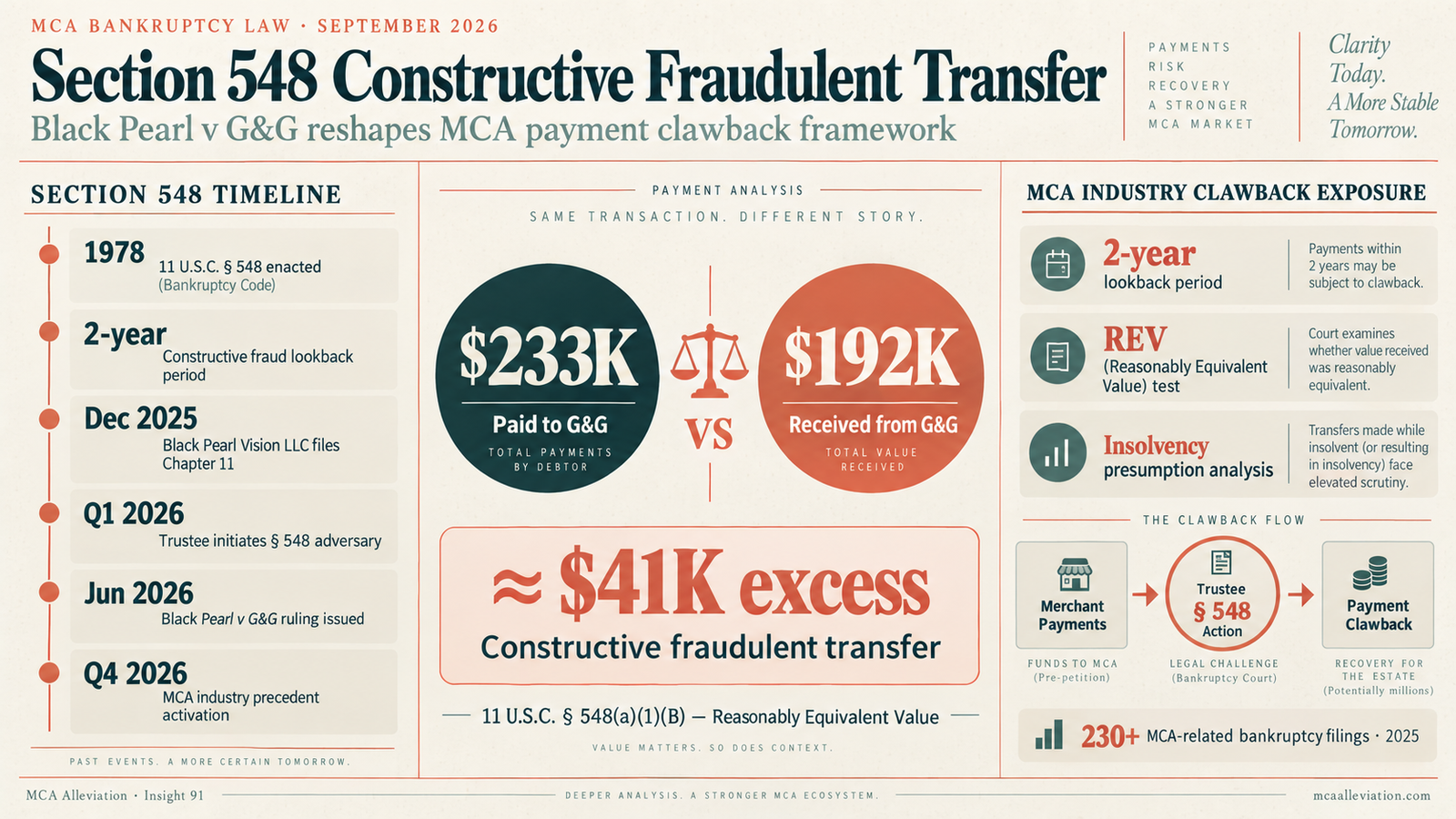
If you're a small business operator with an active MCA obligation contemplating Chapter 11 or Subchapter V bankruptcy pathway, or an MCA industry participant analyzing portfolio clawback exposure across merchant bankruptcy filings, the Black Pearl Vision LLC v G&G Funding Group LLC June 2026 bankruptcy court ruling is critical strategic knowledge affecting MCA payment clawback framework analysis, defensive framework activation, and MCA industry funding practice restructuring. The bankruptcy court ruling establishes framework precedent for Section 548 constructive fraudulent transfer analysis with $233K paid vs $192K received framework creating approximately $41K excess as constructive fraudulent transfer under 11 U.S.C. § 548(a)(1)(B) Reasonably Equivalent Value framework.
Key Section 548 constructive fraudulent transfer framework dynamics include: case framework foundation (Black Pearl Vision LLC Chapter 11 filing December 2025; trustee § 548 adversary proceeding Q1 2026; June 2026 bankruptcy court ruling; $233K paid vs $192K received framework; approximately $41K excess as constructive fraudulent transfer), five Section 548 framework elements (actual fraud § 548(a)(1)(A) vs constructive fraud § 548(a)(1)(B) distinction, REV analysis for MCA transactions, MCA implied APR methodology for REV determination, 2-year federal lookback vs state UFTA/UVTA 4-6 year extended lookback, insolvency presumption analysis), four MCA industry clawback implications (trustee clawback exposure across MCA portfolios, DIP financing framework analysis, MCA funding practice restructuring for REV compliance, cross-reference with Section 547 preferential transfer framework), and three defensive framework consequences (business justification defense preparation, contemporaneous exchange for new value defense under § 547(c)(1), ordinary course of business defense under § 547(c)(2)).
This guide is a comprehensive Section 548 constructive fraudulent transfer framework analysis with strategic operational focus for both MCA industry participants analyzing portfolio clawback exposure and small business borrowers activating defensive framework through Section 548 leverage in coordinated bankruptcy pathway including Subchapter V reorganization with April 2026 $3,424,000 eligibility ceiling.
The Black Pearl Vision LLC v G&G Funding Group LLC June 2026 bankruptcy court ruling establishes framework precedent for Section 548 constructive fraudulent transfer analysis with direct MCA industry portfolio implications. Case framework: $233,000 paid by Black Pearl to G&G during 2-year lookback period vs $192,000 as actual economic value received (MCA advance principal amount) creates approximately $41,000 excess analyzed as constructive fraudulent transfer under 11 U.S.C. § 548(a)(1)(B) Reasonably Equivalent Value framework. Five Section 548 framework elements: actual fraud § 548(a)(1)(A) vs constructive fraud § 548(a)(1)(B) distinction, REV analysis for MCA transactions, MCA implied APR methodology for REV determination (typical MCA implied APR 40-150% creates substantial REV excess), 2-year federal lookback vs state UFTA/UVTA 4-6 year extended lookback under § 544(b), insolvency presumption analysis under § 547(f). Four MCA industry implications: trustee clawback exposure across MCA portfolios (230+ MCA-related bankruptcy filings 2025), DIP financing framework analysis, MCA funding practice restructuring for REV compliance, cross-reference with Section 547 preferential transfer 90-day framework. Three defensive framework consequences: business justification defense preparation, contemporaneous exchange for new value defense under § 547(c)(1), ordinary course of business defense under § 547(c)(2).
Black Pearl v G&G June 2026 ruling and Section 548 statutory framework.
Understanding Black Pearl Vision LLC v G&G Funding Group LLC June 2026 bankruptcy court ruling requires familiarity with 11 U.S.C. § 548 statutory framework and Bankruptcy Code enactment 1978 background and case procedural history from Black Pearl Chapter 11 filing December 2025 through Q1 2026 trustee § 548 adversary proceeding through June 2026 ruling establishing framework precedent for MCA payment clawback analysis across MCA industry portfolio exposure.
11 U.S.C. § 548 statutory framework and Bankruptcy Code background
11 U.S.C. § 548 provides bankruptcy trustees with authority to avoid pre-bankruptcy transfers made without receiving reasonably equivalent value when the debtor was insolvent at time of transfer. Statutory framework: (1) 11 U.S.C. § 548 was enacted as part of the Bankruptcy Code in 1978 as codification of common law fraudulent conveyance doctrine, (2) Section 548(a)(1)(A) provides actual fraud framework requiring intent to hinder, delay, or defraud creditors, (3) Section 548(a)(1)(B) provides constructive fraud framework requiring transfer without receiving reasonably equivalent value (REV) plus debtor insolvency at time of transfer, (4) 2-year federal lookback period from bankruptcy filing date for trustee avoidance actions. Reasonably Equivalent Value (REV) framework: (a) REV analysis focuses on economic reality rather than contractual characterization of transaction, (b) REV framework requires bankruptcy courts to compare payments made against actual economic value received, (c) REV analysis produces excess amount as the difference between payments and value supporting constructive fraudulent transfer analysis, (d) REV framework provides objective economic analysis avoiding subjective intent requirements of § 548(a)(1)(A) actual fraud framework. Insolvency requirement analysis: (1) § 548(a)(1)(B) requires debtor insolvency at time of transfer, (2) insolvency defined under 11 U.S.C. § 101(32) as balance sheet insolvency (liabilities exceeding assets at fair valuation), (3) § 547(f) provides 90-day insolvency presumption for preferential transfer framework, (4) coordinated insolvency framework analysis supports comprehensive Section 548 framework operation. Cross-reference our MCA settlement vs bankruptcy guide.
Black Pearl Vision LLC v G&G Funding Group LLC case procedural history
Black Pearl v G&G case procedural history spans multiple phases from initial Chapter 11 filing through trustee § 548 adversary proceeding through June 2026 ruling establishing framework precedent for MCA payment clawback analysis. Initial Chapter 11 filing phase: (1) Black Pearl Vision LLC filed Chapter 11 bankruptcy December 2025 with MCA obligations to G&G Funding Group LLC among its creditor schedule, (2) Chapter 11 filing followed extended period of merchant financial distress with accumulated MCA obligations and coordinated business challenges, (3) Chapter 11 filing schedules identified G&G Funding Group as MCA creditor with pre-bankruptcy payment history subject to potential trustee avoidance action, (4) coordinated Chapter 11 case administration supporting comprehensive trustee analysis framework. Trustee § 548 adversary proceeding phase: (a) Chapter 11 trustee initiated 11 U.S.C. § 548 adversary proceeding Q1 2026 seeking to avoid pre-bankruptcy MCA payments as constructive fraudulent transfers, (b) trustee framework analysis focused on Section 548(a)(1)(B) constructive fraud framework rather than Section 548(a)(1)(A) actual fraud requiring intent evidence, (c) trustee evidentiary framework established $233,000 paid by Black Pearl to G&G Funding Group during 2-year lookback period preceding bankruptcy filing, (d) trustee evidentiary framework established $192,000 as the actual economic value received by Black Pearl from G&G Funding Group (the MCA advance principal amount), (e) coordinated evidentiary framework supporting comprehensive REV analysis. June 2026 bankruptcy court ruling framework: (1) bankruptcy court analyzed approximately $41,000 excess as constructive fraudulent transfer under 11 U.S.C. § 548(a)(1)(B) Reasonably Equivalent Value framework, (2) court analysis focused on economic reality of MCA transaction structure comparing merchant payments to actual value received, (3) coordinated implied APR analysis supporting REV framework determination, (4) June 2026 ruling establishing framework precedent for MCA payment clawback analysis across MCA industry portfolio exposure. Framework precedent implications: (a) Black Pearl v G&G ruling establishes framework for MCA payment clawback analysis across MCA industry portfolio, (b) coordinated portfolio exposure analysis for MCA industry funders across 230+ MCA-related bankruptcy filings 2025, (c) potential MCA industry funding practice restructuring for REV framework compliance, (d) coordinated legal counsel engagement for portfolio exposure analysis and defensive framework development. Cross-reference our MCA relief buyer guide 2026.
230+ MCA-related bankruptcy filings 2025 comprehensive industry exposure
230+ MCA-related bankruptcy filings reported for 2025 create comprehensive MCA industry clawback exposure environment supporting broad Section 548 framework application across MCA industry portfolio. MCA industry bankruptcy filing landscape: (1) Bloomberg reporting 230+ MCA-related bankruptcy filings 2025 indicating substantial MCA industry exposure across merchant portfolio, (2) coordinated MCA industry bankruptcy exposure across multiple bankruptcy court jurisdictions supporting comprehensive framework application, (3) MCA-related bankruptcy filings including Chapter 11 reorganization pathway and Subchapter V eligibility for qualifying small business borrowers, (4) coordinated MCA industry bankruptcy analysis supporting comprehensive framework exposure analysis. Notable MCA bankruptcy filings 2025-2026: (a) Rogers Landworks LLC Chapter 11 December 2025 with 21 stacked MCA positions totaling $3.6M in MCA obligations supporting complex multi-position MCA clawback analysis, (b) Pat McGrath Labs Chapter 11 January 22, 2026 in Southern District of Florida with $50M+ liabilities supporting large-scale MCA industry exposure analysis, (c) PayPal, Shopify, and Square MCA defaults rose 59% ($1.4B to $2.22B) in one-year period supporting continued MCA industry distress trajectory, (d) coordinated MCA industry bankruptcy filing analysis supporting comprehensive framework exposure. MCA industry portfolio exposure analysis: (1) Black Pearl v G&G $41K per case exposure multiplied across 230+ MCA-related bankruptcy filings creates substantial industry portfolio exposure, (2) coordinated portfolio exposure analysis for MCA industry funders including individual case exposure and aggregate industry exposure, (3) potential MCA industry consolidation with smaller MCA funders unable to absorb clawback exposure, (4) coordinated MCA industry funding practice restructuring for REV framework compliance supporting continued industry operation. Strategic industry implications: (a) MCA industry funding practice restructuring for coordinated Section 548 framework compliance, (b) coordinated MCA industry insurance framework for clawback exposure protection potential, (c) potential MCA industry pivot toward DIP financing structure supporting bankruptcy-integrated funding framework, (d) coordinated MCA industry defensive framework development for coordinated bankruptcy pathway navigation.
MCA obligation contemplating bankruptcy pathway or MCA portfolio clawback exposure analysis?
The intake walks Section 548 constructive fraudulent transfer framework analysis: 11 U.S.C. § 548 statutory framework analysis with Bankruptcy Code enactment 1978 background and Section 548(a)(1)(A) actual fraud versus Section 548(a)(1)(B) constructive fraud distinction and 2-year federal lookback period operation, Black Pearl Vision LLC v G&G Funding Group LLC case procedural history analysis from Chapter 11 filing December 2025 through Q1 2026 trustee § 548 adversary proceeding through June 2026 bankruptcy court ruling with $233K paid vs $192K received framework and approximately $41K excess as constructive fraudulent transfer under Reasonably Equivalent Value framework, five Section 548 framework elements analysis (actual fraud vs constructive fraud distinction, REV analysis for MCA transactions, MCA implied APR methodology for REV determination, 2-year federal lookback vs state UFTA/UVTA 4-6 year extended lookback under § 544(b) strong-arm provision, insolvency presumption analysis), four MCA industry clawback implications analysis (trustee clawback exposure across MCA portfolios with 230+ MCA-related bankruptcy filings 2025 supporting comprehensive industry exposure, DIP financing framework analysis supporting continued MCA funding operation with bankruptcy court oversight, MCA funding practice restructuring for REV compliance including factor rate reduction and payment structure modification, cross-reference with Section 547 preferential transfer 90-day framework supporting comprehensive bankruptcy clawback framework), three defensive framework consequences analysis (business justification defense preparation with genuine business justification documentation, contemporaneous exchange for new value defense under § 547(c)(1), ordinary course of business defense under § 547(c)(2)), and coordinated small business borrower defensive framework activation for bankruptcy pathway including Subchapter V reorganization with April 2026 $3,424,000 eligibility ceiling supporting comprehensive bankruptcy framework navigation and coordinated MCA payment clawback framework leverage integrating with existing MCA state court litigation defensive framework. No documents required to begin the call. Placement organization — not legal representation.
Five Section 548 framework elements.
Five Section 548 framework elements define post-Black Pearl v G&G ruling environment for MCA payment clawback analysis across MCA industry portfolio exposure and merchant bankruptcy filings. Each element addresses specific statutory framework component requiring integrated analysis approach and coordinated framework development supporting comprehensive Section 548 constructive fraudulent transfer analysis.
Actual fraud § 548(a)(1)(A) vs constructive fraud § 548(a)(1)(B) distinction supports differentiated evidentiary framework for Section 548 avoidance action analysis with MCA payment clawback primarily proceeding under § 548(a)(1)(B) constructive fraud framework. Framework distinction analysis: (1) § 548(a)(1)(A) actual fraud requires transfer with intent to hinder, delay, or defraud creditors requiring evidentiary framework demonstrating debtor intent, (2) actual fraud analysis proceeds through badges of fraud framework including transfer to insider, retention of possession or control, concealment, threat of litigation, and other indicia of fraudulent intent, (3) § 548(a)(1)(B) constructive fraud requires transfer without receiving reasonably equivalent value plus debtor insolvency at time of transfer supporting objective economic reality analysis, (4) constructive fraud framework provides objective economic analysis avoiding subjective intent requirements of actual fraud framework. MCA payment clawback framework application: (a) MCA payment clawback analysis primarily proceeds under § 548(a)(1)(B) constructive fraud framework because MCA transactions do not typically involve intent to defraud creditors, (b) constructive fraud framework focuses on Reasonably Equivalent Value analysis comparing merchant payments to actual value received, (c) Black Pearl v G&G ruling applied § 548(a)(1)(B) constructive fraud framework for MCA payment clawback analysis, (d) coordinated constructive fraud framework analysis for MCA industry portfolio exposure. Actual fraud framework MCA analysis exceptions: (1) potential actual fraud framework application for MCA transactions with specific badges of fraud including transfers to insiders or concealment of transactions, (2) coordinated actual fraud framework analysis for specific case circumstances supporting comprehensive Section 548 framework analysis, (3) potential coordinated evidentiary framework development for actual fraud analysis, (4) coordinated legal counsel engagement for comprehensive Section 548 framework analysis. Strategic framework implications: (a) MCA industry participants can primarily focus on § 548(a)(1)(B) constructive fraud framework analysis for portfolio exposure analysis, (b) coordinated constructive fraud framework analysis supports comprehensive REV framework analysis, (c) potential coordinated legal counsel engagement for specific case actual fraud analysis, (d) coordinated MCA industry defensive framework development for Section 548 analysis.
Reasonably Equivalent Value (REV) analysis for MCA transactions provides objective economic framework for § 548(a)(1)(B) constructive fraudulent transfer analysis comparing merchant payments to actual economic value received. REV framework mechanics: (1) REV analysis focuses on economic reality rather than contractual characterization of MCA transaction structure, (2) merchant payments include daily or weekly holdback payments plus any additional fees or charges paid to MCA funder during lookback period, (3) actual economic value received analysis focuses on MCA advance principal amount paid to merchant net of any fees deducted at funding, (4) coordinated REV analysis produces excess amount as the difference between total merchant payments and actual value received supporting constructive fraudulent transfer analysis. Black Pearl v G&G REV framework application: (a) Black Pearl paid $233,000 to G&G Funding Group during 2-year lookback period preceding Chapter 11 filing, (b) Black Pearl received $192,000 as actual economic value (MCA advance principal amount) from G&G Funding Group, (c) approximately $41,000 excess between total payments and actual value received analyzed as constructive fraudulent transfer under Section 548(a)(1)(B), (d) coordinated REV analysis supporting framework precedent for MCA industry portfolio exposure. REV framework for MCA transaction structure: (1) MCA transaction structure analysis for REV framework compliance including factor rate analysis and payment holdback percentage analysis, (2) MCA advance principal amount as actual economic value received framework, (3) merchant payment framework analysis including daily or weekly holdback payments and coordinated MCA transaction structure, (4) coordinated REV framework analysis supporting comprehensive MCA industry portfolio exposure analysis. Framework implications: (a) MCA industry portfolio exposure analysis using standardized REV framework, (b) coordinated MCA transaction structure development for REV framework compliance, (c) potential MCA funding practice restructuring for REV framework alignment, (d) coordinated legal counsel engagement for REV framework analysis. Cross-reference our state MCA regulation 2026 CFDL frameworks guide.
MCA implied APR methodology for REV determination provides standardized calculation approach supporting comprehensive Reasonably Equivalent Value framework analysis for MCA payment clawback under Section 548(a)(1)(B). Framework calculation approach: (1) MCA implied APR calculation using factor rate and payment holdback and repayment period supports standardized REV framework analysis, (2) factor rate framework typical MCA transactions using factor rate of 1.20 to 1.50 or higher for total repayment amount calculation, (3) payment holdback percentage typical 10 to 25 percent of daily or weekly revenue supporting variable repayment framework, (4) repayment period typical 6 to 18 months depending on transaction structure and merchant revenue trajectory, (5) implied APR calculation combining factor rate and holdback percentage and repayment period supporting standardized APR framework analysis. MCA implied APR REV framework analysis: (a) typical MCA transactions with implied APR of 40 to 150 percent create substantial excess positioning between total payments and actual value received, (b) coordinated implied APR analysis supports comprehensive REV framework analysis across MCA industry portfolio, (c) equivalent APR calculation methodology under Texas HB 700 and other state CFDL frameworks providing standardized calculation approach, (d) coordinated implied APR framework supports comprehensive Section 548 constructive fraudulent transfer framework analysis. MCA industry portfolio REV framework exposure analysis: (1) MCA implied APR of 40 percent creates modest REV excess exposure requiring restructuring analysis, (2) MCA implied APR of 100 percent creates substantial REV excess exposure with significant clawback exposure, (3) MCA implied APR of 150 percent creates extreme REV excess exposure with maximum clawback exposure, (4) coordinated implied APR analysis supporting comprehensive MCA industry portfolio exposure framework. Restructuring pathway analysis: (a) MCA transaction restructuring for REV framework compliance requires substantial factor rate reduction and coordinated MCA transaction structure development, (b) coordinated MCA funding practice restructuring supporting REV framework alignment, (c) potential MCA industry consolidation with smaller MCA funders unable to absorb restructuring costs, (d) coordinated legal counsel engagement for restructuring implementation and portfolio exposure analysis. Cross-reference our MCA relief buyer guide 2026.
2-year federal lookback under 11 U.S.C. § 548 vs state UFTA (Uniform Fraudulent Transfer Act) and UVTA (Uniform Voidable Transactions Act) extended lookback periods creates comprehensive federal-state clawback framework for MCA payment analysis. Federal 2-year lookback framework: (1) 11 U.S.C. § 548 provides 2-year lookback period from bankruptcy filing date, (2) trustees can avoid transfers made within 2-year period that constitute constructive fraudulent transfer under REV analysis plus insolvency, (3) 2-year period covers substantial MCA transaction activity given typical MCA repayment periods of 6 to 18 months and repeat MCA funding relationships, (4) Black Pearl v G&G framework analyzed $233K in payments during 2-year federal lookback period. State UFTA and UVTA extended lookback framework: (a) UFTA adopted by 43 states plus D.C. and Virgin Islands providing 4-year lookback period for fraudulent transfer analysis, (b) UVTA adopted by additional states as UFTA replacement providing 4 to 6 year lookback periods with additional framework refinements, (c) state UFTA/UVTA extended lookback allows analysis of transfers beyond federal 2-year period supporting comprehensive clawback framework, (d) coordinated state framework analysis for MCA payment clawback across extended lookback period. Trustee authority under 11 U.S.C. § 544(b) strong-arm provision: (1) trustees can pursue state UFTA/UVTA extended lookback under Section 544(b) strong-arm provision, (2) Section 544(b) allows trustees to step into shoes of unsecured creditor with viable state law claim, (3) coordinated state UFTA/UVTA analysis extends clawback framework beyond federal 2-year period to state 4 to 6 year period, (4) coordinated federal-state framework analysis supports comprehensive MCA payment clawback exposure analysis. MCA industry portfolio implications: (a) MCA industry funders face potential clawback exposure across 2-year federal lookback plus 4 to 6 year state UFTA/UVTA extended lookback, (b) coordinated portfolio exposure analysis supports comprehensive MCA industry clawback framework, (c) potential MCA industry restructuring for coordinated federal-state framework compliance, (d) coordinated legal counsel engagement for portfolio exposure analysis. Strategic framework implications: (1) MCA industry funders must analyze both federal 2-year lookback and state 4-6 year extended lookback exposure, (2) coordinated portfolio exposure analysis for comprehensive MCA industry clawback framework, (3) potential MCA funding practice restructuring for coordinated federal-state framework compliance, (4) coordinated legal counsel engagement for federal-state framework analysis.
Insolvency presumption analysis under 11 U.S.C. § 547(f) for preferential transfer framework and § 548(a)(1)(B) framework requires coordinated insolvency framework analysis for Section 548 constructive fraudulent transfer framework operation. Insolvency framework requirement: (1) § 548(a)(1)(B) requires debtor insolvency at time of transfer as element of constructive fraudulent transfer analysis, (2) insolvency defined under 11 U.S.C. § 101(32) as balance sheet insolvency (liabilities exceeding assets at fair valuation), (3) coordinated insolvency framework analysis requires balance sheet analysis at time of transfer, (4) insolvency framework analysis supports comprehensive Section 548 framework operation. § 547(f) insolvency presumption for preferential transfer framework: (a) § 547(f) provides 90-day insolvency presumption for preferential transfer framework, (b) 90-day presumption supports trustee framework for § 547 preferential transfer analysis, (c) 90-day presumption does not directly apply to § 548 framework requiring separate insolvency analysis, (d) coordinated § 547 and § 548 framework analysis supports comprehensive bankruptcy clawback framework. § 548(a)(1)(B) insolvency framework analysis: (1) § 548(a)(1)(B) requires balance sheet insolvency analysis at time of transfer, (2) balance sheet insolvency analysis focuses on debtor assets vs liabilities at fair valuation, (3) coordinated balance sheet insolvency framework analysis for comprehensive § 548 framework operation, (4) potential coordinated expert witness engagement for balance sheet insolvency analysis. Coordinated insolvency framework analysis: (a) coordinated § 547 and § 548 insolvency framework analysis for comprehensive bankruptcy clawback framework, (b) coordinated 90-day presumption analysis and extended balance sheet insolvency analysis, (c) coordinated MCA industry portfolio insolvency analysis for portfolio exposure framework, (d) coordinated legal counsel engagement for insolvency framework analysis. Strategic framework implications: (1) MCA industry participants must analyze coordinated insolvency framework for portfolio exposure analysis, (2) coordinated legal counsel engagement for insolvency framework analysis, (3) potential coordinated expert witness engagement for balance sheet insolvency analysis, (4) coordinated MCA industry defensive framework development for insolvency framework analysis.
Combined across the five Section 548 framework elements, Black Pearl v G&G ruling establishes comprehensive framework precedent for MCA payment clawback analysis across MCA industry portfolio exposure. Three features distinguish Section 548 framework operation from other MCA regulatory framework developments: objective economic framework analysis through Reasonably Equivalent Value framework rather than subjective intent framework, comprehensive MCA industry portfolio exposure across 230+ MCA-related bankruptcy filings 2025, and coordinated federal-state framework operation extending clawback framework beyond federal 2-year period to state 4-6 year extended lookback. Cross-reference our FTC MCA enforcement 2026 guide.
Want the six fit questions walked for your specific creditors?
The intake call answers each of the six questions, identifies which creditors fit settlement and which do not, and routes the rest to the appropriate pathway — modification, refinance, SBA mechanism, or Subchapter V. No documents required to begin.
Four MCA industry clawback implications.
Four MCA industry clawback implications define post-Black Pearl v G&G ruling environment for MCA industry funding practice and portfolio exposure analysis across 230+ MCA-related bankruptcy filings 2025 and coordinated federal-state framework operation. Each implication addresses specific MCA industry framework component requiring integrated analysis approach and coordinated framework navigation supporting comprehensive MCA industry strategic analysis.
Implication mechanics: bankruptcy trustees can pursue Section 548 constructive fraudulent transfer clawback across MCA industry portfolios for merchant bankruptcy filings creating substantial industry portfolio exposure environment. Framework operation: (1) Black Pearl v G&G $41K per case exposure multiplied across MCA industry portfolio creates substantial aggregate exposure, (2) 230+ MCA-related bankruptcy filings reported for 2025 alone creating comprehensive MCA industry portfolio exposure environment, (3) coordinated portfolio exposure analysis for MCA industry funders including individual case exposure and aggregate industry exposure, (4) coordinated trustee framework analysis across MCA industry portfolio supporting comprehensive Section 548 framework application. Portfolio exposure calculation framework: (a) individual case exposure calculation using Black Pearl v G&G $41K framework baseline, (b) aggregate industry exposure calculation across 230+ MCA-related bankruptcy filings supporting industry portfolio analysis, (c) coordinated portfolio exposure analysis for MCA industry funders including cash reserve requirements, (d) potential coordinated MCA industry insurance framework for clawback exposure protection. MCA industry consolidation implications: (1) potential MCA industry consolidation with smaller MCA funders unable to absorb clawback exposure, (2) coordinated portfolio exposure analysis for continued MCA industry operation, (3) potential MCA industry pivot toward DIP financing structure supporting bankruptcy-integrated funding framework, (4) coordinated legal counsel engagement for portfolio exposure analysis. Strategic framework implications: (a) MCA industry funders must analyze portfolio exposure across coordinated federal-state clawback framework, (b) coordinated MCA industry funding practice restructuring for portfolio exposure management, (c) potential coordinated MCA industry insurance and reserve framework development, (d) coordinated legal counsel and industry association engagement for framework tracking. Cross-reference our MCA settlement vs bankruptcy guide.
Implication mechanics: DIP (Debtor-in-Possession) financing framework analysis supports MCA industry participants potentially serving as DIP financing sources for merchant bankruptcy filings supporting continued MCA funding operation with bankruptcy court oversight. Framework operation: (1) DIP financing under 11 U.S.C. § 364 provides bankruptcy trustees and debtors-in-possession authority to obtain financing during bankruptcy proceedings, (2) DIP financing provides super-priority claim status under § 364(c) or senior lien status under § 364(d) supporting enhanced creditor protection, (3) DIP financing operates under bankruptcy court oversight providing court supervision and creditor protection framework, (4) coordinated DIP financing framework development for MCA industry participants supporting bankruptcy-integrated funding framework. DIP financing framework benefits: (a) super-priority claim status under § 364(c) provides enhanced creditor protection framework, (b) senior lien status under § 364(d) provides collateral protection framework, (c) bankruptcy court oversight provides transaction protection framework, (d) coordinated framework operation supporting MCA funder continued operation with bankruptcy pathway integration. MCA industry DIP financing framework development: (1) MCA industry participants can develop DIP financing capabilities supporting merchant bankruptcy pathway, (2) coordinated legal counsel engagement for DIP financing framework development, (3) coordinated bank partner engagement for DIP financing framework capacity, (4) potential MCA industry pivot toward DIP financing structure supporting bankruptcy-integrated funding framework. Strategic framework implications: (a) MCA industry participants can develop bankruptcy-integrated funding framework supporting continued operation, (b) coordinated DIP financing framework development for MCA industry strategic positioning, (c) coordinated bankruptcy court framework engagement for MCA industry funding practice, (d) coordinated legal counsel engagement for DIP financing framework development. Cross-reference our MCA relief buyer guide 2026.
Implication mechanics: MCA funders face potential funding practice restructuring for Reasonably Equivalent Value framework compliance supporting Section 548 clawback exposure mitigation and coordinated MCA industry framework development. Framework restructuring elements: (1) factor rate reduction supporting REV alignment between merchant payments and actual value received, (2) payment structure modification supporting standardized REV framework analysis, (3) coordinated MCA transaction structure development supporting REV framework compliance, (4) potential coordinated MCA industry funding practice modification for comprehensive framework compliance. Factor rate reduction framework: (a) traditional MCA factor rates of 1.20 to 1.50 or higher creating substantial REV excess exposure, (b) coordinated factor rate reduction supporting REV framework alignment, (c) reduced factor rates supporting narrower excess between payments and value received, (d) coordinated MCA industry factor rate restructuring for framework compliance. Payment structure modification framework: (1) traditional daily or weekly holdback payment structure supporting variable repayment framework, (2) coordinated payment structure modification supporting REV framework analysis, (3) potential fixed payment structure development supporting standardized REV framework analysis, (4) coordinated MCA industry payment structure restructuring for framework compliance. Coordinated MCA transaction structure development: (a) coordinated MCA transaction structure supporting REV framework alignment, (b) coordinated economic value analysis for MCA transaction structure, (c) coordinated MCA industry transaction structure standardization, (d) coordinated legal counsel engagement for MCA transaction structure development. Industry consolidation implications: (1) potential MCA industry consolidation with smaller MCA funders unable to absorb restructuring costs, (2) coordinated MCA industry restructuring for continued industry operation, (3) potential MCA industry funding practice standardization supporting comprehensive framework compliance, (4) coordinated legal counsel and industry association engagement for restructuring framework development. Cross-reference our state MCA regulation 2026 CFDL frameworks guide.
Implication mechanics: 11 U.S.C. § 547 preferential transfer framework provides coordinated 90-day lookback for creditor preference analysis supporting comprehensive bankruptcy clawback framework analysis alongside Section 548 constructive fraudulent transfer framework. Framework operation: (1) § 547 preferential transfer framework provides trustee authority to avoid pre-bankruptcy transfers to creditors that provide preferential treatment relative to other creditors, (2) § 547 90-day lookback period from bankruptcy filing date (extended to 1 year for insider transfers), (3) § 547 elements include transfer to creditor, on account of antecedent debt, made while insolvent (with § 547(f) 90-day insolvency presumption), enabling creditor to receive more than in Chapter 7 liquidation, (4) coordinated § 547 and § 548 framework analysis supports comprehensive bankruptcy clawback framework. § 547 vs § 548 framework distinction: (a) § 547 focuses on preferential treatment of specific creditor relative to other creditors, (b) § 548 focuses on absence of reasonably equivalent value plus insolvency, (c) § 547 has shorter 90-day lookback (1 year for insiders), (d) § 548 has longer 2-year lookback (plus state UFTA/UVTA 4-6 year extended lookback under § 544(b)). Coordinated § 547 and § 548 framework analysis: (1) coordinated framework analysis for MCA payment clawback across both preferential transfer and constructive fraudulent transfer framework, (2) § 547 90-day framework provides shorter-term clawback framework focused on preferential treatment, (3) § 548 2-year framework provides longer-term clawback framework focused on REV analysis, (4) coordinated framework analysis supports comprehensive MCA industry portfolio exposure analysis. Section 547 defenses application to MCA framework: (a) § 547(c)(1) contemporaneous exchange for new value defense, (b) § 547(c)(2) ordinary course of business defense, (c) § 547(c)(4) subsequent new value defense, (d) coordinated Section 547 defensive framework for MCA industry defensive framework development. Strategic framework implications: (1) MCA industry participants must analyze coordinated § 547 and § 548 framework exposure, (2) coordinated defensive framework development across both preferential transfer and constructive fraudulent transfer framework, (3) potential coordinated MCA industry defensive framework standardization, (4) coordinated legal counsel engagement for comprehensive federal bankruptcy clawback framework analysis.
The four MCA industry clawback implications operate together to create comprehensive MCA industry framework analysis requiring integrated approach supporting MCA industry strategic framework navigation. Integrated approach — trustee clawback exposure across portfolios + DIP financing framework analysis + MCA funding practice restructuring for REV compliance + cross-reference with Section 547 preferential transfer framework — produces case-specific MCA industry framework analysis supporting comprehensive strategic planning across MCA industry funding practice restructuring and coordinated bankruptcy framework navigation.
Three defensive framework consequences.
Three defensive framework consequences define post-Black Pearl v G&G ruling defensive environment for MCA industry participants navigating Section 548 constructive fraudulent transfer exposure across merchant bankruptcy filings and coordinated small business borrower defensive framework activation. Each consequence provides specific defensive framework component supporting integrated defensive strategy for MCA industry participants and coordinated small business borrower defensive framework navigation.
Consequence 1: Business justification defense preparation
Business justification defense preparation creates fundamental defensive framework requirement for MCA industry participants navigating Section 548 constructive fraudulent transfer exposure. Defense framework components: (1) genuine business justification documentation for MCA transactions supporting Section 548 defense framework with focus on merchant business purpose analysis, (2) documentation of merchant business purpose for MCA advance including working capital needs and business growth objectives, (3) coordinated business justification documentation supporting comprehensive defensive framework for bankruptcy court adversary proceeding defense, (4) potential coordinated legal counsel engagement for business justification framework development. Business justification documentation framework: (a) merchant business purpose documentation for MCA advance including specific business need analysis, (b) working capital needs documentation supporting operational business justification, (c) business growth objectives documentation supporting strategic business justification, (d) coordinated documentation framework supporting comprehensive business justification defense, (e) coordinated legal counsel engagement for business justification framework development. MCA transaction structure business justification analysis: (1) MCA transaction structure supporting merchant business justification analysis, (2) coordinated MCA transaction structure documentation supporting comprehensive defensive framework, (3) coordinated economic analysis for MCA transaction business justification, (4) coordinated business justification framework supporting comprehensive Section 548 defense. Case-specific business justification analysis: (a) case-specific merchant business circumstances supporting business justification defense, (b) coordinated case-specific analysis for comprehensive defensive framework development, (c) coordinated legal counsel engagement for case-specific business justification analysis, (d) potential coordinated expert witness engagement for business justification analysis. Strategic defensive framework implications: (1) MCA industry participants can develop standardized business justification documentation framework, (2) coordinated legal counsel engagement for business justification framework development, (3) potential coordinated MCA industry defensive framework standardization for business justification analysis, (4) coordinated defensive framework development supporting comprehensive Section 548 defense strategy. Cross-reference our MCA settlement vs bankruptcy guide.
Consequence 2: Contemporaneous exchange for new value defense under § 547(c)(1)
Contemporaneous exchange for new value defense under 11 U.S.C. § 547(c)(1) analysis for MCA transaction structure supports preferential transfer defense framework operating alongside Section 548 defensive framework analysis. Defense framework components: (1) 11 U.S.C. § 547(c)(1) contemporaneous exchange for new value defense analysis for MCA transaction structure supporting preferential transfer defense framework, (2) contemporaneous exchange framework requires payment and value exchange in single integrated transaction, (3) MCA transaction structure analysis for contemporaneous exchange qualification supporting coordinated defensive framework, (4) coordinated defense framework for coordinated Section 547 and Section 548 analysis. Contemporaneous exchange framework mechanics: (a) § 547(c)(1) requires transfer intended by debtor and creditor to be contemporaneous exchange for new value given to debtor, (b) contemporaneous exchange framework requires substantial contemporaneity between payment and value exchange, (c) new value framework requires actual economic value provided to debtor in exchange for payment, (d) coordinated contemporaneous exchange framework analysis for MCA transaction structure. MCA transaction contemporaneous exchange analysis: (1) traditional MCA transaction structure with initial advance and ongoing payment collection potentially challenging contemporaneous exchange framework, (2) coordinated MCA transaction structure analysis for contemporaneous exchange qualification, (3) potential MCA transaction structure modification supporting contemporaneous exchange framework compliance, (4) coordinated legal counsel engagement for contemporaneous exchange framework analysis. Coordinated Section 547 and Section 548 defensive framework: (a) coordinated defensive framework analysis across preferential transfer and constructive fraudulent transfer framework, (b) coordinated legal counsel engagement for comprehensive federal bankruptcy defensive framework development, (c) coordinated MCA industry defensive framework standardization for coordinated framework compliance, (d) potential coordinated MCA industry insurance framework for defensive framework support. Strategic defensive framework implications: (1) MCA industry participants can develop coordinated Section 547 and Section 548 defensive framework, (2) coordinated legal counsel engagement for comprehensive defensive framework development, (3) potential coordinated MCA industry defensive framework standardization, (4) coordinated defensive framework development supporting comprehensive federal bankruptcy defensive strategy. Cross-reference our FTC MCA enforcement 2026 guide.
Consequence 3: Ordinary course of business defense under § 547(c)(2)
Ordinary course of business defense under 11 U.S.C. § 547(c)(2) analysis for MCA transaction pattern supports ordinary course defense framework operating alongside coordinated Section 547 and Section 548 defensive framework analysis. Defense framework components: (1) 11 U.S.C. § 547(c)(2) ordinary course of business defense analysis for MCA transaction pattern supporting ordinary course defense framework, (2) ordinary course framework requires transactions in ordinary course of business between debtor and transferee AND ordinary business terms in the industry, (3) MCA industry ordinary course analysis for coordinated framework compliance, (4) coordinated defensive framework development for MCA industry participants. Ordinary course framework mechanics: (a) § 547(c)(2)(A) requires payments made in ordinary course of business or financial affairs of debtor and transferee, (b) § 547(c)(2)(B) requires payments made according to ordinary business terms in the industry, (c) either prong satisfies the defense framework requirement, (d) coordinated ordinary course framework analysis for MCA transaction pattern. MCA transaction ordinary course analysis: (1) MCA transaction pattern analysis for ordinary course of business between debtor and transferee, (2) MCA industry ordinary business terms analysis for ordinary course industry framework, (3) coordinated MCA transaction pattern analysis for ordinary course framework compliance, (4) coordinated legal counsel engagement for ordinary course framework analysis. MCA industry ordinary business terms framework: (a) MCA industry standard practice analysis supporting ordinary business terms framework, (b) coordinated MCA industry ordinary business terms documentation, (c) coordinated MCA industry practice standardization supporting ordinary course framework compliance, (d) potential coordinated MCA industry association engagement for ordinary business terms framework development. Coordinated defensive framework integration: (1) coordinated ordinary course defense integration with contemporaneous exchange defense and business justification defense, (2) coordinated Section 547 and Section 548 defensive framework development, (3) coordinated MCA industry defensive framework standardization, (4) coordinated legal counsel engagement for comprehensive defensive framework development. Small business borrower coordinated defensive framework activation implications: (a) coordinated defensive framework activation for merchant bankruptcy filing pathway including Subchapter V reorganization with April 2026 $3,424,000 eligibility ceiling supporting comprehensive bankruptcy framework navigation, (b) coordinated MCA payment clawback framework leverage integrating with existing MCA state court litigation defensive framework and workout coordination, (c) settlement negotiation leverage using Section 548 constructive fraudulent transfer framework exposure, (d) coordinated legal counsel engagement for comprehensive defensive framework activation. Strategic defensive framework implications: (1) MCA industry participants can develop coordinated ordinary course defensive framework, (2) coordinated legal counsel engagement for comprehensive defensive framework development, (3) potential coordinated MCA industry defensive framework standardization for ordinary course analysis, (4) coordinated defensive framework development supporting comprehensive federal bankruptcy defensive strategy.
MCA portfolio Section 548 clawback exposure or bankruptcy pathway defensive framework?
The intake walks the three defensive framework consequences with case-specific application: business justification defense preparation with genuine business justification documentation for MCA transactions including working capital needs and business growth objectives supporting Section 548 defense framework; contemporaneous exchange for new value defense under 11 U.S.C. § 547(c)(1) analysis for MCA transaction structure with contemporaneous exchange framework requiring payment and value exchange in single integrated transaction; ordinary course of business defense under 11 U.S.C. § 547(c)(2) analysis for MCA transaction pattern with ordinary course framework requiring transactions in ordinary course of business between debtor and transferee AND ordinary business terms in the industry. Coordinated defensive framework development supporting comprehensive federal bankruptcy defensive strategy. No documents required to begin. Placement organization — not legal representation.
Three things worth remembering from this guide.
Black Pearl v G&G June 2026 ruling establishes framework: $233K paid vs $192K received creates constructive fraudulent transfer analysis.
Black Pearl Vision LLC v G&G Funding Group LLC June 2026 bankruptcy court ruling is a foundational Section 548 constructive fraudulent transfer case. Black Pearl paid $233,000 to G&G Funding Group during 2-year lookback period preceding Chapter 11 filing December 2025; Black Pearl received $192,000 as actual economic value (MCA advance principal amount); approximately $41,000 excess analyzed as constructive fraudulent transfer under 11 U.S.C. § 548(a)(1)(B) Reasonably Equivalent Value framework. 230+ MCA-related bankruptcy filings reported for 2025 alone creating comprehensive MCA industry portfolio exposure environment.
Five Section 548 framework elements: actual vs constructive fraud, REV, MCA APR, 2-year vs 4-6 year lookback, insolvency.
Five Section 548 framework elements define post-Black Pearl v G&G ruling environment. Actual fraud § 548(a)(1)(A) intent requirement vs constructive fraud § 548(a)(1)(B) REV plus insolvency requirement distinction; Reasonably Equivalent Value REV analysis for MCA transactions comparing merchant payments to actual value received; MCA implied APR methodology for REV determination with typical MCA implied APR 40-150% creating substantial REV excess; 2-year federal lookback under § 548 vs state UFTA/UVTA 4-6 year extended lookback under § 544(b) strong-arm provision; insolvency presumption analysis under § 547(f) 90-day framework and § 548(a)(1)(B) balance sheet insolvency analysis.
Three defensive framework consequences: business justification, contemporaneous exchange, ordinary course.
Three defensive framework consequences shape post-Black Pearl v G&G defensive environment for MCA industry participants. Business justification defense preparation with genuine business justification documentation including working capital needs and business growth objectives supporting Section 548 defense; contemporaneous exchange for new value defense under 11 U.S.C. § 547(c)(1) analysis with contemporaneous exchange requiring payment and value exchange in single integrated transaction; ordinary course of business defense under 11 U.S.C. § 547(c)(2) analysis with ordinary course requiring transactions in ordinary course of business AND ordinary business terms in the industry. Coordinated defensive framework development supporting comprehensive federal bankruptcy defensive strategy.
Frequently asked questions.
What is the Black Pearl Vision LLC v G&G Funding Group LLC June 2026 bankruptcy court ruling and why is it critical for MCA industry?
The Black Pearl Vision LLC v G&G Funding Group LLC June 2026 bankruptcy court ruling is a foundational Section 548 constructive fraudulent transfer case establishing framework analysis for MCA payment clawback in bankruptcy with direct implications for MCA industry portfolio exposure across the 230+ MCA-related bankruptcy filings reported for 2025 alone. Case framework: Black Pearl Vision LLC filed Chapter 11 bankruptcy December 2025 with MCA obligations to G&G Funding Group LLC among its creditor schedule; Chapter 11 trustee initiated 11 U.S.C. § 548 adversary proceeding Q1 2026; evidentiary framework established $233,000 paid by Black Pearl to G&G Funding Group during 2-year lookback period preceding bankruptcy filing; evidentiary framework established $192,000 as the actual economic value received by Black Pearl from G&G Funding Group (the MCA advance principal amount); bankruptcy court analyzed the approximately $41,000 excess as constructive fraudulent transfer under 11 U.S.C. § 548(a)(1)(B) Reasonably Equivalent Value framework; June 2026 bankruptcy court ruling issued establishing framework precedent for MCA payment clawback analysis. Statutory framework: 11 U.S.C. § 548 was enacted as part of the Bankruptcy Code in 1978 providing trustees with authority to avoid pre-bankruptcy transfers made without receiving reasonably equivalent value when the debtor was insolvent at time of transfer. MCA industry significance: rent-a-charter and traditional MCA transactions with implied APR calculations of 40 to 150 percent or higher create substantial excess between total merchant payments and MCA advance principal amounts, positioning the excess as potential constructive fraudulent transfer exposure across MCA industry portfolios.
How does Reasonably Equivalent Value analysis apply to MCA transactions under Section 548?
Reasonably Equivalent Value (REV) analysis under 11 U.S.C. § 548(a)(1)(B) requires bankruptcy courts to compare merchant payments made to MCA funders during the lookback period against the actual economic value received by the merchant from the MCA transaction. Framework mechanics: REV analysis focuses on economic reality rather than contractual characterization of MCA transaction structure; merchant payments include daily or weekly holdback payments plus any additional fees or charges paid to MCA funder during lookback period; actual economic value received analysis focuses on MCA advance principal amount paid to merchant net of any fees deducted at funding; coordinated REV analysis produces excess amount as the difference between total merchant payments and actual value received supporting constructive fraudulent transfer analysis. Black Pearl v G&G application: Black Pearl paid $233,000 to G&G Funding Group during 2-year lookback period preceding Chapter 11 filing; Black Pearl received $192,000 as actual economic value from G&G Funding Group; approximately $41,000 excess between total payments and actual value received analyzed as constructive fraudulent transfer under Section 548(a)(1)(B). MCA implied APR methodology for REV: MCA implied APR calculation using factor rate and payment holdback and repayment period supports standardized REV framework analysis; typical MCA transactions with implied APR of 40 to 150 percent create substantial excess positioning between total payments and actual value received. Insolvency requirement: § 548(a)(1)(B) requires debtor insolvency at time of transfer, with insolvency presumed under § 547(f) for 90-day period preceding bankruptcy filing and analyzed on balance sheet basis for extended lookback periods.
What are the five Section 548 framework elements for MCA payment clawback analysis?
Five Section 548 framework elements define post-Black Pearl v G&G ruling environment for MCA payment clawback analysis. Element 1 — Actual fraud § 548(a)(1)(A) vs constructive fraud § 548(a)(1)(B) distinction: § 548(a)(1)(A) actual fraud requires intent to hinder, delay, or defraud creditors requiring evidentiary framework demonstrating debtor intent through badges of fraud analysis; § 548(a)(1)(B) constructive fraud requires transfer without receiving REV plus debtor insolvency at time of transfer supporting different evidentiary framework focused on economic reality analysis; MCA payment clawback analysis primarily proceeds under § 548(a)(1)(B) constructive fraud framework. Element 2 — Reasonably Equivalent Value REV analysis for MCA transactions: REV analysis compares merchant payments to actual economic value received; MCA advance principal amount analysis provides actual value received framework. Element 3 — MCA implied APR methodology for REV determination: implied APR calculation using factor rate and payment holdback and repayment period; typical MCA implied APR of 40 to 150 percent creates substantial REV excess exposure. Element 4 — 2-year federal lookback vs state UFTA UVTA extended lookback: 11 U.S.C. § 548 provides 2-year federal lookback period from bankruptcy filing date; state UFTA and UVTA provide 4 to 6 year extended lookback periods under state law; trustees can pursue extended state lookback under 11 U.S.C. § 544(b) strong-arm provision. Element 5 — Insolvency presumption analysis: § 547(f) provides insolvency presumption for 90-day preferential transfer lookback; § 548(a)(1)(B) requires balance sheet insolvency analysis at time of transfer.
How does the 2-year federal lookback under Section 548 coordinate with state UFTA UVTA extended lookback for MCA payment clawback?
2-year federal lookback under 11 U.S.C. § 548 coordinates with state UFTA (Uniform Fraudulent Transfer Act) and UVTA (Uniform Voidable Transactions Act) extended lookback periods creating comprehensive federal-state clawback framework for MCA payment analysis. Federal 2-year lookback framework: 11 U.S.C. § 548 provides 2-year lookback period from bankruptcy filing date; trustees can avoid transfers made within 2-year period that constitute constructive fraudulent transfer under REV analysis plus insolvency; 2-year period covers substantial MCA transaction activity given typical MCA repayment periods of 6 to 18 months and repeat MCA funding relationships. State UFTA and UVTA extended lookback framework: UFTA adopted by 43 states plus D.C. and Virgin Islands providing 4-year lookback period for fraudulent transfer analysis; UVTA adopted by additional states as UFTA replacement providing 4 to 6 year lookback periods; state UFTA/UVTA extended lookback allows analysis of transfers beyond federal 2-year period. Trustee authority under 11 U.S.C. § 544(b): trustees can pursue state UFTA/UVTA extended lookback under Section 544(b) strong-arm provision; Section 544(b) allows trustees to step into shoes of unsecured creditor with viable state law claim; coordinated state UFTA/UVTA analysis extends clawback framework beyond federal 2-year period to state 4 to 6 year period. MCA industry portfolio implications: MCA industry funders face potential clawback exposure across 2-year federal lookback plus 4 to 6 year state UFTA/UVTA extended lookback; coordinated portfolio exposure analysis supports comprehensive MCA industry clawback framework.
What are the four MCA industry clawback implications from Black Pearl v G&G ruling?
Four MCA industry clawback implications define post-Black Pearl v G&G ruling environment. Implication 1 — Trustee clawback exposure across MCA portfolios: bankruptcy trustees can pursue Section 548 constructive fraudulent transfer clawback across MCA industry portfolios for merchant bankruptcy filings; Black Pearl v G&G $41K per case exposure multiplied across MCA industry portfolio exposure; 230+ MCA-related bankruptcy filings reported for 2025 alone creating substantial industry portfolio exposure. Implication 2 — DIP financing framework analysis: MCA funders potentially serving as DIP (Debtor-in-Possession) financing sources for merchant bankruptcy filings supporting continued MCA funding operation with bankruptcy court oversight; DIP financing provides super-priority claim status and bankruptcy court protection; coordinated DIP financing framework development for MCA industry participants. Implication 3 — MCA funding practice restructuring for REV compliance: MCA funders face potential funding practice restructuring for REV framework compliance including factor rate reduction supporting REV alignment; payment structure modification supporting standardized REV framework analysis; coordinated MCA transaction structure development. Implication 4 — Cross-reference with Section 547 preferential transfer framework: 11 U.S.C. § 547 preferential transfer framework provides 90-day lookback for creditor preference analysis; coordinated Section 547 and Section 548 framework analysis supports comprehensive bankruptcy clawback framework; Section 547 preferential transfer defenses provide potential defensive framework for MCA industry participants.
What are the three defensive framework consequences for MCA industry participants navigating Section 548 constructive fraudulent transfer exposure?
Three defensive framework consequences define post-Black Pearl v G&G ruling defensive environment for MCA industry participants navigating Section 548 constructive fraudulent transfer exposure. Consequence 1 — Business justification defense preparation: MCA industry participants can develop business justification defense framework demonstrating genuine business justification for MCA transactions; documentation of merchant business purpose for MCA advance including working capital needs and business growth objectives; coordinated business justification documentation supporting comprehensive defensive framework. Consequence 2 — Contemporaneous exchange for new value defense under § 547(c)(1): 11 U.S.C. § 547(c)(1) contemporaneous exchange for new value defense analysis for MCA transaction structure supporting preferential transfer defense framework; contemporaneous exchange framework requires payment and value exchange in single integrated transaction; MCA transaction structure analysis for contemporaneous exchange qualification. Consequence 3 — Ordinary course of business defense under § 547(c)(2): 11 U.S.C. § 547(c)(2) ordinary course of business defense analysis for MCA transaction pattern supporting ordinary course defense framework; ordinary course framework requires transactions in ordinary course of business between debtor and transferee AND ordinary business terms in the industry; MCA industry ordinary course analysis for coordinated framework compliance. Small business borrower implications: coordinated defensive framework activation for merchant bankruptcy filing pathway including Subchapter V reorganization with April 2026 $3,424,000 eligibility ceiling supporting comprehensive bankruptcy framework navigation and coordinated MCA payment clawback framework leverage.
Contemplating bankruptcy pathway with MCA obligations or analyzing MCA portfolio Section 548 clawback exposure? The next conversation is the Section 548 framework diagnostic.
The fifteen-minute confidential intake walks the Black Pearl v G&G ruling framework analysis (June 2026 bankruptcy court ruling with $233K paid vs $192K received creating approximately $41K excess as constructive fraudulent transfer under 11 U.S.C. § 548(a)(1)(B) Reasonably Equivalent Value framework), five Section 548 framework elements (actual fraud vs constructive fraud distinction, REV analysis for MCA transactions, MCA implied APR methodology, 2-year federal lookback vs state UFTA/UVTA 4-6 year extended lookback, insolvency presumption analysis), four MCA industry clawback implications (trustee clawback exposure across portfolios, DIP financing framework analysis, MCA funding practice restructuring for REV compliance, cross-reference with Section 547 preferential transfer framework), three defensive framework consequences (business justification defense preparation, contemporaneous exchange for new value defense under § 547(c)(1), ordinary course of business defense under § 547(c)(2)), and coordinated small business borrower defensive framework activation for bankruptcy pathway including Subchapter V reorganization with April 2026 $3,424,000 eligibility ceiling supporting comprehensive bankruptcy framework navigation and coordinated MCA payment clawback framework leverage. No documents required to begin. No obligation to engage anyone afterward. Placement organization — not legal representation.