Cannot pay MCA? Here's what happens next — and 4 real options.
If you cannot make your merchant cash advance payment this week, the next 72 hours matter more than the next 72 days. Below is the honest, hour-by-hour breakdown of what happens when MCA payments stop, five things you should do today, and the four real options that actually work — including which one fits which fact pattern. Same-day confidential intake at +1 (602) 902-0895.
If you're in crisis right now, call before reading further.
The confidential 15-minute intake identifies which of the four options fits your case in real time. No documents required to begin. No obligation. Placement organization — not legal representation.
If you're reading this, you probably already know the numbers don't work anymore. Daily or weekly MCA payments have crossed the line from "manageable" to "eating the business," and the next payment is either not going to clear or is going to clear at the cost of payroll, rent, or a supplier check. The question you're really asking is: what happens if I stop paying — and what can I actually do instead?
This guide is short on purpose. It gives you the honest day-by-day timeline of what happens when MCA payments stop, the five things that matter most in the first 72 hours, and the four real options that actually work — including which one fits which fact pattern. Read it in eight minutes. Or skip straight to the phone number and get the same information in fifteen minutes from someone who reviews your specific case.
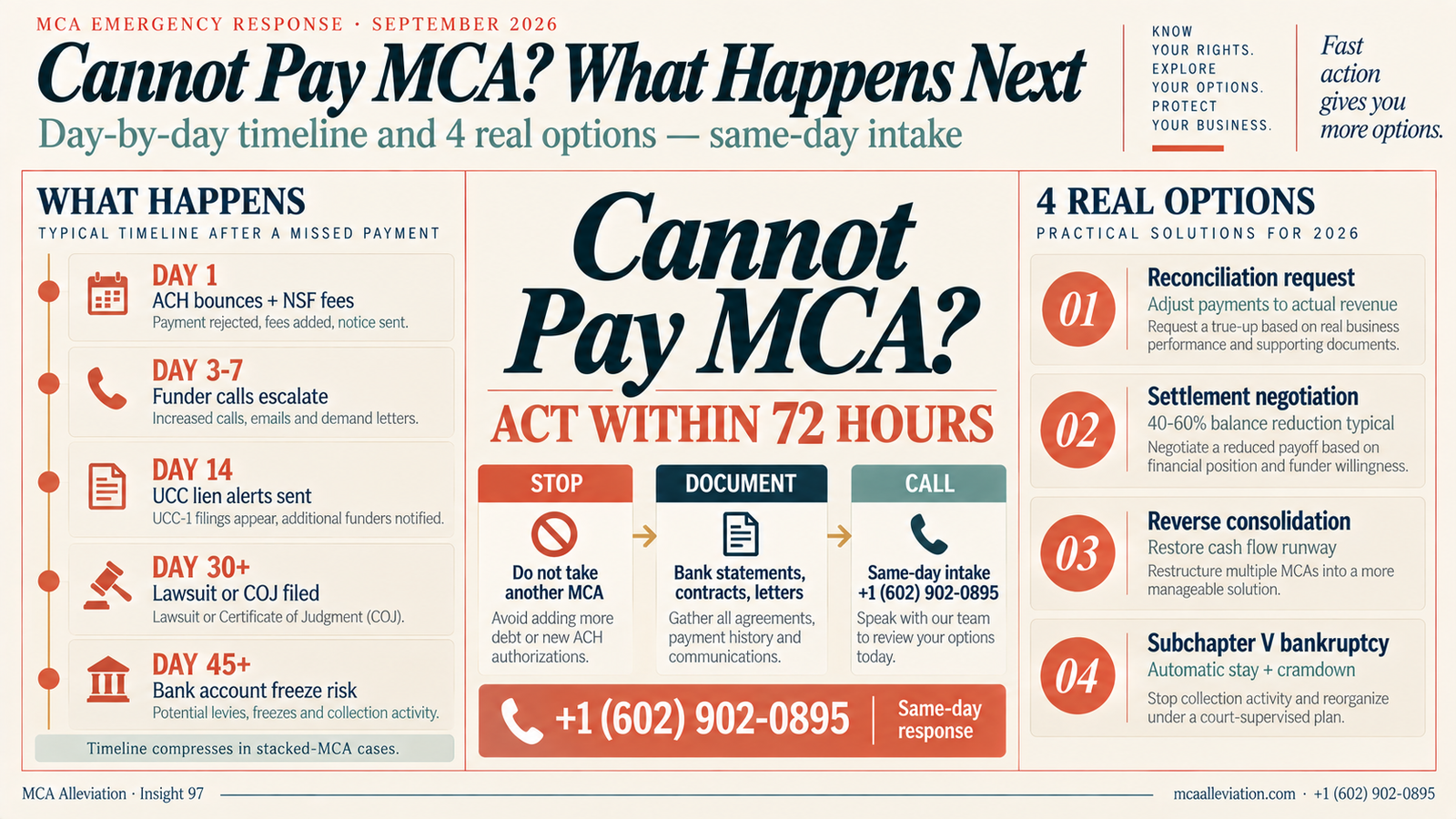
If you cannot pay your MCA, the timeline typically unfolds like this: Day 1 the ACH bounces with NSF fees; Day 3 to 7 collections calls escalate; Day 14 the funder may notify your senior UCC-1 lienholder; Day 30+ a lawsuit or confession of judgment may be filed; Day 45+ bank account freezes become an active risk. The window to act meaningfully is usually within 72 hours. The four real options are: reconciliation request (adjust payments to actual revenue), settlement negotiation (40-60 percent balance reduction typical), MCA reverse consolidation (restore cash flow runway), and Subchapter V bankruptcy (automatic stay plus cramdown, April 2026 ceiling $3,424,000). Which fits your case depends on how many MCAs you have, whether senior lenders are involved, and whether litigation has been filed. Same-day intake at +1 (602) 902-0895.
What happens when MCA payments stop.
Every case is different, but the pattern below is what unfolds in roughly 80 percent of MCA default cases. Timelines compress substantially when there are multiple MCA positions stacked, when a senior lender is already watching, or when the funder has an aggressive collections practice. Assume the compressed timeline until proven otherwise.
Day 1: ACH bounces and NSF fees hit
The MCA funder attempts the daily or weekly ACH withdrawal from your business bank account. It fails. Your bank charges an NSF fee (typically $25 to $35 per return). The MCA funder charges its own NSF fee (typically $25 to $50 per return, per funder). If you have three stacked MCAs and all three ACHs bounce, you're looking at $150 to $250 in fees on the first day alone, plus your bank may start restricting account activity. Some banks will freeze the account after 3 to 5 consecutive NSF events.
Day 3 to 7: Funder collections escalate
The MCA funder's collections team begins the phone campaign. Expect 5 to 15 calls per day per funder, plus emails and, in some cases, texts to your business phone and personal phone if you gave it as a contact. Most funders send a formal "notice of default" or "cure demand" letter by day 5 to 7, giving you a nominal cure period (usually 3 to 10 business days). The tone escalates quickly. If you have a personal guarantee (nearly every MCA does), the demands begin referencing personal liability by day 7.
Day 14: UCC alerts and senior lender notification
The MCA funder, if it has a UCC-1 filed against your business (most do), may trigger a UCC alert to your senior lienholder — typically your bank line of credit, SBA lender, or factor. This is the moment cross-default provisions on your senior credit facilities can activate, even if your senior payments are current. The senior lender receives an alert that a subordinate creditor is in default, which under many bank loan covenants is itself an event of default. This is the single most important reason to notify your senior lender proactively before day 14 — walking in with a workout plan is materially different from being caught by a UCC alert.
Day 30+: Lawsuit or confession of judgment
By day 30 to 45, most MCA funders that intend to litigate have filed suit. In states that still allow enforceable confessions of judgment (COJs) against out-of-state defendants — the landscape has narrowed substantially since New York's 2019 COJ ban, but pockets remain — the funder may enter a COJ directly, converting the debt to an immediately enforceable judgment. In non-COJ jurisdictions, a standard breach-of-contract lawsuit is filed and served. Either way, judgment can be entered within 60 to 90 days of default in most cases.
Day 45+: Bank account freezes and asset levies
With a judgment in hand, the MCA funder's next move is typically a restraining notice to your bank (freezing account activity) followed by a levy on those frozen funds. In some jurisdictions, the restraining notice can hit the same day the judgment is entered. Once your business bank account is frozen, payroll cannot process, supplier payments cannot clear, and the business often faces an existential timeline measured in days, not weeks. This is the point at which Subchapter V bankruptcy filing (which provides an automatic stay that unfreezes the account) becomes not just an option but often the only viable path forward.
The honest read: every day matters, but the first 72 hours matter most. Options that were available on day 3 are often gone by day 30. That's why the same-day intake call exists.
The 15-minute intake identifies exactly which options remain viable for your specific case.
Day 3 with three stacked MCAs? Day 30 with a lawsuit served? Day 45 with a frozen account? Each fact pattern has a different operative path. The intake walks that assessment with you and routes to the pathway that fits. No documents required to begin.
5 things to do within the next 72 hours.
These five actions are ordered by consequence, not convenience. Doing them in this order — even if you don't do all five — meaningfully changes what options remain viable a week from now. Skipping any of them, particularly items 1 and 3, is what closes doors that don't reopen.
The single most destructive move at this stage is "stacking" — taking a new MCA to cover the payment on an existing one. Every stacked position accelerates the crisis math, destroys your settlement leverage (funders discount less when they see fresh money went to another funder instead of them), and shortens your runway to zero. Brokers will call you the day you miss a payment with "emergency funding" offers. The offers are real. Taking one usually ends the business. If you take nothing else from this article, take this.
Pull the last 90 days of business bank statements. Collect all MCA contracts (originals, not just addenda). Save every funder email, voicemail transcript, and letter — screenshot the voicemails if you have to. This case file is the foundation of every relief option: reconciliation requests, settlement negotiations, bankruptcy petitions, and, if it comes to it, litigation defense. Cases with a clean documented file consistently produce better outcomes than cases where the owner is reconstructing from memory two weeks in.
The earlier a professional reviews your position, the more options remain viable. On day 3, most cases still have four full pathways available. On day 30, one or two of those pathways have often closed. On day 45+ with a frozen account, the operative path is usually Subchapter V and only Subchapter V. MCA Alleviation offers same-day intake at +1 (602) 902-0895. The call is confidential, no documents are required to begin, and there is no obligation to engage anything afterward.
If you have a bank line of credit, SBA loan, factor arrangement, or ABL lender, they likely hold a first-priority UCC-1 position above your MCAs. That position is your leverage — and it evaporates if the senior lender finds out about the MCA default from the funder's UCC alert instead of from you. Call your senior lender within 72 hours, explain the situation honestly, and ask about workout options on the senior facility. Nine times out of ten, senior lenders would rather work with you than watch you fail; the tenth time, at least you found out before they froze your credit line.
In a panic, most owners default to the first path someone offers them — usually reverse consolidation from a broker who cold-called them, or bankruptcy from a family friend who's a lawyer. Neither is inherently wrong, but neither is universally right either. The four real options (Section 03 below) each fit specific fact patterns. Picking the wrong one in a panic — or worse, taking two contradictory paths simultaneously — makes the whole picture materially worse. The 15-minute intake exists precisely to sort this before the panic decides for you.
Not every item on this list requires paid help. Item 4 (calling your senior lender) is something you can do yourself in an hour. Item 2 (documenting the file) is a Saturday afternoon of work. Items 1 and 5 are decisions, not tasks. Item 3 is the phone call that keeps the other four aligned.
Want the six fit questions walked for your specific creditors?
The intake call answers each of the six questions, identifies which creditors fit settlement and which do not, and routes the rest to the appropriate pathway — modification, refinance, SBA mechanism, or Subchapter V. No documents required to begin.
4 real options for MCA debt relief (with fit criteria).
Every legitimate MCA relief pathway falls into one of four categories. Which one fits depends on facts specific to your case: how many MCAs you have, whether senior lenders are involved, whether litigation has been filed, and whether lump-sum funding is available. The table below is the honest breakdown.
What it does: most MCA contracts include a reconciliation clause requiring the funder to adjust daily or weekly payments when actual revenue drops. A properly drafted reconciliation request letter, delivered in writing with supporting bank statements, can produce a legal payment reduction that buys 30 to 90 days of runway. When it fits: early crisis (day 1 to 14), one or two MCAs, revenue drop that's clearly documented, no active litigation. When it doesn't: three or more stacked MCAs (funders coordinate to reject), litigation already filed, or contracts with illusory reconciliation clauses (documentation demanded beyond merchant capacity, unreasonable timing, default triggers on request). See our reconciliation request invocation letter guide.
What it does: out-of-court negotiated reduction of the MCA balance in exchange for lump-sum payoff. Typical range is 40 to 60 cents on the dollar, expanding when a senior UCC-1 lienholder above the MCA position doubles the pressure to settle. When it fits: documented hardship, lump-sum funding available (own cash, senior lender workout, or SBA 7(a) refinance), one to three MCAs, funder still willing to engage. When it doesn't: no lump-sum funding, funder has already filed suit and refuses to negotiate, four or more stacked positions with cross-default coordination. See our MCA debt relief framework.
What it does: new advance placed on top of the existing MCAs where the new funder takes the daily aggregate payments and pays out to the existing MCAs on a slower schedule. Restores 40 to 60 percent of daily cash flow immediately. When it fits: the business is fundamentally sound, revenue supports the aggregate payment, no active litigation, and the goal is buying 6 to 12 months of runway to either grow out of the debt or set up a proper settlement or refinance. When it doesn't: revenue is genuinely insufficient to support even the reduced aggregate payment (in which case you're delaying the crisis, not resolving it), or the business needs full debt reduction rather than restructuring. See our reverse consolidation strategy guide.
What it does: streamlined Chapter 11 for small businesses. Filing triggers the automatic stay, which halts every enforcement action, ACH withdrawal, and lawsuit on the day of filing. A confirmed plan is binding on creditors who do not consent (cramdown power). Owner retains control without a trustee in most cases. When it fits: four or more MCAs with coordinated cross-default, litigation already filed, bank account frozen or freeze imminent, or settlement/consolidation cannot deliver the resolution needed. When it doesn't: single-MCA cases with lump-sum funding available (settlement is faster and cheaper), or debt levels above $3,424,000 (traditional Chapter 11 required). See our settlement vs bankruptcy comparison.
Roughly a quarter of the cases that come through intake are good fits for reconciliation-first, another quarter for direct settlement, another quarter for reverse consolidation as a bridge, and the final quarter for Subchapter V because case complexity, creditor coordination, or active enforcement makes voluntary out-of-court resolution structurally impossible. The triage is the work — and the 15-minute intake is where that triage happens.
The intake identifies the operative path in fifteen minutes.
Same-day confidential review. No documents required to begin. No obligation to engage anyone afterward. Placement organization — not legal representation.
How MCA Alleviation helps and what happens on the call.
MCA Alleviation is a placement organization headquartered in Phoenix, Arizona, serving all 50 U.S. states. We are not a law firm, and we do not represent clients in litigation directly. What we do is triage cases in the first 15 minutes, identify which of the four relief pathways fits, and place the case with the professional (settlement negotiator, workout counsel, bankruptcy attorney, refinance broker) who actually executes the work. The intake is free, confidential, and requires no documents to begin.
What happens on the intake call
The 15-minute confidential conversation covers five things, in this order: (1) which MCAs you have, how much is outstanding on each, and daily/weekly payment amount per position; (2) whether senior lenders (bank, SBA, factor, ABL) are in the picture and where they sit in UCC priority; (3) current enforcement status — any missed payments, funder demand letters, lawsuits served, judgments entered, or bank account activity; (4) hardship documentation status — do you have 90 days of bank statements, MCA contracts, and funder correspondence organized; (5) available funding for settlement, if applicable — own cash, senior lender workout capacity, or SBA 7(a) refinance eligibility.
The output of the call is a clear identification of which of the four relief pathways fits your case and a specific next step: either a same-day case setup with the right professional, or a defined 48-to-72-hour action plan if the case needs additional documentation or coordination before placement.
Three things that make the intake different
First, it's genuinely free — no upfront fees, no "consultation charge," no obligation to engage anything afterward. Second, it's honest about which cases we cannot help with — single-MCA cases with clean payment history often don't need us and we'll say so. Third, we route to the right specialist rather than trying to sell you our specific product; that means we sometimes route cases to bankruptcy counsel even when settlement would generate a fee for us, because bankruptcy was the right answer for that case.
What we do not do
We do not represent clients in court. We do not draft legal pleadings. We do not provide legal advice — which is what "placement organization, not legal representation" means throughout our materials. What we do is identify the right pathway, connect you to the right professional in your jurisdiction, and coordinate the operational pieces (documentation, senior lender communications, funder negotiations at the settlement stage) that make the case go faster than it would otherwise.
The next fifteen minutes can change the trajectory of the next fifteen weeks.
Same-day intake. Confidential. No documents required to begin. No obligation to engage anyone afterward. Serving all 50 U.S. states from Phoenix, Arizona.
Three things worth remembering from this guide.
If you cannot pay MCA, the first 72 hours matter most.
MCA default timeline compresses quickly: Day 1 the ACH bounces with NSF fees; Day 3-7 collections calls escalate; Day 14 the funder may notify your senior UCC-1 lienholder triggering cross-default; Day 30+ a lawsuit or confession of judgment may be filed; Day 45+ bank account freezes become an active risk. Options that were available on day 3 are often gone by day 30. Same-day intake at +1 (602) 902-0895 identifies which of the four relief pathways remains viable for your specific case. Timelines compress further in stacked-MCA cases where multiple funders escalate simultaneously.
Five things to do today, in order.
The 72-hour checklist is ordered by consequence, not convenience. (1) Do NOT take another MCA to cover the current one — stacking accelerates the crisis and destroys settlement leverage. (2) Document everything — 90 days of bank statements, all MCA contracts, every funder communication. (3) Call an MCA relief professional the same day — MCA Alleviation intake at +1 (602) 902-0895. (4) Preserve your senior lender relationship — proactive call before the funder's UCC alert triggers cross-default. (5) Understand your real options before deciding — reconciliation, settlement, reverse consolidation, and Subchapter V each fit specific fact patterns. Skipping items 1 or 3 closes doors that don't reopen.
Four real options: reconciliation, settlement, reverse consolidation, Subchapter V.
Every legitimate MCA relief pathway falls into one of four categories. Reconciliation request (adjust payments to actual revenue, 7-30 days, best for early crisis 1-2 MCAs); settlement negotiation (40-60% balance reduction typical, 30-90 days, requires lump-sum funding); MCA reverse consolidation (restore 40-60% of cash flow, 14-30 days, best when business is fundamentally sound); Subchapter V bankruptcy (automatic stay plus cramdown, 6-9 months to confirmation, April 2026 ceiling raised to $3,424,000 in noncontingent liquidated debts). Which fits depends on how many MCAs you have, whether senior lenders are involved, whether litigation has been filed, and whether lump-sum funding is available.
Frequently asked questions.
What happens if I cannot pay my MCA?
If you cannot pay your MCA, the timeline typically unfolds like this: Day 1, your ACH payment bounces and you incur NSF fees from both your bank and your MCA funder (often $25 to $50 per bounce, per funder). Day 3 to 7, the funder's collections team begins escalating phone calls and email demands, sometimes with formal cure-period letters. Day 14, the MCA funder may notify your senior lender (bank, SBA, factor) through UCC-1 alert systems, which can trigger cross-default provisions on your other credit facilities. Day 30+, the funder may file a lawsuit or, in states that still allow them, enter a confession of judgment (COJ). Day 45+, if a judgment has been entered, bank account freezes and asset levies become an active risk. Timelines compress substantially in stacked-MCA cases. The window to act meaningfully is usually within the first 72 hours.
What should I do in the first 72 hours of an MCA payment crisis?
Five things matter most: (1) Do NOT take another MCA to cover the current one — stacking accelerates the crisis and destroys settlement leverage. (2) Document everything — 90 days of bank statements, all MCA contracts, every funder email and voicemail. (3) Call an MCA relief professional the same day — MCA Alleviation offers same-day intake at +1 (602) 902-0895. (4) Preserve your senior lender relationship — proactive call before the funder's UCC alert triggers cross-default provisions. (5) Understand your real options before making decisions — reconciliation, settlement, reverse consolidation, and Subchapter V all fit different fact patterns.
Can I legally stop MCA payments if I cannot afford them?
Yes, in most cases, but the mechanism matters. The two legitimate paths are: (1) Reconciliation request — most MCA contracts include a reconciliation clause requiring the funder to adjust daily or weekly payments when actual revenue drops. A properly drafted reconciliation request letter, delivered in writing with supporting documentation, can produce a legal payment reduction. (2) ACH revocation with senior lienholder coordination — you can revoke ACH authorization at your bank, but this must be coordinated with legal counsel and, ideally, with your senior UCC-1 lienholder to avoid triggering cross-default provisions. Simply stopping payments without a legal framework typically escalates the crisis faster. Same-day intake at +1 (602) 902-0895 can identify which path fits your specific case.
How much does MCA debt relief typically reduce what I owe?
Realistic MCA settlement discounts typically land in the 40 to 60 percent range on remaining balance when documented hardship, lump-sum funding, and senior lien coordination are present. The discount range expands (sometimes to 30 to 40 cents on the dollar) when a senior UCC-1 lienholder above the MCA position doubles the pressure on the MCA funder to settle rather than pursue litigation. Discount ranges compress (60 to 75 cents on the dollar) when there is no senior lien, no documented hardship, or the funder has already filed suit. Anyone advertising consistently better discounts as a function of negotiation skill alone is misrepresenting how the structural mechanics work — the discount is a function of leverage, not sales technique.
What is the difference between MCA settlement, consolidation, and bankruptcy?
MCA Settlement is an out-of-court negotiated reduction of the balance — typically 40 to 60 percent off on lump-sum payoff, closes in 30 to 90 days, requires funder consent. MCA Reverse Consolidation restructures multiple MCA positions into a single new advance with lower daily or weekly payments, restoring cash flow runway of 40 to 60 percent — good when settlement is not viable but the business is fundamentally sound. Subchapter V Bankruptcy is a formal reorganization under Chapter 11 with streamlined process for small businesses (April 2026 ceiling raised to $3,424,000 in noncontingent liquidated debts), provides automatic stay that halts all enforcement on the day of filing, and can bind non-consenting creditors through court-approved cramdown. Choosing among them depends on how many MCAs you have, whether you have senior lenders, whether litigation has been filed, and whether you have funding for a lump-sum settlement.
How fast can MCA Alleviation help if I am in immediate crisis?
MCA Alleviation offers same-day intake at +1 (602) 902-0895, Monday through Saturday 8 AM to 6 PM Pacific. The initial 15-minute confidential conversation reviews your MCA positions, senior lender relationships, current enforcement status, and hardship documentation to identify which relief pathway fits your case. No documents are required to begin the call. If your situation is genuinely time-critical (bank account already frozen, lawsuit already served, COJ already entered), the intake can escalate directly to case setup within the same business day. MCA Alleviation is headquartered in Phoenix, Arizona and serves all 50 U.S. states. Note: MCA Alleviation is a placement organization, not a law firm — for cases requiring active litigation defense, the intake includes referral to counsel in your jurisdiction.
Cannot pay MCA? The next fifteen minutes can change the trajectory of the next fifteen weeks.
The confidential intake reviews your MCA positions, senior lender status, current enforcement, and hardship documentation to identify which of the four relief pathways fits your case in real time. Same-day, confidential, no documents required to begin, no obligation to engage anyone afterward. Serving all 50 U.S. states from Phoenix, Arizona. Placement organization — not legal representation.