MCA attorney fees, what you actually pay — no surprises after engagement.
Before you engage an MCA attorney for lawsuit defense, Subchapter V bankruptcy, settlement negotiation, or emergency response, understand the four fee structures that dominate MCA defense (contingency, flat fee, retainer plus hourly, placement coordination), the cost ranges by matter type (lawsuit $5-20K, Subchapter V $20-60K, settlement 15-30% contingency, emergency $3-10K + ongoing), the counsel versus placement organization fee separation that most prospects do not fully understand until after engagement, and the four hidden costs that recur across the industry (court filing fees, Subchapter V trustee fees, expert witness fees, placement coordination fee separation). Free written quote at +1 (602) 902-0895 — itemized across all four categories.
Get a written fee quote before you engage any MCA attorney.
The 15-minute confidential quote conversation itemizes attorney fees (contingency, flat, or retainer+hourly), placement coordination fees (separate from counsel fees), court filing fees and trustee fees for your matter type, and any expert witness costs for your specific case. No documents required to begin. No obligation. Placement organization — not legal representation.
- 01Why MCA attorney fees differ from standard legal fees
- 02The 4 fee structures: contingency, flat, retainer+hourly, placement
- 03Cost by matter type: lawsuit, Subchapter V, settlement, emergency
- 044 hidden costs most prospects miss until after engagement
- 05Three things worth remembering before engaging MCA counsel
- 06Frequently asked questions
Before you engage an MCA defense attorney, the single question that matters most is not "what is your hourly rate" but "which fee structure applies to my matter type, what are the hidden costs beyond the headline attorney fee, and how does the counsel fee relate to the placement coordination fee?" A $400 per hour retainer plus hourly engagement sounds expensive, but on a Subchapter V bankruptcy where total scope cannot be defined upfront, it often costs less than a flat fee quoted at the high end of the range. A 20 percent contingency on documented settlement savings sounds high, but if there is no upfront retainer and the attorney is only paid on results, the risk-adjusted cost is often materially lower than any other structure.
This guide walks the four fee structures that dominate MCA defense in 2026, maps cost ranges across the four matter types (lawsuit defense, Subchapter V bankruptcy, settlement negotiation, emergency response), explains the counsel versus placement organization fee separation that affects total engagement cost, and names the four hidden costs most prospects miss until after engagement. Read it in eight minutes, or call for a free written quote at +1 (602) 902-0895 and get the same information itemized for your specific case in fifteen minutes.
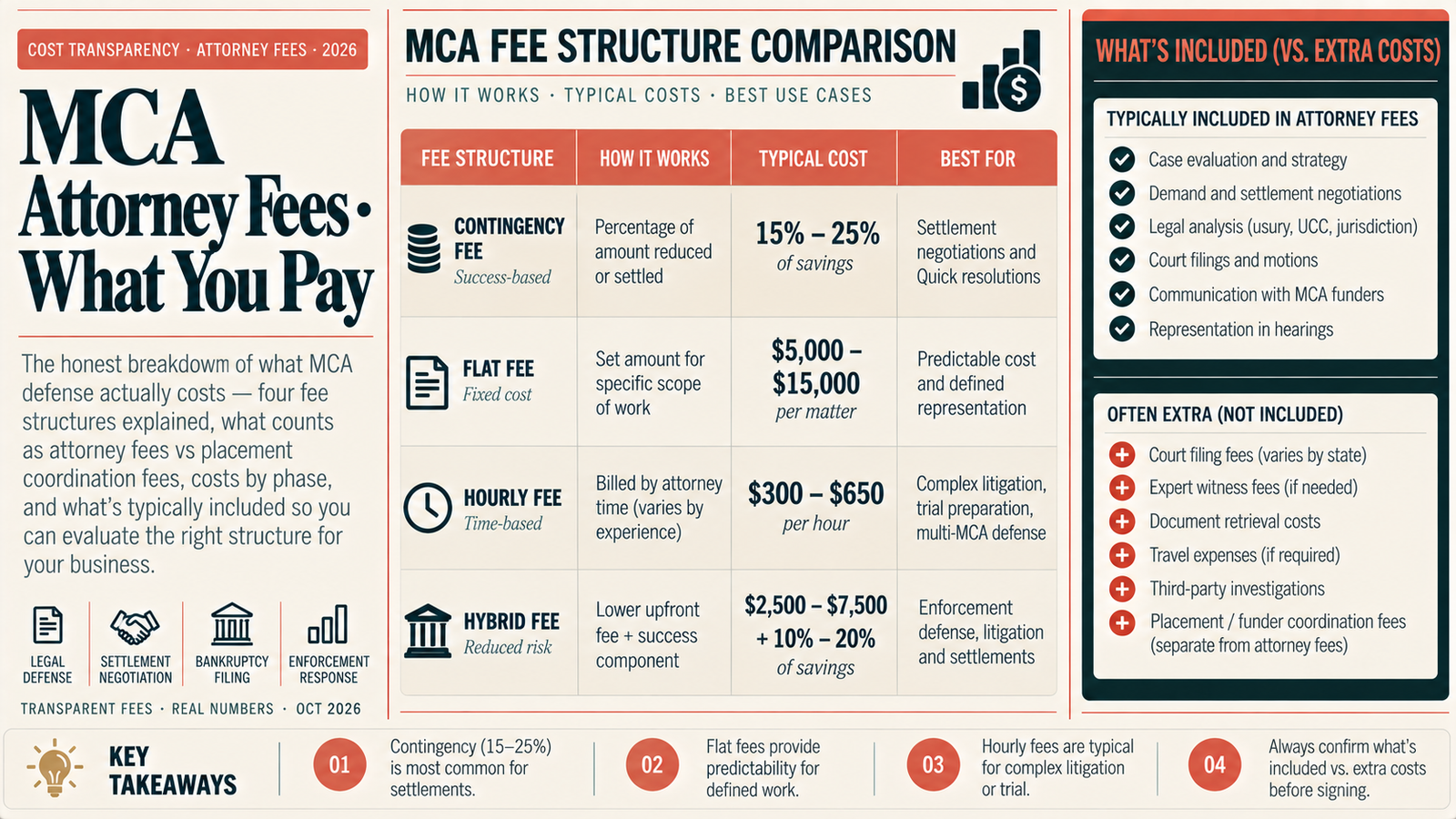
MCA attorney fees in 2026 operate under four fee structures: contingency (15-30% of documented savings paid at closing with no upfront retainer) for settlement matters where attorney incentive aligns with client results; flat fee ($5,000-$25,000 per matter engagement by matter type) for defined-scope lawsuit defense and discrete bankruptcy work; retainer plus hourly ($5,000-$15,000 initial retainer plus $350-$650/hr billed as incurred) for Subchapter V and complex matters where total scope cannot be defined upfront; and placement coordination fee (paid separately from counsel fees to the placement organization) which is distinct from attorney fees and often misunderstood by prospects. Cost ranges by matter type: lawsuit defense $5,000-$20,000, Subchapter V bankruptcy $20,000-$60,000 through plan confirmation, settlement 15-30% contingency on savings, emergency response $3,000-$10,000 initial plus ongoing. Four hidden costs most prospects miss: court filing fees ($338 Subchapter V filing fee as example), Subchapter V trustee fees ($300-$500/hr), expert witness fees for economic analysis ($2,500-$10,000 per case), and the counsel versus placement organization fee separation. Free written quote at +1 (602) 902-0895.
MCA attorney fees are different from standard legal fees — four reasons.
MCA defense attorney fees run on different structures than general commercial litigation or standard transactional legal work for four specific reasons that affect how counsel prices the engagement. Understanding these four reasons is what lets you evaluate whether a fee quote is aggressive, fair, or a red flag — and whether the fee structure makes sense for your specific matter type.
Reason 1: Specialized expertise is narrow and jurisdiction-specific
MCA case law is narrow and heavily concentrated in a small number of jurisdictions — primarily New York state and federal courts (where most MCA contracts designate venue), California (where SB 1235 Commercial Financing Disclosure Law created a developed regulatory framework), and Texas (where the New York forum-selection problem drives most of the case work). An attorney who regularly handles MCA matters knows the operative statutes (GOL § 5-501 civil usury, GOL § 5-521(3) criminal usury, California SB 1235, Texas Finance Code Chapter 302, the CPLR procedural toolkit, the Subchapter V debt ceiling and plan confirmation process) and the operative case law on MCA reclassification, forum-selection enforcement, and automatic stay application. A general commercial litigation attorney who takes an MCA matter must climb the learning curve on the client's budget — which is why specialized MCA counsel often costs less in total engagement despite higher hourly rates than non-specialists charging less per hour but requiring more hours.
Reason 2: MCA matters are time-sensitive with hard deadlines
MCA defense frequently operates against hard procedural deadlines that make hourly billing unpredictable and favor fee structures with built-in urgency recognition. The CPLR § 320 twenty-day answer deadline (thirty days when served by mail or outside New York) is strict and non-extendible without court order. CPLR § 5222 restraining notices freeze operating bank accounts immediately on service, with CPLR § 5240 motions to vacate often filed the same day the freeze is discovered. Confession of Judgment entries under CPLR § 3218 can authorize immediate enforcement without lawsuit or notice. The time-sensitive nature of these matters affects fee pricing: emergency response engagements command premium rates because they displace other work and require immediate attention; flat fees for defined-scope matters build in the emergency overhead; retainer plus hourly engagements require larger initial retainers to cover emergency work on arrival.
Reason 3: Outcome-contingent fee structures are common and appropriate
Settlement-stage MCA defense is uniquely suited to contingency fee structures because the economic result (dollar amount of debt reduction) is measurable, documented, and directly attributable to the attorney's negotiation work. Contingency fees in MCA settlement matters are typically 15 to 30 percent of documented savings — a structure that aligns the attorney with client outcomes because the attorney is paid only when actual balance reduction is achieved. Not every matter supports contingency pricing: lawsuit defense is work that must be done regardless of outcome (an answer must be filed, a motion must be briefed, discovery must be managed) and is typically priced on flat fee or retainer plus hourly; Subchapter V bankruptcy is a defined court process with fee ranges set by the type and complexity of the case rather than by a measurable outcome; emergency response is urgent work priced on initial engagement fees plus ongoing billing. The right fee structure matches the matter type.
Reason 4: Counsel fees are separate from placement coordination fees
Many MCA defense engagements involve two distinct service providers with distinct fee structures: the assigned counsel who provides the legal representation (and is paid attorney fees in one of the three structures above), and the placement organization that coordinates the case placement, identifies the operative pathway, and monitors the matter through resolution (and is paid placement coordination fees as a separate line item). The two are not the same, do not operate under the same professional rules, and should not be conflated in cost analysis. Counsel fees are paid to the law firm at the law firm's rates and terms, with attorney-client privilege operating between the client and the law firm. Placement coordination fees are paid to the placement organization for the coordination work, which is distinct from legal representation. A quote that bundles both into a single number without disclosing the breakdown is making the engagement harder to evaluate — ask for the two line items separately.
The honest read: MCA attorney fee quotes are only comparable when they itemize fee structure (contingency, flat, or retainer plus hourly), matter type (lawsuit, Subchapter V, settlement, or emergency), and counsel versus placement coordination fee separation. A headline hourly rate or contingency percentage without those four dimensions is insufficient to make an engagement decision. The written quote process at MCA Alleviation itemizes all four.
The 15-minute quote itemizes the fee structure, matter type, and cost ranges for your specific case.
Settlement negotiation with contingency on documented savings? Lawsuit defense with flat fee or retainer plus hourly? Subchapter V bankruptcy through plan confirmation on retainer plus hourly? Emergency CPLR § 5240 restraining notice response with initial engagement plus ongoing work? Each matter type maps to a different fee structure and dollar range. The quote walks that assessment and delivers written itemization with counsel fees separated from placement coordination fees.
The 4 fee models the MCA relief industry actually uses.
MCA defense attorney fees operate under four fee structures. Each structure fits specific matter types better than others, has a specific alignment with client outcomes, and a specific set of pitfalls. Understanding all four is what lets you evaluate any quote against the appropriate benchmark rather than against the wrong one — and determine whether the fee structure quoted actually fits your matter type.
The attorney is paid a percentage of documented savings after settlement closes. No upfront fee, no retainer, no charge if the matter does not resolve favorably. Alignment with client outcome is the tightest of any structure — the attorney only generates fees when actual balance reduction is achieved. Best fit: settlement negotiation matters where the outcome (dollar amount of debt reduction) is measurable and directly attributable to the attorney's work. Range: 15 to 30 percent of documented savings depending on matter complexity (position count, senior lien coordination, jurisdiction, settlement funding availability). Pitfall: on very small matters (under $50,000 aggregate MCA balance), contingency percentage may not cover professional hours required; attorneys may decline these matters or quote at the top of the range.
A defined flat fee for a defined-scope engagement, paid at engagement or on milestone schedule. Range varies by matter type: $5,000 to $10,000 for straightforward lawsuit defense (CPLR § 320 answer, motion to dismiss, limited discovery), $8,000 to $15,000 for Confession of Judgment challenge or settlement litigation, $10,000 to $25,000 for complex matters with multiple MCAs or concurrent proceedings. Best fit: defined-scope matters where total work can be estimated at engagement — lawsuit defense through motion practice, discrete bankruptcy work (motion for relief from stay, specific plan negotiation task), or emergency response with defined deliverable. Alignment is neutral: attorney is paid flat fee regardless of outcome but has incentive to work efficiently. Pitfall: scope creep can trigger supplemental fee requests; always confirm in writing what the flat fee covers and what triggers additional charges.
Initial retainer ($5,000 to $15,000 typical) replenished as billed, with hourly billing at $350 to $650 per hour depending on attorney seniority and jurisdiction (New York and California at higher end of range, other markets lower). Best fit: Subchapter V bankruptcy and complex matters where total scope cannot be defined upfront — plan negotiation complexity varies with creditor engagement, discovery scope depends on contested matters that arise during the case, trustee requirements can expand the attorney's work. Total engagement cost for Subchapter V typically $20,000 to $60,000 through plan confirmation over six to nine months. Alignment is neutral: client pays for time worked. Pitfall: unbudgeted work can run matter cost materially higher than initial estimate; always request a matter budget with milestone caps and monthly billing review in writing.
A placement organization (not a law firm) coordinates case placement with assigned counsel, identifies the operative pathway, and monitors the matter through resolution. Placement coordination fees are separate from and in addition to the counsel fees charged by the assigned law firm. The placement organization is not providing legal representation; the attorney-client relationship runs between the client and the assigned law firm. Structure varies: contingency on settlement savings (common for settlement matters where the placement organization negotiates the settlement directly), flat coordination fee per engagement (common for Subchapter V and emergency matters), or no separate placement fee where the attorney directly engages the client without placement coordination. Pitfall: ensure both counsel fees and placement coordination fees are disclosed as separate line items before engagement — a bundled quote without the breakdown is harder to evaluate against alternatives.
The right structure depends on the matter type, not on which attorney you happened to call first. A settlement negotiation with documented savings fits contingency at 15 to 25 percent. A lawsuit defense with defined scope (answer plus motion practice) fits flat fee at $8,000 to $15,000. A Subchapter V bankruptcy fits retainer plus hourly at $20,000 to $60,000 total engagement. An emergency response (CPLR § 5240 restraining notice vacatur) fits flat initial fee plus hourly for ongoing work. Any attorney quoting a single fee structure for every matter type is either selling one product or hasn't diagnosed yours — ask specifically which structure fits your matter and why.
The written quote names the fee structure, the matter type, and the total dollar range — before you engage.
Contingency on settlement savings? Flat fee for defined-scope lawsuit defense? Retainer plus hourly for Subchapter V bankruptcy? Flat initial for emergency CPLR response? Each fits a specific matter type and produces a specific total dollar range. The 15-minute written quote picks the right structure for your facts, puts the number in writing with counsel fees and placement coordination fees as separate line items, and identifies hidden costs so you can compare apples to apples across quotes.
MCA attorney fees broken down by matter type.
Every MCA defense engagement falls into one of four matter types, and each matter type has a typical fee structure and dollar range that applies regardless of which attorney or placement organization you engage. The breakdown below shows what you should expect to see in a written quote for each matter type — including both the attorney fee and the hidden costs (filing fees, trustee fees, expert witness) that apply to that matter type.
What is covered: CPLR § 320 twenty-day answer filing, affirmative defenses (GOL § 5-521(3) criminal usury, Commercial Finance Disclosure Law non-compliance where applicable, reconciliation breach), motion to dismiss where grounds exist, limited discovery scope, and settlement negotiation during the litigation window. Typical total cost: $8,000 to $15,000 for straightforward matters with flat fee structure; $5,000 to $20,000 under retainer plus hourly where total scope is unpredictable (contested motion practice, expanded discovery). Hidden costs: court filing fees (state court filing fees vary by jurisdiction, typically $200 to $500 for initial filing plus motion fees); copy and service costs; deposition costs if the matter proceeds to discovery.
What is covered: petition drafting and filing, schedules and statements, first-day motions, 341 meeting of creditors, Subchapter V trustee coordination, plan negotiation with creditors, plan filing (within 90 days of petition), plan confirmation hearing, and post-confirmation administration. Typical total cost: $20,000 to $35,000 for straightforward small-dollar matters with cooperative creditors; $35,000 to $60,000 for complex matters with multiple MCAs, senior lender coordination, or contested plan confirmation. Hidden costs: $338 federal bankruptcy court filing fee (as of April 2026, paid at filing); Subchapter V trustee fees billed separately at $300 to $500 per hour (typically $5,000 to $15,000 total through plan confirmation); US Trustee quarterly fees post-petition; credit counseling and debtor education fees ($50 to $200 total).
What is covered: initial funder outreach, settlement negotiation across one or more MCA positions, senior lender coordination where applicable, settlement agreement drafting and review, closing coordination, and release/termination documentation. Typical fee math: on a $250,000 MCA settling at 60 cents on the dollar ($100,000 documented savings), 20 percent contingency fee is $20,000 paid at settlement close. On a $500,000 case settling at 50 cents ($250,000 savings), 20 percent is $50,000. Hidden costs: expert witness fees for economic analysis of MCA reclassification (needed for GOL § 5-521(3) criminal usury analysis in NY cases) typically $2,500 to $10,000 per case; litigation fees if settlement negotiation fails and the matter proceeds to lawsuit defense or Subchapter V.
What is covered: emergency CPLR § 5240 motion to vacate restraining notice (filed same-day or next-day of freeze), CPLR § 3215 motion to vacate default judgment, CPLR § 5015 motion for relief from judgment, Confession of Judgment challenge under CPLR § 3218, or immediate Subchapter V filing to trigger automatic stay. Typical total cost: $3,000 to $10,000 initial engagement fee covering the first 10 to 30 days of emergency work; ongoing work billed hourly if the matter escalates to prolonged litigation or converts to Subchapter V. Hidden costs: emergency motion filing fees ($200 to $500 depending on court); if conversion to Subchapter V occurs, add the $338 federal filing fee and Subchapter V attorney fee range above.
The matter type matrix above gives dollar ranges, not quotes. Actual fees depend on specific case facts — number of MCAs, jurisdiction, enforcement status, availability of defenses, settlement funding posture. The written quote itemizes which matter type applies to your case, the fee structure within that matter type, the dollar range specific to your facts, and the hidden costs you should expect in addition to the attorney fee. A quote that gives a headline attorney fee without identifying the matter type and the hidden costs is incomplete and makes comparison against alternatives impossible.
Get a written quote itemizing matter type, fee structure, and hidden costs before you engage.
Which matter type applies to your case? Which fee structure fits within that matter type? What are the dollar ranges specific to your facts? What hidden costs should you expect beyond the headline attorney fee? The written quote itemizes all four so you can compare it side-by-side against any other attorney quote on the same matter. Free, confidential, no obligation to engage.
Before you engage any MCA attorney, get a quote you can actually compare.
Written itemization of attorney fee structure (contingency, flat, or retainer plus hourly), matter type and dollar range for your specific case, court filing fees and trustee fees expected for your matter type, expert witness fee estimate if applicable, and placement coordination fee as a separate line item from counsel fees. No surprises after engagement. Serving all 50 U.S. states from Phoenix, Arizona.
Three things worth remembering before engaging MCA counsel.
Match the fee structure to your matter type.
Four fee structures dominate MCA defense and each fits specific matter types better than others. Contingency (15-30% of documented savings, no upfront retainer) fits settlement negotiation matters where outcome is measurable; flat fee ($5,000-$25,000 per matter) fits defined-scope lawsuit defense and discrete bankruptcy work; retainer plus hourly ($5,000-$15,000 initial + $350-$650/hr) fits Subchapter V bankruptcy and complex matters where scope cannot be defined upfront; placement coordination fee (separate from counsel fees) applies when a placement organization coordinates case placement with assigned counsel. A fee quote without identifying the matter type and the fee structure that fits it is incomplete. Free written quote at +1 (602) 902-0895.
Dollar ranges vary materially by matter type.
Cost ranges for MCA defense attorney fees by matter type in 2026: lawsuit defense $5,000-$20,000 (flat fee for defined scope, retainer plus hourly for unpredictable scope); Subchapter V bankruptcy $20,000-$60,000 through plan confirmation over six to nine months (retainer plus hourly structure); settlement negotiation 15-30% contingency on documented savings ($20,000 fee on $100,000 savings at 20 percent); emergency response $3,000-$10,000 initial engagement plus ongoing work for CPLR § 5240 restraining notice vacatur, Confession of Judgment challenge, or newly served lawsuit response. The actual fee for your matter depends on specific facts — the written quote itemizes which matter type applies, the fee structure within it, and the dollar range specific to your case. Free written quote at +1 (602) 902-0895.
Ask about the four hidden costs beyond the headline attorney fee.
Four hidden costs recur across MCA defense engagements that most prospects miss until after engagement: (1) court filing fees separate from attorney fees ($338 Subchapter V filing fee, state court filing fees $200-$500, motion fees $50-$200 each); (2) Subchapter V trustee fees billed separately at $300-$500/hr totaling $5,000-$15,000 through plan confirmation; (3) expert witness fees for economic analysis of MCA reclassification totaling $2,500-$10,000 per case where applicable; (4) counsel versus placement organization fee separation where counsel fees and placement coordination fees are distinct line items that both apply to total engagement cost. A quote that gives only the headline attorney fee without identifying these four hidden cost categories is incomplete. Free written quote itemizing all four at +1 (602) 902-0895.
Frequently asked questions.
How much do MCA attorneys cost in 2026?
MCA attorney fees in 2026 depend on the fee structure and the matter type. Four fee structures dominate the market: (1) Contingency (15 to 30 percent of documented savings, paid at settlement closing with no upfront retainer) — typical for settlement matters where the incentive aligns the attorney with the client. (2) Flat fee ($5,000 to $25,000 per matter engagement depending on scope and matter type) — common for lawsuit defense and discrete bankruptcy work with defined scope. (3) Retainer plus hourly ($5,000 to $15,000 initial retainer plus $350 to $650 per hour billed as incurred) — typical for Subchapter V and complex matters where total scope cannot be defined upfront. (4) Placement coordination fee (paid separately from counsel fees to a placement organization) — distinct from attorney fees and often misunderstood by prospects. Cost ranges by matter type: lawsuit defense $5,000 to $20,000, Subchapter V bankruptcy $20,000 to $60,000 through plan confirmation, settlement 15 to 30 percent contingency on savings, emergency response $3,000 to $10,000 initial plus ongoing work. Free written quote at +1 (602) 902-0895.
Which attorney fee structure fits my MCA case?
The right fee structure depends on the matter type and the predictability of scope. For settlement matters, contingency (15 to 30 percent of documented savings) produces the best economic alignment because the attorney is paid only if actual savings are generated, so the incentive to deliver real balance reduction sits directly on the attorney. For lawsuit defense with defined scope (CPLR § 320 answer, motion to dismiss, limited discovery), flat fee ($8,000 to $15,000 typical) provides cost certainty. For Subchapter V bankruptcy where total scope cannot be defined upfront (plan negotiation complexity varies with creditor engagement), retainer plus hourly ($5,000 to $15,000 retainer plus $350 to $650 per hour) is the standard structure, with total engagement cost typically $20,000 to $60,000 through plan confirmation over six to nine months. For emergency response matters (CPLR § 5240 motion to vacate restraining notice, Confession of Judgment challenge), flat fee or hourly billing on a short-engagement basis typically applies. Free written quote comparing fit at +1 (602) 902-0895.
What is the difference between attorney fees and placement coordination fees?
Attorney fees and placement coordination fees are two distinct categories of cost that many prospects conflate until they engage. Attorney fees are paid directly to the counsel assigned to the matter at the counsel's own rates and terms — contingency on savings, flat fee per matter, or retainer plus hourly — and the attorney-client relationship and attorney-client privilege run between the client and the assigned counsel. Placement coordination fees are paid separately to a placement organization (not a law firm) that coordinates the case placement, identifies the operative pathway, and monitors the matter through resolution; the placement organization is not providing legal representation. The fee structures are independent — a placement organization typically charges placement coordination fees for emergency and bankruptcy matters where the coordination work is substantial, or earns contingency fees for settlement matters where the organization negotiates the settlement directly and places only when enforcement escalates. The key cost transparency question is: what does the attorney charge and what does the placement organization charge, as two distinct line items. Free written quote clarifying the breakdown at +1 (602) 902-0895.
What hidden costs should I ask about before engaging an MCA attorney?
Four categories of cost beyond the headline attorney fee recur often enough to warrant specific pre-engagement questions. (1) Court filing fees are separate from attorney fees and paid directly to the court — a Subchapter V bankruptcy filing fee is currently $338, state court filing fees vary by jurisdiction and matter type, motion filing fees apply to each contested motion. (2) Subchapter V trustee fees apply in every Subchapter V case and are billed separately from the debtor's attorney fees at typically $300 to $500 per hour, usually totaling $5,000 to $15,000 through plan confirmation. (3) Expert witness fees apply when the case requires economic analysis (MCA reclassification as a disguised loan, effective interest rate computation for GOL § 5-521(3) criminal usury analysis, true-nature analysis for California or New York cases) and typically run $2,500 to $10,000 per case. (4) Placement coordination fees (if a placement organization is involved) are distinct from attorney fees and should be disclosed as a separate line item before engagement. Ask for a written fee quote that breaks out all four categories, not just the headline attorney fee. Free written quote at +1 (602) 902-0895.
Are MCA attorney fees tax-deductible for my business?
MCA attorney fees are generally deductible as ordinary and necessary business expenses under IRC section 162 when incurred in connection with debt used in the trade or business. The specific categorization depends on the fee structure and matter type: attorney retainers and hourly fees for litigation defense deduct as legal and professional fees in the year paid; contingency fees on settlement savings deduct in the year the settlement closes; Subchapter V attorney fees deduct as administrative expenses of the bankruptcy estate, with specific timing rules; flat fees deduct in the year paid. Placement coordination fees (paid to a placement organization rather than to the attorney) are typically deductible as general business services expense. Debt discharged through settlement or bankruptcy may create cancellation of debt (COD) income under IRC section 61(a)(11) that can offset the fee deduction depending on solvency at time of discharge; a bankruptcy exclusion under IRC section 108 may apply. This is a general framework, not tax advice — consult a CPA on your specific facts.
How do I get a free written quote for MCA attorney fees?
MCA Alleviation offers a free 15-minute written quote at +1 (602) 902-0895, Monday through Saturday 8 AM to 6 PM Pacific. The confidential quote conversation covers four things: (1) your MCA position(s), outstanding balances, and current enforcement status — this establishes the matter type and determines which fee structure applies; (2) which of the four relief pathways fits your case (settlement, reverse consolidation, Subchapter V bankruptcy, emergency response) — different pathways have different fee structures because the work involved differs materially; (3) an itemized fee quote breaking out attorney fees from placement coordination fees, with cost ranges for each category, and identifying any hidden costs (filing fees, trustee fees, expert witness fees); (4) the payment trigger structure (contingency on close, flat per matter, milestone-based retainer plus hourly) so you can budget cash flow around the engagement. No documents required to begin the call, no upfront fee, and no obligation to engage anyone afterward. MCA Alleviation is a placement organization, not a law firm.
Get a written MCA attorney fee quote before you engage any counsel.
The written quote itemizes attorney fee structure (contingency, flat, or retainer plus hourly), matter type and dollar range for your specific case (lawsuit defense, Subchapter V bankruptcy, settlement, or emergency response), court filing fees and Subchapter V trustee fees expected for your matter type, expert witness fee estimate if applicable, and the placement coordination fee as a separate line item from counsel fees. No surprises after engagement — every cost disclosed at the quote stage. Compare it side-by-side against any other attorney quote on the same facts. Serving all 50 U.S. states from Phoenix, Arizona. Placement organization — not legal representation.