MCA settlement vs consolidation, side by side — pick the one that fits.
Settlement and reverse consolidation are the two most common MCA relief pathways, and most owners end up picking the wrong one because they're compared on the wrong dimensions — "which gives a bigger discount?" is the wrong question when one pathway offers no discount at all and the other requires lump-sum funding you may not have. Below is the honest side-by-side across six dimensions (timeline, cost, discount, funding, outcome, fit), a three-question decision framework to pick the right one, and the sequencing analysis for cases where both pathways combine. Same-day diagnostic at +1 (602) 902-0895.
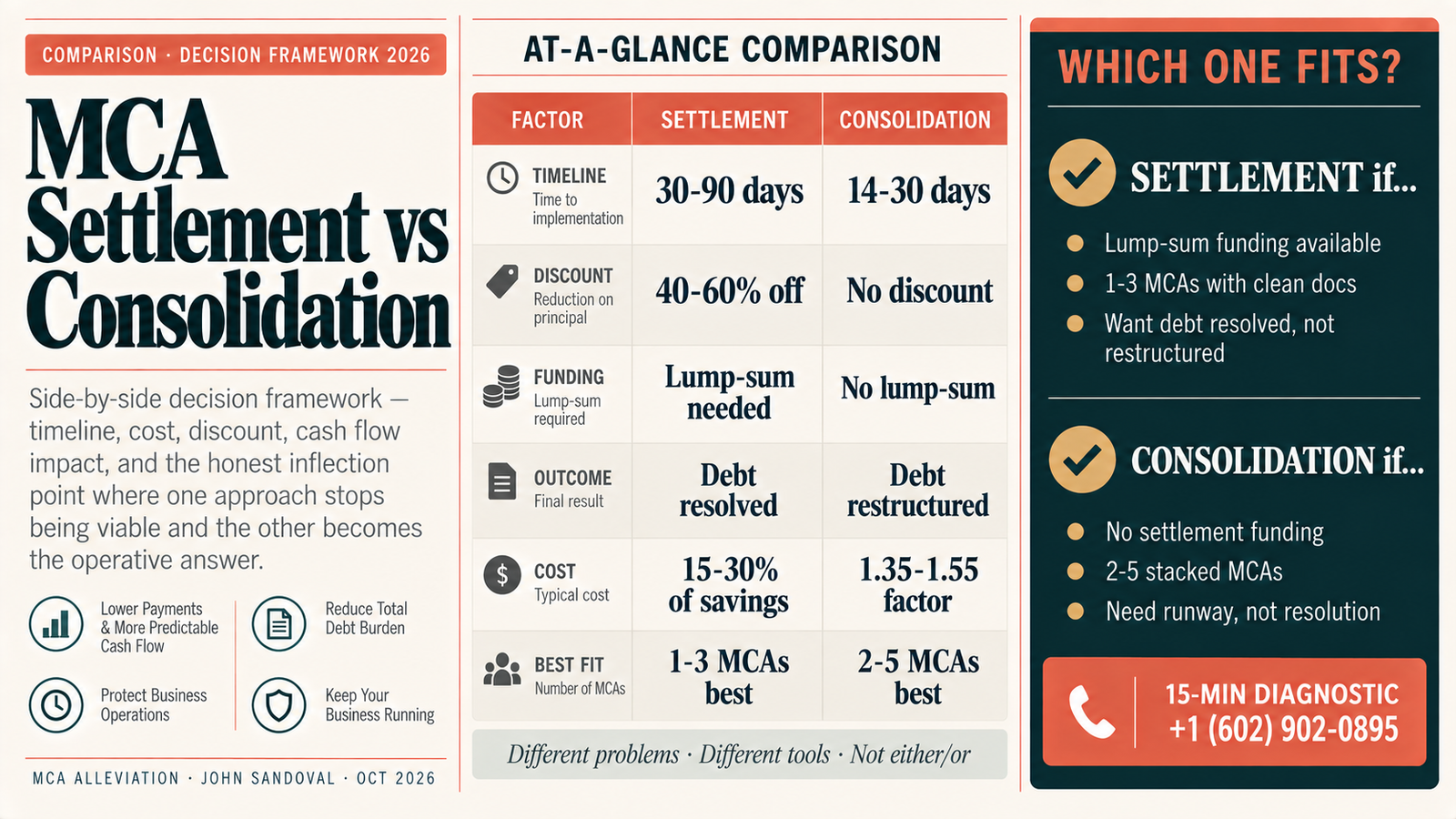
Settlement or consolidation? The diagnostic answers which fits your case.
The 15-minute confidential diagnostic walks the three fit questions — lump-sum funding availability, number of stacked MCAs, debt resolution vs runway preservation objective — and identifies whether settlement, reverse consolidation, or a sequenced combination of both pathways fits your specific case. No documents required to begin. Placement organization — not legal representation.
The question of settlement vs consolidation is one most owners end up answering backwards because they compare the two pathways on the wrong dimensions. "Which gives a bigger discount?" is the wrong question when one pathway offers no discount at all and the other requires lump-sum funding you may not have. "Which is faster?" is the wrong question when both are measured in weeks and the actual timing difference is often negligible compared to the enforcement timeline. The right question is: which problem is my business actually trying to solve — resolving the debt or restoring cash flow runway? That question has one right answer per case, and it's the question this guide is built around.
This guide walks what each pathway actually does mechanically, the honest side-by-side comparison across six dimensions (timeline, cost, discount, funding requirement, outcome type, fit criteria), the three-question decision framework for picking the right one, and the sequencing analysis for cases where both pathways combine. Read it in eight minutes, or call for a 15-minute diagnostic at +1 (602) 902-0895 and get the pathway identified for your specific case in real time.
MCA settlement and MCA reverse consolidation solve different problems using fundamentally different mechanics. Settlement is a lump-sum transaction that resolves the debt at a discount — 40 to 60 percent off remaining balance typical, 30 to 90 day timeline, 15 to 30 percent contingency fee on documented savings, lump-sum funding required at closing. Debt resolved at closing. Reverse consolidation is a cash flow restructuring that preserves the debt but reduces daily payment pressure — new consolidation advance takes aggregate daily payments while paying out to existing MCAs on a slower schedule, 14 to 30 day timeline, factor rate 1.35 to 1.55 on new advance, no settlement funding required. Debt restructured, not resolved. Three questions determine the fit: (1) lump-sum funding availability, (2) number of stacked MCAs, (3) debt resolution vs runway preservation objective. Same-day diagnostic +1 (602) 902-0895.
Settlement vs consolidation — the mechanical difference.
Before any comparison makes sense, both pathways need to be understood on their own terms. Settlement and reverse consolidation are often discussed interchangeably in sales conversations, which is where owners pick up the misconception that they're alternative ways to solve the same problem. They are not. They are different tools that solve different problems using fundamentally different mechanics.
MCA Settlement · Mechanics
Settlement is a lump-sum transaction that resolves the debt at a discount. The structure: the small business negotiates with each MCA funder individually, offers a lump-sum payment at a discount to the remaining balance, and the funder accepts in exchange for closing the file and releasing any UCC-1 position. Discount range is 40 to 60 percent off remaining balance when documented hardship and senior lien coordination are present (expanding to 30 to 40 cents on the dollar with coordinated senior UCC-1 leverage, compressing to 60 to 75 cents without senior lien or documented hardship).
Timeline runs 30 to 90 days from engagement to closing. The sequence: document gathering (bank statements, MCA contracts, hardship evidence) in week one, funder outreach and initial negotiation in weeks two through four, lump-sum coordination and offer structuring in weeks four through eight, closing documentation and funds transfer in weeks eight through twelve. Cost is typically 15 to 30 percent of documented savings on contingency, paid at closing. Lump-sum funding is required — settlement cannot close without the funds in hand to make the discounted payment. Debt is resolved at closing. The settled MCA position is released, the UCC-1 is terminated, and the matter is closed with respect to that funder.
What settlement does well: produces real debt reduction, cleans up the commercial credit profile over time, resolves the matter definitively with each settled funder. What settlement does poorly: requires lump-sum funding most owners in MCA crisis don't readily have, requires funder willingness to engage (funders that have filed suit often refuse to negotiate until the lawsuit is resolved), produces no immediate cash flow relief during the 30-90 day settlement window.
MCA Reverse Consolidation · Mechanics
Reverse consolidation is a cash flow restructuring that preserves the debt but reduces daily payment pressure. The structure: a new consolidation funder places an advance on top of the existing MCA stack. The consolidation funder takes the daily aggregate payment the business was making to all existing MCAs, holds enough to service the new consolidation advance on a slower schedule (typically weekly instead of daily, or longer-tenor instead of short-tenor), and pays out the remainder to the existing MCAs over an extended timeline.
Timeline runs 14 to 30 days from engagement to funding. The sequence: consolidation funder underwriting (bank statements, revenue verification, existing MCA documentation) in week one, factor rate finalization and term sheet in weeks one through two, funding and execution in weeks two through four. Cost is factor rate 1.35 to 1.55 on the new advance (effectively 35 to 55 percent cost of capital on the consolidation), not a contingency fee on savings. No lump-sum funding is required. The consolidation funds itself. Debt is restructured but not resolved. The underlying MCA balances remain outstanding; the restructuring changes the payment schedule but not the obligation.
What reverse consolidation does well: produces immediate cash flow relief (restores 40 to 60 percent of daily cash flow within 14 to 30 days), does not require lump-sum funding the business doesn't have, keeps the operation running through the restructuring. What reverse consolidation does poorly: adds a new MCA position to the commercial credit profile, carries meaningful cost of capital (factor rate 1.35 to 1.55 is expensive money), does not reduce the underlying debt, requires the business to have revenue sufficient to support the restructured aggregate payment even after the consolidation reduces it.
The real difference: resolution vs runway
The fundamental distinction is this: settlement eliminates debt at a cost (contingency fee plus lump-sum capital), while consolidation preserves debt in exchange for cash flow runway (factor rate cost of capital on a new advance). Owners whose businesses are fundamentally sound but temporarily cash-constrained typically fit consolidation better. Owners who need the MCA debt gone to move forward (fresh commercial credit relationship, SBA refinance, business sale) typically fit settlement better. The pathway choice depends on which problem the business is actually trying to solve — not which pathway sounds better in a sales conversation.
The diagnostic identifies which problem your business is actually trying to solve.
Need the debt resolved to move forward with a sale, refinance, or new credit relationship? Settlement path. Need cash flow restored to keep operating through a temporary revenue gap? Consolidation path. Both at different stages of the same case? Sequenced combination. The 15-minute diagnostic walks that analysis for your specific situation.
Settlement vs consolidation across six dimensions.
The honest comparison runs across six dimensions, not two or three. Each dimension matters differently depending on the specific case — a dimension that is decisive for one owner (lump-sum funding availability) may be irrelevant for another (if the owner has an SBA 7(a) refinance in flight that will fund settlement). The grid below is the complete comparison; the relative weight of each dimension depends on the case.
Settlement: 30 to 90 days from engagement to closing. Document gathering (week 1), funder negotiation (weeks 2-4), lump-sum coordination and offer structuring (weeks 4-8), closing documentation (weeks 8-12). Reverse consolidation: 14 to 30 days from engagement to funding. Consolidation funder underwriting (week 1), factor rate finalization (weeks 1-2), funding and execution (weeks 2-4). Difference: consolidation is roughly 2 to 3x faster than settlement, which matters when enforcement is active or when weekly cash flow pressure cannot wait 2-3 months for settlement to close.
Settlement: 15 to 30 percent contingency fee on documented savings, paid at closing. Example: $100,000 in savings generates $15,000 to $30,000 fee. No upfront fee, no fee if settlement does not close. Reverse consolidation: factor rate 1.35 to 1.55 on the new advance (effectively 35 to 55 percent cost of capital). Example: $200,000 consolidation at 1.45 factor rate requires $290,000 in total payback over the term. Difference: settlement cost is calculated on savings generated; consolidation cost is calculated on new advance amount. Different structures, not directly comparable as a percentage.
Settlement: 40 to 60 percent off remaining balance typical (expanding to 30 to 40 cents on the dollar with coordinated senior UCC-1 leverage, compressing to 60 to 75 cents without senior lien or documented hardship). The debt is reduced in dollar terms. Reverse consolidation: no discount on the underlying MCA balances. The debt is restructured — total amount owed does not change, only the payment schedule. In fact, total cost increases because of the factor rate on the consolidation advance. Difference: only settlement reduces the debt; consolidation preserves it.
Settlement: lump-sum funding required at closing. Sources include own cash, senior lender workout capacity, SBA 7(a) refinance proceeds, or asset sale proceeds. Settlement cannot close without the funds in hand. Reverse consolidation: no settlement funding required. The consolidation funds itself through the new advance. The business must have revenue sufficient to support the restructured aggregate payment, but no lump-sum capital is required at engagement. Difference: this is often the dispositive factor. Businesses without access to lump-sum funding cannot pursue settlement regardless of other factors; consolidation does not require this.
Settlement: debt resolved at closing. The MCA position is paid off at the settled amount, UCC-1 released, matter closed with respect to the funder. Commercial credit profile shows the position as resolved (improves over time as the resolved position ages off). Reverse consolidation: debt restructured, not resolved. The underlying MCA positions remain outstanding during the consolidation term, which can be 6 to 18 months depending on structure. A new consolidation position appears on the commercial credit profile. Difference: settlement produces a cleaner end state (debt gone); consolidation produces an interim state (debt restructured, final resolution deferred).
Settlement: best fit for 1 to 3 MCAs with documented hardship, lump-sum funding available, no active litigation, funder still willing to negotiate. Senior UCC-1 lienholder coordination expands discount range. Reverse consolidation: best fit for 2 to 5 stacked MCAs where the business is fundamentally sound once aggregate daily payment is reduced, no active litigation, revenue supports the restructured aggregate payment, goal is 6-12 months of runway. Difference: settlement fits concentrated MCA cases with capital available; consolidation fits stacked MCA cases without capital that need cash flow restoration.
The side-by-side above holds the dimensions constant to make the comparison direct. In practice, dimension weight varies — a business with abundant settlement funding and three stacked MCAs weighs funding availability lightly and fit criteria heavily. A business with no settlement funding and two MCAs weighs funding availability as the dispositive factor. The three-question decision framework in Section 03 walks the dimension weighting for your specific case. Same-day diagnostic at +1 (602) 902-0895.
The diagnostic weighs the six dimensions against your specific situation.
Lump-sum funding available or not? One MCA or four? Enforcement already filed or not yet? Senior lender posture supportive or hostile? Each answer changes which dimensions are decisive and which are secondary. The 15-minute diagnostic walks the dimension weighting for your case and identifies the operative pathway.
Three questions that pick the pathway.
The six-dimension comparison in Section 02 lays out the full picture; the three questions below compress that picture into a decision framework. Each question has a clear answer that points toward one pathway or the other, and in most cases the three answers point consistently to a single pathway — settlement, consolidation, or sequenced combination. When the three answers point in different directions, the inconsistency itself is diagnostic and typically indicates a case that needs the full 15-minute conversation to resolve.
What counts as lump-sum funding: own cash reserves, senior lender workout capacity (ABL draw, line of credit availability), SBA 7(a) refinance proceeds already in underwriting, equipment sale or asset liquidation proceeds, equity injection from investor or family. What doesn't count: expected revenue, pending receivables, verbal commitments from lenders. If lump-sum funding is not credibly in hand or in near-term pipeline, settlement is not viable regardless of other factors. This question is often the dispositive gate: if NO, the decision reduces to "consolidation vs Subchapter V" rather than "settlement vs consolidation." If YES, both pathways remain open and Questions 2 and 3 determine the choice.
Why MCA count matters: settlement requires individual funder negotiation, which scales linearly with position count — each additional MCA adds 10 to 30 days of settlement timeline, administrative load, and risk of one funder refusing to engage. At 4+ MCAs, the probability of all funders settling simultaneously drops materially, which can leave the business with some positions settled and others still active (worst-case outcome). Consolidation handles 2 to 5 stacked positions as a single transaction because the consolidation funder deals with the existing MCAs through a single aggregated payment stream. At 1 MCA: settlement almost always wins. At 4+ MCAs: consolidation or Subchapter V almost always wins. At 2-3 MCAs: both pathways are viable and Questions 1 and 3 determine the choice.
Resolution use cases: business is being sold or merged (buyer requires clean balance sheet at closing), SBA 7(a) refinance is in progress (SBA requires MCA debt resolved before refinance funds), owner is transitioning out and needs clean exit, new senior lender relationship requires MCA elimination as condition of credit facility. Runway use cases: business is fundamentally sound but temporarily cash-constrained (seasonal downturn, project delay, customer concentration event), revenue trajectory is improving and 6-12 months of restored cash flow would restore operating stability, specific operational initiatives (new contract, equipment acquisition, hiring) are expected to resolve the underlying cash pressure within the consolidation term. If resolution: settlement is the pathway. If runway: consolidation is the pathway. If both: sequencing — see Section 04.
Reading the three answers together: if all three point to settlement (funding YES, 1-3 MCAs, resolution objective), settlement is the clear pathway. If all three point to consolidation (funding NO, 2-5 MCAs, runway objective), consolidation is the clear pathway. If they split (funding YES but 4 MCAs, or funding NO but resolution needed), the case is either a sequencing scenario (see Section 04) or requires a different pathway entirely (Subchapter V bankruptcy). Same-day diagnostic at +1 (602) 902-0895 walks the three questions for your specific case.
The diagnostic walks all three questions in a single confidential conversation.
Lump-sum funding availability (yours, senior lender capacity, SBA refinance pipeline). MCA count and position type. Resolution vs runway objective tied to your specific business situation. Three answers that identify the pathway — or the sequencing scenario, or the Subchapter V signal — in 15 minutes.
Sequencing patterns when both pathways work together.
The decision framework in Section 03 reads as a binary — settlement OR consolidation — but in practice many cases combine both pathways through a sequencing strategy that uses one as a bridge to the other. The three sequencing patterns below cover substantially all combination cases. Pattern selection depends on which pathway starts first and what the ultimate end state should be.
Pattern 1: Consolidation first, settlement later (the runway bridge)
The most common sequencing pattern. The business starts with no lump-sum settlement funding available and 3 to 5 stacked MCAs creating daily aggregate payment pressure that cannot continue. Pathway choice: reverse consolidation first, which restores 40 to 60 percent of daily cash flow in 14 to 30 days and buys 6 to 12 months of runway. During the consolidation term, the business works on assembling settlement funding — SBA 7(a) refinance application, senior lender workout to free up ABL capacity, business improvement that generates retained earnings. At the end of the consolidation term (or earlier if settlement funding becomes available sooner), the consolidated MCA position is settled at a discount using the newly available lump-sum funding. End state: debt resolved at the consolidation term end, cash flow restored throughout the term. This pattern fits businesses that need runway now but have a credible path to settlement funding within 12 months.
Pattern 2: Partial settlement plus consolidation (the mixed pathway)
The second most common sequencing pattern. The business has partial settlement funding — enough to settle one or two of the most aggressive MCAs but not all of them — plus 3 to 5 stacked MCAs where the aggregate daily payment is unsustainable. Pathway choice: settle the one or two most aggressive positions (typically the ones with active enforcement, highest daily payment, or shortest tenor) using the available settlement funding, and simultaneously reverse-consolidate the remaining positions to reduce aggregate daily payment pressure. The combination produces both debt reduction (on the settled positions) and cash flow restoration (on the consolidated positions). End state: fewer MCA positions outstanding, lower aggregate payment, mixed resolution profile. This pattern fits businesses with partial settlement capacity that need both debt reduction AND cash flow runway rather than either alone.
Pattern 3: Consolidation as settlement bridge (the simultaneous close)
A less common but structurally elegant pattern. The business has 2 to 5 stacked MCAs and wants to settle them all simultaneously at a discount, but does not have the full lump-sum funding available in own cash. Pathway choice: a reverse consolidation funder underwrites the new advance specifically sized to fund a simultaneous lump-sum settlement of all underlying MCAs at a negotiated discount. The consolidation closes and the settlement closes on the same day — the new advance proceeds flow directly to the settling MCA funders at the discounted amounts. End state: multiple MCA positions converted into a single consolidated position at a settled aggregate amount, which is lower than the sum of the original positions would have been. This pattern requires careful coordination between the consolidation underwriter and the MCA funders, and typically only works when all MCA funders are willing to settle at discounts large enough to make the arithmetic work (discount savings must materially exceed the consolidation cost of capital).
When neither pathway fits: the Subchapter V signal
Some cases do not fit any of the three sequencing patterns because the facts foreclose both settlement and consolidation. Settlement is foreclosed when there is no lump-sum funding available in own cash, senior lender capacity, or SBA refinance pipeline, and no credible path to assemble it within 6 to 12 months. Consolidation is foreclosed when the business revenue is genuinely insufficient to support even the reduced aggregate payment, or when active enforcement (lawsuit filed, judgment entered, bank account frozen) has already closed the consolidation underwriting window because consolidation funders will not underwrite businesses in active litigation. When both are foreclosed, the operative answer is typically Subchapter V bankruptcy (11 U.S.C. §§ 1181-1195) — the automatic stay under 11 U.S.C. § 362 halts all enforcement, the cramdown mechanism binds non-consenting creditors through a confirmed plan, and the April 2026 debt ceiling of $3,424,000 in noncontingent liquidated debts fits most small business MCA cases. The Subchapter V signal is itself diagnostic: if the facts foreclose both out-of-court pathways, that forced foreclosure is itself the indication to escalate to the bankruptcy pathway.
The MCA Alleviation position: pathway choice is not binary. The three sequencing patterns above cover most combination cases, and the Subchapter V signal covers the cases where both out-of-court pathways are foreclosed. The 15-minute diagnostic identifies which pattern fits — settlement alone, consolidation alone, one of the three sequencing patterns, or Subchapter V as the operative answer. Same-day diagnostic at +1 (602) 902-0895.
Get the pathway identified — settlement, consolidation, sequenced, or Subchapter V signal.
Three fit questions (lump-sum funding, MCA count, resolution vs runway). Sequencing analysis if both pathways combine. Subchapter V signal if both out-of-court pathways are foreclosed. All of it in fifteen confidential minutes. Serving all 50 U.S. states from Phoenix.
Three things to remember before deciding.
Pick based on the problem — not based on which sounds better.
Settlement and reverse consolidation solve different problems using different mechanics. Settlement resolves debt at a discount (40 to 60 percent off typical) but requires lump-sum funding; consolidation restores cash flow runway (40 to 60 percent of daily payment restored) but preserves the underlying debt at a factor rate cost of capital. "Which sounds better" is the wrong question — if the business needs clean debt resolution to move forward (sale, SBA refinance, new credit relationship), settlement is the pathway even if cash flow is tight. If the business is fundamentally sound but temporarily cash-constrained, consolidation is the pathway even if debt reduction would be nice. Problem drives pathway. Same-day diagnostic at +1 (602) 902-0895.
Six dimensions · Three decisive questions.
The honest side-by-side comparison runs across six dimensions (timeline, cost structure, discount outcome, funding requirement, outcome type, fit criteria), and the three-question decision framework compresses that into the practical choice. Question 1 — do you have lump-sum funding available? Settlement requires YES, consolidation requires NO. Question 2 — how many MCAs are stacked? Settlement works best at 1-3 positions, consolidation at 2-5 positions. Question 3 — do you want debt resolved or runway restored? Settlement serves resolution, consolidation serves runway. Three consistent answers point to one pathway; split answers point to sequencing or the Subchapter V signal. Same-day diagnostic at +1 (602) 902-0895.
When both combine · Three sequencing patterns.
Many cases are not binary — they combine both pathways through sequencing. Pattern 1: consolidation first, settlement later (the runway bridge) — reverse consolidation restores immediate cash flow while settlement funding is assembled, settle the consolidated position at the end of the term. Pattern 2: partial settlement plus consolidation (the mixed pathway) — settle the one or two most aggressive MCAs with available funding, consolidate the rest for cash flow restoration. Pattern 3: consolidation as settlement bridge (the simultaneous close) — new consolidation advance funds a simultaneous lump-sum settlement of all underlying MCAs at a discount. When neither pathway fits (no lump-sum funding available, revenue insufficient for consolidation, or active enforcement has closed the window), Subchapter V bankruptcy is the operative answer. Same-day diagnostic at +1 (602) 902-0895.
Frequently asked questions.
What is the difference between MCA settlement and MCA consolidation?
MCA settlement and MCA reverse consolidation solve different problems using fundamentally different mechanics. Settlement is a lump-sum transaction that resolves the debt at a discount — the funder accepts a reduced payment (typically 40 to 60 percent of remaining balance) in exchange for closing the file. Timeline is 30 to 90 days, cost is 15 to 30 percent of documented savings on contingency, lump-sum funding is required. Debt is resolved at closing. Reverse consolidation is a cash flow restructuring that preserves the debt but reduces daily payment pressure — a new consolidation funder places an advance that takes aggregate daily payments and pays out to existing MCAs on a slower schedule. Timeline is 14 to 30 days, cost is factor rate 1.35 to 1.55 on the new advance, no settlement funding required. Debt is restructured but not resolved. Same-day diagnostic at +1 (602) 902-0895 identifies which fits.
Which is better for my business — MCA settlement or consolidation?
Neither is universally better — they solve different problems. Three questions determine the fit: (1) Do you have lump-sum funding available? Settlement requires a lump-sum payoff at closing (own cash, senior lender workout capacity, or SBA 7(a) refinance); consolidation does not. If no lump-sum funding is available, settlement is not viable regardless of other factors. (2) How many MCAs are stacked? Settlement works best for 1-3 MCA positions where each funder can be negotiated with individually; consolidation works best for 2-5 stacked positions where the daily aggregate payment is the primary problem. (3) Do you want debt resolved or runway restored? Settlement resolves the debt at a discount; consolidation preserves the debt but restores cash flow for 6-12 months. The right answer depends on which problem your business is actually trying to solve. Same-day diagnostic at +1 (602) 902-0895.
Does MCA reverse consolidation hurt my credit?
In most cases MCA activity, including reverse consolidation, is not reported to consumer credit bureaus because MCAs are structured as commercial purchases of future receivables rather than as business loans — commercial purchases of receivables typically are not credit-reportable transactions. However, MCA activity is reported through commercial credit bureaus (Experian Business, Dun & Bradstreet, Equifax Small Business) and appears on the business credit profile. Reverse consolidation adds a new MCA position to the commercial credit profile, which may affect the business's ability to obtain future commercial credit (bank lines of credit, SBA loans, equipment finance). Settlement, by contrast, typically resolves existing MCA positions and can improve commercial credit posture over time once the resolved positions age off the commercial profile. The commercial credit implications are case-specific — same-day diagnostic at +1 (602) 902-0895 walks the credit impact for your specific case.
Can I combine MCA settlement and consolidation in the same case?
Yes, and in many cases a sequenced combination produces better outcomes than either pathway alone. Three common sequencing patterns appear in cases that combine the two approaches. (1) Consolidation first, settlement later — reverse consolidation restores immediate cash flow and buys 6-12 months of runway, during which settlement funding is assembled (SBA 7(a) refinance, senior lender workout, business improvement) to settle the consolidated position at a discount at the end of the consolidation term. (2) Partial settlement plus consolidation — the most aggressive one or two MCAs are settled at a discount while the remaining positions are reverse-consolidated to reduce aggregate daily payment pressure, combining debt reduction with cash flow restoration. (3) Consolidation as settlement bridge — reverse consolidation funds the lump-sum payoff for simultaneous settlement of all underlying MCAs, converting multiple MCA positions into a single consolidated position at a settled amount. Same-day diagnostic at +1 (602) 902-0895.
What happens if neither MCA settlement nor consolidation fits my case?
If neither out-of-court pathway fits, the operative answer is typically Subchapter V bankruptcy (11 U.S.C. §§ 1181-1195). Settlement fails when there is no lump-sum funding available, when the funder has already filed suit and refuses to negotiate, or when four or more stacked positions with cross-default coordination make settlement structurally impossible. Consolidation fails when revenue is genuinely insufficient to support even the reduced aggregate payment, when the business needs full debt reduction rather than restructuring, or when active enforcement (lawsuit filed, judgment entered, bank account frozen) has already closed the consolidation window. In these cases, Subchapter V bankruptcy provides the automatic stay (11 U.S.C. § 362) that halts all enforcement, the cramdown mechanism that binds non-consenting creditors through a confirmed plan, and the April 2026 debt ceiling of $3,424,000 in noncontingent liquidated debts that fits most small business MCA cases. Same-day diagnostic at +1 (602) 902-0895 identifies when Subchapter V has become the operative answer.
How long does the MCA settlement vs consolidation decision take?
The decision itself takes 15 minutes with a diagnostic intake that walks the three fit questions (lump-sum funding availability, MCA count, debt resolution vs runway preservation objective) and reviews current enforcement status, senior lender posture, and business cash flow structure. Once the pathway is identified, settlement execution takes 30 to 90 days (document gathering, funder negotiation, lump-sum coordination, closing) while consolidation execution takes 14 to 30 days (consolidation underwriting, factor rate finalization, funding). Combined sequencing cases where consolidation is initiated first and settlement follows typically run 6 to 12 months end-to-end. Delaying the decision is the single most expensive move — cases that compress the 15-minute diagnostic to the first week of crisis consistently produce better outcomes than cases that reach decision point after enforcement escalation. Same-day intake at +1 (602) 902-0895 initiates the diagnostic.
Settlement or consolidation? The diagnostic answers which fits your case.
The confidential diagnostic walks the three fit questions — lump-sum funding availability, number of stacked MCAs, debt resolution vs runway preservation objective — and identifies whether settlement, reverse consolidation, a sequenced combination of both, or Subchapter V bankruptcy is the operative pathway for your specific case. Same-day, confidential, no documents required to begin, no obligation to engage anyone afterward. Serving all 50 U.S. states from Phoenix, Arizona. Placement organization — not legal representation.