MCA debt relief in California, with SB 1235 & DFPI protections on your side.
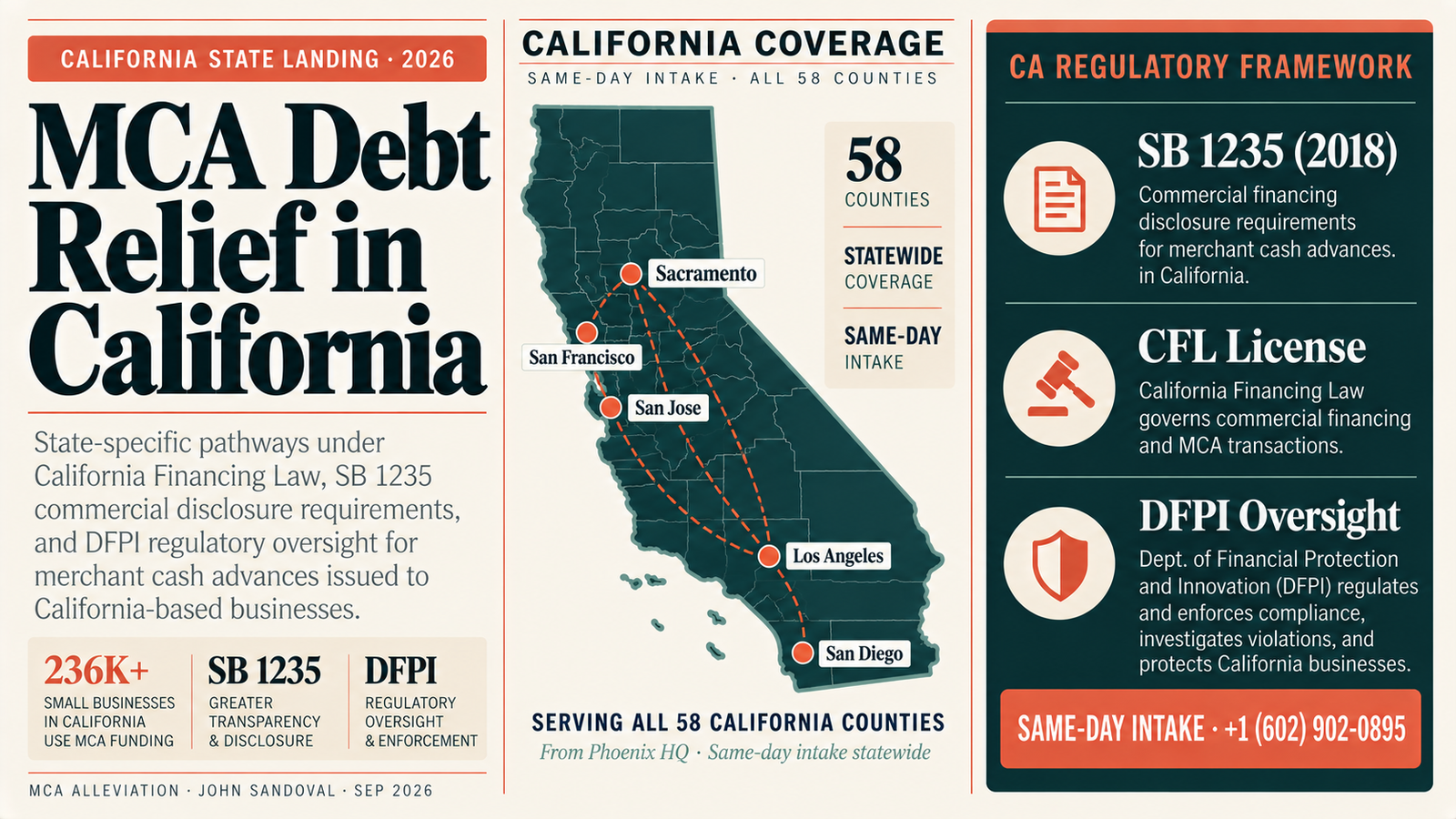
California is one of the most regulated MCA jurisdictions in the United States, and that regulation creates real defenses California-based businesses often don't know they have. Below is the state-specific framework — SB 1235 commercial financing disclosure requirements, California Financing Law licensing, DFPI regulatory oversight, and the choice-of-law defenses that apply when a New York MCA contract lands on a California business — plus the four relief pathways that work in Los Angeles, San Diego, San Francisco, San Jose, Sacramento, and every one of California's 58 counties. Same-day intake at +1 (602) 902-0895.
MCA case in California? See which state-specific defenses apply to you.
The 15-minute confidential intake reviews SB 1235 disclosure compliance of your MCA contracts, DFPI regulatory posture of your funder(s), choice-of-law defenses if a New York judgment is being domesticated in California, and which of the four relief pathways fits your specific case. No documents required to begin. Placement organization — not legal representation.
If your business is in California and an MCA is eating cash flow, the important thing to know is this: California-based businesses often have state-specific defenses that businesses in other states simply do not have. The California Financing Law licensing framework, the SB 1235 commercial financing disclosure requirements effective since December 2018 (with full APR-equivalent disclosure enforcement since 2022), and the California Department of Financial Protection and Innovation's active oversight since 2020 have created a regulatory environment that materially changes the analysis of MCA relief pathways compared to unregulated states.
This guide walks the California-specific framework, the four relief pathways adapted for California businesses, the top markets served (Los Angeles, San Diego, San Francisco, San Jose, Sacramento — plus every one of California's 58 counties), and the enforcement patterns California businesses should expect. Read it in eight minutes, or call for a same-day California-specific intake at +1 (602) 902-0895 and get the same analysis for your specific contracts in fifteen minutes.
MCA debt relief in California operates under a state-specific regulatory framework that creates defenses not available in most other states. SB 1235 (California Financial Code § 22800 et seq., effective December 2018, full APR-equivalent disclosure enforcement since 2022) requires commercial financing providers to disclose the amount financed, total dollar cost, term, payment method, and estimated APR to California businesses on financings under $500,000 — non-compliant contracts may be voidable. California Financing Law (CFL) licensing framework may create defenses against unlicensed MCA activity. DFPI regulatory oversight under the California Consumer Financial Protection Law of 2020 empowers investigation and enforcement against abusive commercial financing practices. Four relief pathways adapt to California: SB 1235 disclosure defense, reconciliation with California good-faith duty, settlement with California jurisdictional leverage, and Subchapter V bankruptcy in California federal districts. Same-day intake +1 (602) 902-0895.
Why California MCA cases are materially different.
California is one of a small handful of U.S. states that has built out an active commercial financing regulatory framework specifically covering merchant cash advances and related products. Four regulatory dimensions matter most for California-based businesses facing MCA debt, each of which can create defenses or leverage that businesses in unregulated states simply do not have.
SB 1235 · Commercial financing disclosure requirements
Senate Bill 1235, codified at California Financial Code § 22800 et seq., became effective in December 2018 and requires providers of commercial financing under $500,000 issued to California-based businesses to make specific disclosures at the point of financing. The disclosures include the amount financed, the total dollar cost of the financing, the term or estimated term, the method and frequency of payments, prepayment policies, and — under full enforcement of the DFPI's final regulations since 2022 — an estimated annualized percentage rate (APR) or annualized rate equivalent that allows the business to compare the true cost of the financing against alternatives. Non-compliance with the SB 1235 disclosure requirements can create defenses against enforcement of the underlying MCA contract, potentially including voidability, damages under state consumer protection frameworks, and standing for DFPI enforcement action against the provider.
California Financing Law (CFL) · Licensing framework
The California Financing Law, codified at California Financial Code § 22000 et seq., requires certain lenders operating in California to hold a CFL license issued by the DFPI. The scope of MCA activity that requires CFL licensing has been the subject of substantial regulatory and litigation activity, particularly as MCA products increasingly overlap with characteristics of true loans. Where an MCA provider is operating without a required CFL license, its enforcement of contracts against California-based businesses may face defenses grounded in the licensing requirement. A California-experienced practitioner can assess whether a specific MCA provider's licensing status creates a defense on your case.
DFPI · Regulatory oversight and enforcement
The California Department of Financial Protection and Innovation (DFPI) is California's primary financial services regulator, restructured and empowered under the California Consumer Financial Protection Law of 2020 (Assembly Bill 1864) to oversee commercial financing providers, investigate abusive practices, and issue enforcement actions against non-compliant lenders. DFPI enforcement actions against MCA providers have accelerated since 2022, targeting non-compliant SB 1235 disclosures, unlicensed lending activity under the CFL framework, and unfair or deceptive practices under California consumer protection statutes. Where DFPI has an open investigation or resolved enforcement action against your MCA provider, that regulatory posture is directly relevant to your defense analysis.
California constitutional usury cap · Article XV Section 1
The California Constitution's Article XV Section 1 establishes usury caps for loans made in California, with certain statutory exceptions. Whether an MCA contract is subject to the usury cap depends on whether the contract is properly analyzed as a true purchase of receivables (typically outside usury caps) or as a disguised loan (typically subject to usury analysis). California's approach to the "true nature" analysis has been shaped by both state case law and by federal cases interpreting California law. Where the MCA's structure, reconciliation provisions, or economic terms suggest it functions as a loan rather than a true purchase, usury reclassification can be a viable defense with material impact on the enforceable balance.
Choice-of-law defenses · When New York MCA contracts hit California businesses
MCA contracts almost universally designate New York as the governing law and forum, meaning enforcement typically begins in New York courts even where the borrower's business operates in California. California businesses can nonetheless assert choice-of-law defenses under California public policy, particularly where the New York contract's enforcement would violate California's SB 1235 disclosure requirements, CFL licensing framework, or DFPI regulatory oversight. Additionally, once a New York judgment is domesticated in California under the Uniform Enforcement of Foreign Judgments Act (California CCP § 1710.10 et seq.), procedural challenges to the domestication and California-specific defenses to enforcement (bank levy, personal guarantor collection) become available.
The honest read: California-based businesses have real, state-specific defenses that businesses in unregulated states do not have. Whether those defenses apply to your specific case depends on when the MCA was funded, which regulatory version was in effect at that time, and how the contract's choice-of-law provision interacts with California public policy. Same-day intake at +1 (602) 902-0895 walks that analysis for your specific contracts.
The intake walks SB 1235, CFL, and DFPI analysis for your specific contracts.
MCA funded before or after December 2018? Full APR disclosure or partial? Funder holds CFL license or operating unlicensed? DFPI enforcement history? Each factor changes which California defenses are viable. The 15-minute intake walks that analysis and identifies the operative path.
4 relief pathways adapted for California businesses.
Every MCA relief pathway operates differently in California than in unregulated states because California's regulatory framework changes both the leverage in negotiation and the defenses available in litigation. The four pathways below are the standard MCA relief options adapted for the California-specific framework — SB 1235 disclosure compliance, CFL licensing analysis, DFPI enforcement posture, and choice-of-law considerations for New York MCA contracts.
This pathway is genuinely California-specific and has no counterpart in most other states. Where an MCA contract issued to a California-based business under $500,000 fails to comply with SB 1235 disclosure requirements (California Financial Code § 22800 et seq.) — missing amount financed, total dollar cost, term, payment method, or estimated APR disclosures required at the point of financing — the non-compliance may render the contract voidable or unenforceable, and may create standing for DFPI enforcement action against the provider. This pathway is most powerful for MCAs funded after full DFPI regulation enforcement in 2022, and for MCAs from providers with existing DFPI enforcement history. The pathway requires careful contract review to identify specific disclosure gaps. Same-day intake at +1 (602) 902-0895.
Most MCA contracts include a reconciliation clause requiring the funder to adjust daily or weekly payments when actual revenue drops. California law adds a general duty of good faith and fair dealing (California Civil Code § 1655 and related case law) that applies to every contract governed by California law and, in some cases, to contracts with California parties even where choice-of-law provisions designate other jurisdictions. This overlay can strengthen a reconciliation request from a California business by grounding it in both the contract's express reconciliation clause and California's implied duty of good-faith performance. The pathway is fastest of the four (7 to 30 days), lowest cost, and best suited for early-crisis single-MCA or two-MCA California cases with documented revenue declines.
Out-of-court settlement negotiation for California businesses can leverage California-specific factors that increase the funder's incentive to settle rather than litigate. The factors include: SB 1235 disclosure defense availability that undermines the funder's projected recovery; DFPI regulatory posture where the funder has open investigations or resolved enforcement actions; California public policy defenses to choice-of-law provisions in the underlying contract; and the practical cost to the funder of pursuing enforcement in a California court with California defenses on the table. Typical settlement discount range for California cases with viable state-specific defenses is 40 to 60 percent on remaining balance, expanding to 30 to 40 cents on the dollar when SB 1235 non-compliance is documented alongside senior UCC-1 lien coordination.
Subchapter V bankruptcy for California businesses is filed in the federal bankruptcy court for the appropriate California district — Central (Los Angeles metro), Eastern (Sacramento and Central Valley), Northern (San Francisco Bay Area including Oakland, San Jose), or Southern (San Diego and Imperial County). Filing triggers 11 U.S.C. § 362 automatic stay, halting every enforcement action including active bank account freezes and California-domesticated New York judgments. The Subchapter V debt ceiling as of April 2026 is $3,424,000 in noncontingent liquidated debts. California districts have well-established Subchapter V practice with experienced trustees and confirmed plans across the state. The pathway fits when out-of-court settlement is not viable, when multiple MCAs have coordinated cross-default enforcement, or when a domesticated New York judgment threatens payroll timing.
The four pathways are not exclusive — many California MCA cases combine two or more (SB 1235 disclosure defense as leverage for settlement negotiation, or reconciliation request as a preliminary step before Subchapter V filing). Which combination fits depends on the specific California regulatory posture of your MCA contracts, your business's cash flow position, and the enforcement status at time of intake. Same-day California intake at +1 (602) 902-0895 walks that assessment.
The intake places you with California-admitted counsel where your case lives.
Central District (LA), Eastern (Sacramento/Central Valley), Northern (Bay Area), Southern (San Diego). Each California federal district and state court jurisdiction has counsel specifically experienced with California SB 1235 defenses, DFPI enforcement patterns, and Subchapter V California practice.
Top 5 California markets served for MCA relief.
MCA Alleviation serves small business owners in every one of California's 58 counties, coordinating placement with California-experienced counsel across the state and federal court jurisdictions. The five markets below account for the majority of California MCA case volume, each with distinct industry mixes, regulatory patterns, and typical case profiles. Every California market is served — the list below is descriptive of case volume, not exclusive of coverage.
Coverage: Greater Los Angeles including LA County, Orange County (Anaheim, Irvine, Santa Ana), and Ventura County. Case profile: highest California volume, particularly for restaurants and hospitality post-2020 industry disruption; MCA stacking is more common in LA than in other California markets due to industry concentration and the density of MCA brokers operating in the region. Court venue: most Subchapter V filings in the U.S. Bankruptcy Court for the Central District of California (Los Angeles, Riverside, Santa Ana, Woodland Hills divisions); state court MCA enforcement typically in Los Angeles Superior Court or the county Superior Court where the business is registered.
Coverage: San Diego County and Imperial County, including San Diego, Chula Vista, Oceanside, and Escondido. Case profile: growing MCA case volume driven by biotech and healthcare startup concentration; tourism and hospitality cases spiked post-2020 and remain elevated. Defense contractor MCA cases are less common but structurally distinct due to federal contracting compliance considerations. Court venue: Subchapter V filings in U.S. Bankruptcy Court for the Southern District of California (San Diego division); state MCA enforcement typically in San Diego Superior Court.
Coverage: San Francisco, Oakland, Berkeley, and Marin County. Case profile: lower case volume than LA but higher average MCA balances given industry concentration; tech-adjacent professional services firms represent a growing share of Bay Area MCA cases. Bay Area MCA cases tend to intersect with senior venture debt facilities or SBA-guaranteed loans more often than other California markets. Court venue: Subchapter V filings in U.S. Bankruptcy Court for the Northern District of California (San Francisco, Oakland, San Jose divisions); state MCA enforcement typically in San Francisco Superior Court or Alameda County Superior Court.
Coverage: Santa Clara County (San Jose, Sunnyvale, Mountain View, Santa Clara) and southern San Mateo County. Case profile: Silicon Valley MCA cases skew toward hardware manufacturing, contract engineering, and services companies serving the tech ecosystem — typically higher-balance cases with more complex senior lender relationships (venture debt, SBA 7(a), commercial bank lines). Tech services firms in this market face distinct SB 1235 analysis where MCAs were structured around anticipated contract revenue. Court venue: U.S. Bankruptcy Court for the Northern District of California, San Jose division; state MCA enforcement typically in Santa Clara County Superior Court.
Coverage: Sacramento, Fresno, Stockton, Modesto, Bakersfield, and the broader Central Valley. Case profile: construction and government contractor MCA cases dominate the Sacramento market; agriculture-adjacent businesses (packing, distribution, equipment) are more common in the Central Valley. Cases in this region tend to have longer-tenor MCA contracts and more predictable seasonal revenue patterns, which affects both reconciliation viability and settlement negotiation posture. Court venue: U.S. Bankruptcy Court for the Eastern District of California (Sacramento, Fresno, Modesto divisions); state MCA enforcement typically in Sacramento or Fresno County Superior Court depending on business location.
Beyond the five markets above, MCA Alleviation serves every California county — from Humboldt in the far north through Kern in the south, including coastal markets (Santa Barbara, San Luis Obispo, Monterey), the Inland Empire (Riverside, San Bernardino), and rural agricultural counties. Same-day California intake at +1 (602) 902-0895 identifies the appropriate federal district and state court venue for your specific case.
From LA to Sacramento — the intake identifies your federal district and state venue.
Central, Eastern, Northern, or Southern federal bankruptcy district. Los Angeles Superior, San Francisco Superior, San Diego Superior, Alameda Superior, or the county Superior Court where your business is registered. Same-day intake identifies venue and initiates placement with California-experienced counsel.
California regulatory triggers and enforcement posture.
Beyond the four relief pathways, California has active regulatory triggers and enforcement patterns that shape how MCA cases are analyzed in the state. Three regulatory dimensions recur across California MCA cases with sufficient frequency to warrant specific attention when evaluating your options.
Trigger 1: SB 1235 disclosure non-compliance findings (2022–2026)
Since the DFPI's final regulations under SB 1235 took full effect in 2022, the department has issued findings against multiple MCA providers for non-compliance with the disclosure requirements. Findings have targeted missing APR-equivalent disclosures, incomplete total-cost-of-financing disclosures, and disclosures that did not conform to the required format. Where a specific MCA provider has been the subject of a DFPI SB 1235 non-compliance finding, that finding is directly relevant to a defense on your contract if the contract was funded during the finding's relevant period. Cross-referencing the DFPI enforcement record against your specific MCA funder is a standard first step in California-specific intake.
Trigger 2: DFPI enforcement actions against unlicensed lending activity
Concurrent with the SB 1235 disclosure regime, the DFPI has issued enforcement actions against MCA providers operating without required California Financing Law (CFL) licensing. The scope of MCA activity that requires CFL licensing depends on the specific product structure and has been the subject of ongoing regulatory clarification. Where a specific MCA provider has been found to be operating without required CFL licensing, that finding creates a defensive posture on enforcement of that provider's contracts against California-based businesses. Same-day California intake includes review of the MCA provider's licensing status against the CFL requirements.
Trigger 3: California-specific jurisdictional wins on choice-of-law defenses
California case law has developed choice-of-law analysis that, in specific fact patterns, allows California-based businesses to challenge enforcement of MCA contracts governed by New York law on California public policy grounds. The threshold analysis considers whether the contract's enforcement would violate California's fundamental public policy — including the SB 1235 disclosure regime, the CFL licensing framework, or California's approach to true-nature analysis for disguised loans under the constitutional usury cap. Cases where California-based businesses have successfully asserted choice-of-law defenses to New York MCA judgments provide precedent for similar defenses in the current regulatory environment, particularly where the underlying New York contract lacks SB 1235-equivalent disclosures.
The honest read: California's regulatory framework is not merely additive to standard MCA relief analysis — it can materially change which pathway is optimal and which defenses are viable. A California business owner evaluating MCA relief without factoring in SB 1235, CFL licensing, DFPI enforcement history, and California choice-of-law defenses is leaving meaningful leverage unused. Same-day intake at +1 (602) 902-0895 integrates the California framework into the analysis from the first fifteen minutes.
Get the California-specific analysis for your specific MCA contracts.
SB 1235 disclosure compliance review. CFL licensing status of your funder(s). DFPI enforcement history cross-reference. Choice-of-law analysis if a New York judgment is being domesticated in California. All four in fifteen minutes. Serving every California county from Phoenix HQ.
Three things every California business owner should know.
California businesses have state-specific defenses most other states do not.
California's regulatory framework — SB 1235 commercial financing disclosure requirements (California Financial Code § 22800 et seq., effective December 2018, full APR-equivalent disclosure enforcement since 2022), California Financing Law (CFL) licensing framework, DFPI regulatory oversight under the California Consumer Financial Protection Law of 2020, and the constitutional usury cap analysis under Article XV Section 1 — creates defenses that businesses in unregulated states simply do not have. A California business owner evaluating MCA relief without factoring in these four regulatory dimensions is leaving meaningful leverage unused. Same-day California intake at +1 (602) 902-0895 walks the analysis in the first fifteen minutes.
Four relief pathways adapt to the California framework.
The four standard MCA relief pathways all operate differently in California. (1) SB 1235 disclosure defense is genuinely California-specific — where an MCA contract issued to a California business fails to comply with disclosure requirements, the non-compliance may render the contract voidable. (2) Reconciliation request under California good-faith duty (Cal. Civ. Code § 1655) can strengthen a California business's reconciliation position beyond the contract's express clause. (3) Settlement negotiation with California jurisdictional leverage — SB 1235 defense availability, DFPI enforcement posture, and California public policy defenses to choice-of-law provisions all increase funder incentive to settle. (4) Subchapter V bankruptcy in California federal districts (Central, Eastern, Northern, Southern) invokes 11 U.S.C. § 362 automatic stay with April 2026 $3,424,000 debt ceiling. Same-day intake identifies which combination fits.
Every California county served · placement with California-experienced counsel.
MCA Alleviation serves all 58 California counties, with top case volume markets in Los Angeles (Central District, restaurants + retail + hospitality), San Diego (Southern District, biotech + tourism + healthcare), San Francisco Bay Area (Northern District, tech + professional services), San Jose Silicon Valley (Northern District, technology + manufacturing), and Sacramento & Central Valley (Eastern District, construction + government contractors + agriculture-adjacent). Every California federal bankruptcy district and state court jurisdiction has counsel specifically experienced with California SB 1235 defenses, DFPI enforcement patterns, and Subchapter V California practice. Placement organization headquartered in Phoenix Arizona, not law firm — coordination with California-admitted counsel in the client's jurisdiction. Same-day California intake +1 (602) 902-0895.
Frequently asked questions.
What makes MCA debt relief different in California?
California is one of the most regulated MCA jurisdictions in the United States, which creates distinct relief pathways not available in most other states. Four regulatory dimensions matter most: (1) SB 1235 commercial financing disclosure requirements, codified at California Financial Code § 22800 et seq., effective December 2018 with full APR-equivalent disclosure enforcement since 2022, requires MCA providers to disclose the estimated APR and total dollar cost of financing to California businesses — non-compliant contracts may be voidable. (2) California Financing Law (CFL) licensing framework requires certain lenders operating in California to hold a CFL license issued by DFPI. (3) DFPI regulatory oversight under the California Consumer Financial Protection Law of 2020 empowers investigation of abusive commercial financing practices. (4) California constitutional usury cap analysis (Article XV Section 1) can be relevant in MCA reclassification cases. Same-day intake at +1 (602) 902-0895.
Does SB 1235 give California businesses a defense against MCA collection?
Potentially, depending on facts. SB 1235 requires providers of commercial financing under $500,000 issued to California-based businesses to disclose amount financed, total dollar cost, term, payment method, prepayment policies, and estimated APR or annualized rate equivalent. Non-compliance can create defenses against enforcement of the underlying MCA contract, potentially including voidability or damages under state consumer protection frameworks. Whether SB 1235 provides a viable defense depends on when the MCA was funded, whether the disclosures were compliant with the version of the regulation in effect at that time, and whether the underlying contract's choice-of-law provision (typically New York) can be challenged on California public policy grounds. Same-day intake at +1 (602) 902-0895 walks the SB 1235 analysis for your specific contracts.
Can a New York MCA lawsuit be enforced against my California business?
Yes, in most cases, but California businesses often have jurisdictional and choice-of-law defenses that materially change the enforcement posture. MCA contracts almost universally designate New York as the governing law and forum, meaning the initial lawsuit is filed in New York state or federal court. A New York judgment can be domesticated in California under the Uniform Enforcement of Foreign Judgments Act (California CCP § 1710.10 et seq.) to enable enforcement — bank account levies, wage garnishment against personal guarantors. However, three California-specific defenses can be asserted: (1) SB 1235 non-compliance may render the underlying contract voidable; (2) California public policy defense against enforcement of contracts that violate California consumer or commercial financing protections; (3) procedural challenges to the domestication itself. Same-day intake at +1 (602) 902-0895.
What California cities does MCA Alleviation serve?
MCA Alleviation serves small business owners in every one of California's 58 counties, with top markets by case volume being Los Angeles (restaurants, retail, hospitality, professional services), San Diego (biotech, tourism, defense contractors, healthcare), San Francisco (tech companies, professional services, financial firms), San Jose and Silicon Valley (technology, engineering, manufacturing), and Sacramento (government contractors, construction, agriculture-adjacent businesses). Secondary markets include Orange County (Anaheim, Irvine, Santa Ana), the Inland Empire (Riverside, San Bernardino), Alameda County (Oakland, Fremont), Fresno and the Central Valley, and coastal markets from Santa Barbara through Monterey. Placement organization headquartered in Phoenix, Arizona — case placement is with California-experienced counsel in the client's federal bankruptcy district or state court jurisdiction. Same-day intake at +1 (602) 902-0895.
Is DFPI regulation relevant to my California MCA case?
Yes, in most cases involving unlicensed or unregistered MCA providers. The California Department of Financial Protection and Innovation (DFPI) is the state's primary financial services regulator, empowered under the California Consumer Financial Protection Law of 2020 to oversee commercial financing providers, investigate abusive practices, and issue enforcement actions against non-compliant lenders. DFPI enforcement actions against MCA providers have accelerated since 2022, with actions targeting non-compliant SB 1235 disclosures, unlicensed lending activity under the California Financing Law, and unfair or deceptive practices under California consumer protection frameworks. Whether DFPI regulatory posture is relevant to your specific case depends on the MCA provider's licensing status, its disclosure compliance, and whether any DFPI enforcement action is pending or resolved against the provider.
How fast can MCA Alleviation help a California business owner?
MCA Alleviation offers same-day intake at +1 (602) 902-0895, Monday through Saturday 8 AM to 6 PM Pacific — the same time zone as California. The initial 15-minute confidential conversation reviews the California-based business's MCA positions, senior lender relationships, current enforcement status (including whether a New York MCA lawsuit has been filed or domesticated in California), SB 1235 disclosure compliance of the underlying contracts, and available California-specific defenses. No documents required to begin the call. If the situation is time-critical (bank account already frozen after a domesticated New York judgment, California lawsuit already served, or California state or federal enforcement action pending), the intake can escalate directly to placement with California-experienced counsel within the same business day. Placement organization, not law firm.
California business facing MCA debt? Get the state-specific analysis in fifteen minutes.
The confidential intake reviews SB 1235 disclosure compliance of your MCA contracts, DFPI regulatory posture of your funder(s), choice-of-law defenses if a New York judgment is being domesticated in California, and which of the four relief pathways fits your specific case. Same-day, confidential, no documents required to begin, no obligation to engage anyone afterward. Serving all 58 California counties from Phoenix, Arizona. Placement organization — not legal representation.