MCA froze your bank account? Here's the 24-hour recovery playbook.
If a restraining notice was served on your bank this morning, payroll is going to fail this week and every recurring ACH is going to bounce. Below is the hour-by-hour countdown of what happens next, the five moves that matter in the first 24 hours, and the two recovery pathways — motion to vacate in state court, or Subchapter V bankruptcy with the automatic stay — that actually unfreeze the account within 24 to 48 hours. Same-day emergency intake at +1 (602) 902-0895.
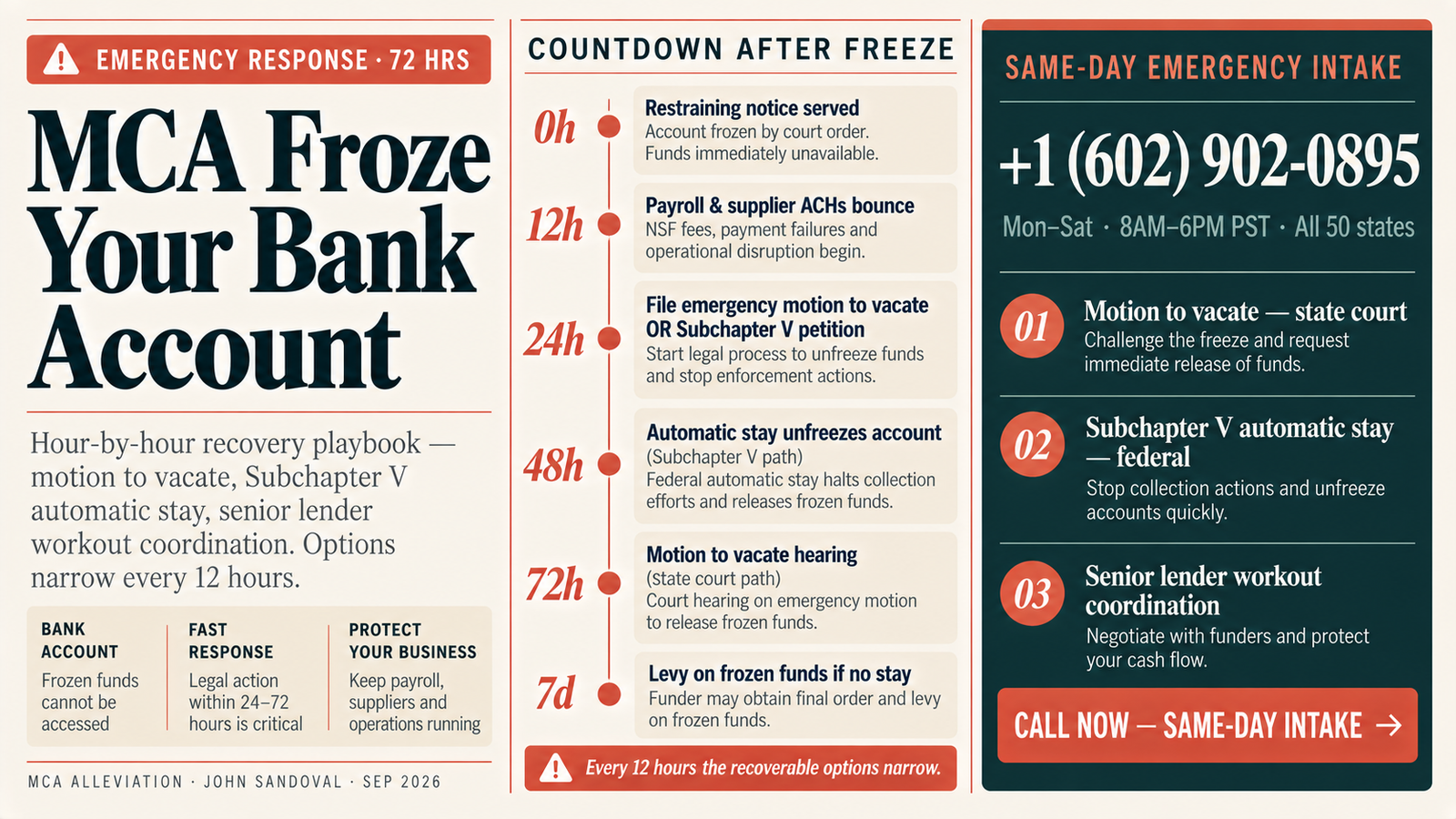
If the freeze already happened, every 12 hours matters.
The 15-minute emergency intake identifies which recovery pathway fits your case in real time — motion to vacate (5-10 business days) or Subchapter V automatic stay (24-48 hours). No documents required to begin. No obligation. Placement organization — not legal representation.
If you're reading this at 9am and the freeze hit at 8am, the most important thing to know is this: the next 24 hours will decide whether payroll processes this Friday. The MCA funder's restraining notice under CPLR § 5222 or your state's equivalent has locked every dollar in your business account up to the judgment amount, and every recurring ACH — payroll, supplier payments, vendor debits — will bounce over the next 48 to 72 hours unless the freeze is lifted by an intervening legal action.
This guide is short on purpose. It gives you the honest hour-by-hour countdown of what happens after the freeze, the five moves that matter in the first 24 hours (including one you probably want to do that would make everything worse), and the two recovery pathways — motion to vacate the restraining notice, or Subchapter V bankruptcy invoking the 11 U.S.C. § 362 automatic stay — that actually unfreeze the account. Read it in seven minutes. Or skip straight to the emergency line and get the same information in fifteen minutes from someone reviewing your specific case.
If MCA froze your bank account, two recovery pathways can unfreeze it. Subchapter V bankruptcy petition (11 U.S.C. § 362 automatic stay) unfreezes the account within 24 to 48 hours of filing — the stay is automatic on the day of filing and the bank must release the freeze on service. Motion to vacate the restraining notice (CPLR § 5240 in New York, equivalent state rules elsewhere) typically produces a hearing in 5 to 10 business days with the freeze released immediately on a favorable order. Do NOT move money between accounts (11 U.S.C. § 548 fraudulent transfer exposure, plus contempt risk on the underlying restraining order). Same-day emergency intake at +1 (602) 902-0895.
What happens in the hours after the freeze.
Every freeze scenario is different, but the pattern below is what unfolds in roughly 85 percent of MCA restraining notice cases. Timelines compress substantially when the freeze includes multiple accounts (some judgment creditors serve restraining notices on every bank they can identify from your ACH history), when the account holds the payroll balance for a Friday cycle, or when the judgment includes joint personal guarantor accounts. Assume the compressed timeline until proven otherwise.
Hour 0: Restraining notice served, account frozen
The MCA funder's counsel serves a restraining notice on your bank under CPLR § 5222 (New York), Texas Rule of Civil Procedure 663a, California CCP § 700.140, or the equivalent state rule. The bank is prohibited from releasing funds up to the judgment amount plus interest and costs, typically the entire account balance in most MCA judgment scenarios. Outbound activity stops immediately. Inbound deposits continue but are captured by the freeze. You may not be notified by the bank for 12 to 24 hours; often the first sign is a bounced payment or a customer call about a rejected wire.
Hour 12: Payroll and supplier ACH cascade begins
Every recurring ACH tied to the frozen account begins to fail. Payroll processors (Gusto, ADP, Paychex, QuickBooks Payroll) attempt the withdrawal — it bounces. Supplier ACHs bounce. Vendor debits bounce. Each bounce generates an NSF fee from your bank (typically $25 to $35) and, in many cases, a return fee from the receiving side (typically $15 to $50). By hour 24, aggregate NSF exposure can reach $500 to $2,000 depending on ACH volume, and secondary consequences begin — payroll processor may suspend service, supplier may put your account on credit hold, vendors may cancel scheduled deliveries.
Hour 24: File motion to vacate OR Subchapter V petition
This is the decision point. Either an emergency motion to vacate the restraining notice is filed in the court that entered the underlying judgment (state court, typically county civil court or supreme court depending on jurisdiction), or a Subchapter V bankruptcy petition is filed in the federal bankruptcy court for your district. Both actions can be initiated within 24 hours of the freeze in most cases. The motion to vacate keeps the case in state court and preserves the ability to challenge the underlying judgment on the merits; the Subchapter V petition immediately invokes 11 U.S.C. § 362 automatic stay, halting the freeze and every other enforcement action, but commits the case to a formal reorganization process. Which fits depends on multiple case-specific factors covered in Section 03.
Hour 48: Automatic stay unfreezes account (Subchapter V path)
If the Subchapter V path was chosen, the account should be unfrozen by hour 48 in most cases. The automatic stay is effective the day of filing under 11 U.S.C. § 362(a). Once the petition is served on the restraining creditor (and, in most cases, on the bank holding the frozen account), the bank must release the freeze. Practical execution takes 24 to 48 hours because the bank's legal department needs to process the served notice. Payroll can be scheduled once the account is released, though the intervening payroll cycle may already have missed.
Hour 72: Motion to vacate hearing (state court path)
If the motion to vacate path was chosen, the emergency motion is typically calendared for hearing within 5 to 10 business days depending on jurisdiction. In New York, CPLR § 5240 allows the court to modify, suspend, or vacate the restraining notice on a showing of extraordinary circumstances. Grounds commonly asserted include: defective service of the original judgment, defective confession of judgment (particularly in jurisdictions where COJ statutes have narrowed), unconscionability of the underlying MCA contract, or hardship (payroll interruption, supplier interruption, business viability threatened). A favorable ruling releases the freeze immediately. An unfavorable ruling leaves the freeze in place and typically requires pivoting to the Subchapter V pathway.
Day 7: Levy on frozen funds absent stay
If neither pathway has been initiated within 7 days of the freeze, the restraining creditor typically converts the restraining notice to a levy — meaning the frozen funds are actually transferred out of your account and to the creditor. In New York and most states, the levy requires an additional court-authorized order (execution) which typically takes 7 to 14 days after the freeze to obtain and serve. Once the levy is executed, recovery of the transferred funds requires an adversary proceeding in bankruptcy court (if a stay is subsequently filed) or a motion in state court challenging the levy — both substantially harder than preventing the levy in the first place.
The honest read: the recovery window closes fast, and every 12 hours the operative options narrow. Same-day emergency intake at +1 (602) 902-0895 identifies which pathway fits before the levy converts the situation from recoverable to painful.
The 15-minute emergency intake identifies which pathway still fits your specific hour.
Hour 12 with payroll bouncing? Hour 24 with the pathway decision pending? Day 5 with a hearing calendared? Each hour maps to a different operative move. The emergency intake walks that assessment and routes to the pathway that fits before the levy converts recoverable into painful. No documents required to begin.
5 things to do in the first 24 hours.
These five actions are ordered by consequence, not convenience. Doing them in this order — even if you don't do all five — meaningfully changes what recovery options remain viable 48 hours from now. Skipping any of them, particularly items 1 and 2, is what converts a recoverable freeze into a levy that requires substantially harder recovery work.
The instinct to shelter funds by transferring them to a personal account, a spouse's account, or a secondary business account is the single most destructive move at this stage. Transfers made while insolvent or with intent to hinder creditors are voidable under 11 U.S.C. § 548 constructive fraudulent transfer and state analogs (New York DCL, Uniform Voidable Transactions Act adopted in most states); the transferee can be personally liable for the transferred amount. Additionally, movement during the freeze period can constitute contempt of the underlying restraining order, exposing the owner to sanctions on top of the underlying debt. Whatever the balance is when the freeze hits, leave it exactly where it is until the pathway (motion to vacate or Subchapter V) is initiated.
The Subchapter V automatic stay pathway is the fastest recovery route (24 to 48 hours to account release) and can only be initiated by a filed bankruptcy petition, which requires an attorney admitted in the federal bankruptcy court for your district. Even if the motion to vacate path is ultimately chosen, having bankruptcy counsel engaged in the first 24 hours preserves the pivot option if the motion to vacate hearing is unfavorable. MCA Alleviation coordinates same-day emergency placement with bankruptcy counsel in the client's jurisdiction. Same-day emergency intake at +1 (602) 902-0895.
Photograph or scan every piece of paper related to the freeze immediately: the restraining notice served on the bank (request a copy from the bank if you have not received one directly), the underlying judgment papers (from the court file if not received), the MCA contract at issue, all funder correspondence in the 90 days preceding the freeze, and the last 90 days of bank statements. This case file is the foundation of every recovery pathway. Cases with a clean documented file consistently produce better outcomes than cases where the owner is reconstructing from memory two weeks into the recovery.
If you have a bank line of credit, SBA loan, factor arrangement, or ABL lender, they will find out about the bank account freeze — either from you today or from their automated monitoring within 48 to 72 hours. Proactive disclosure with a workout proposal is materially different from being caught by automated monitoring. Nine times out of ten, senior lenders prefer to work with a borrower who has disclosed the situation and is executing a recovery plan; the tenth time, at least you found out about the senior lender's position before their cross-default acceleration compounds the recovery difficulty. Call the senior lender's workout desk within the first 24 hours.
Every remaining dollar not captured by the freeze — receivables coming in on paper checks, wires, or credit card receipts routed to a different account — needs to be preserved for two purposes: legal fees to initiate the recovery pathway (motion to vacate retainer typically $5,000 to $15,000; Subchapter V bankruptcy retainer typically $10,000 to $25,000 at filing), and payroll for the intervening cycle if the pathway execution stretches beyond one pay period. Suspend every non-essential vendor payment, marketing spend, subscription, and equipment lease that can be deferred without immediate operational consequence. Preserve cash for the two priorities: recovery pathway retainer and next payroll.
Not every item on this list requires paid help. Items 1 and 5 are decisions. Item 3 is a Saturday afternoon of work. Items 2 and 4 are phone calls that keep the other three aligned. Item 2 is the phone call that starts the recovery clock.
The intake places you with bankruptcy counsel in your jurisdiction within hours.
MCA Alleviation coordinates same-day emergency placement with bankruptcy counsel admitted in the federal bankruptcy court for your district, or with state court workout counsel where the motion to vacate pathway fits. No documents required to begin. No obligation.
2 recovery pathways (with fit criteria).
Two legitimate recovery pathways can unfreeze the account after an MCA restraining notice. Both are available in the first 24 to 48 hours if initiated promptly. Which one fits depends on facts specific to your case: whether the underlying judgment can be challenged on the merits, whether total debt levels qualify for Subchapter V, whether senior lenders are involved, and whether the business intends to reorganize or resolve the underlying MCA position through settlement. The table below is the honest breakdown.
What it does: emergency motion filed in the court that entered the underlying judgment (typically state court) asking the court to modify, suspend, or vacate the restraining notice under CPLR § 5240 in New York, Texas Rule of Civil Procedure 663a analog, California CCP § 700.140 challenges, or the equivalent state rule. A favorable ruling releases the freeze immediately. When it fits: underlying judgment can be challenged on the merits (defective service, defective COJ, unconscionability, illusory reconciliation clause, fraudulent inducement), payroll timing allows 5-10 business days, single-MCA case where full bankruptcy is disproportionate, or business intends to defend the underlying claim rather than reorganize. When it doesn't: payroll cycle within 5 days cannot wait for hearing, judgment cannot be challenged on merits, multiple stacked MCAs with coordinated enforcement making state court battle economically impractical. See our MCA bank account frozen legal options guide.
What it does: Subchapter V of Chapter 11 bankruptcy petition filed in the federal bankruptcy court for your district. Filing triggers the 11 U.S.C. § 362 automatic stay, which halts every enforcement action including active bank account freezes as of the day of filing. The bank must release the freeze once the petition is served on the restraining creditor and the bank (typically 24 to 48 hours). Owner retains control without a trustee in most cases; plan confirmation binds non-consenting creditors through cramdown. When it fits: payroll timing cannot wait for state court hearing (48-hour recovery needed), multiple stacked MCAs with coordinated cross-default enforcement, business intends to reorganize rather than defend on merits, senior lender workout is being coordinated on parallel timeline, total noncontingent liquidated debt under $3,424,000. When it doesn't: single-MCA case with clean merit challenge available (motion to vacate is faster and cheaper), business has already engaged Chapter 11 or Chapter 7 within the last 8 years (dismissed for cause bars refile), debt levels above $3,424,000 (traditional Chapter 11 required). See our reverse consolidation strategy guide for alternative pathways when neither recovery fits.
Roughly 60 percent of MCA-frozen bank account cases that come through emergency intake fit the Subchapter V pathway because payroll timing cannot wait for a state court hearing and the underlying judgment (typically a COJ or an unopposed default judgment) has no viable merit challenge. The remaining 40 percent fit motion to vacate because the merit challenge is genuine (defective COJ, unconscionability, illusory reconciliation), the payroll timing allows the hearing window, or the total debt level exceeds Subchapter V's $3,424,000 ceiling. The emergency intake identifies which fits in fifteen minutes.
The emergency intake identifies motion to vacate or Subchapter V in fifteen minutes.
Underlying judgment challengeable on merits with payroll timing that allows 5-10 days? Motion to vacate. Payroll cycle within 48 hours, multiple stacked MCAs, or reorganization intent? Subchapter V automatic stay. The intake walks that assessment and initiates placement with counsel in your jurisdiction.
How to prevent the freeze from happening again.
Recovery from an MCA bank account freeze is the acute problem. The chronic problem is whether the same restraining creditor — or a different MCA funder pursuing the same enforcement pathway — can freeze the account again 30 or 60 days after recovery. The answer depends on which recovery pathway was chosen and what structural changes were made in parallel. Three prevention measures matter most.
Prevention 1: Resolve the underlying judgment or discharge the MCA
A motion to vacate the restraining notice unfreezes the account but does not extinguish the underlying judgment. The same judgment creditor can serve a new restraining notice on the same account (or a new account you subsequently open) at any time. Preventing re-freeze after a motion to vacate recovery requires either resolving the underlying judgment (satisfaction of judgment through settlement, or vacatur of the underlying judgment on merits) or restructuring the account architecture so the judgment creditor cannot readily identify a new target account. The Subchapter V pathway resolves this differently — the confirmed plan discharges the MCA debt through cramdown at plan confirmation (typically 6 to 9 months post-filing), permanently eliminating the freeze risk from that creditor.
Prevention 2: Change bank relationships and account architecture
Restraining notices are served on specific banks identified from the debtor's ACH activity or from asset discovery in judgment enforcement. Preventing re-freeze requires either moving the operating account to a bank not previously identified in ACH activity, or restructuring the account architecture to separate operating cash from ACH-facing collection accounts. Some businesses maintain a receiving account at Bank A (where credit card processors and customer ACHs deposit), a sweeping mechanism that moves funds daily to Bank B (operating account for payroll and supplier ACHs), and a reserve account at Bank C. The complexity is worth the reduced freeze exposure — a restraining notice served on Bank A captures only that day's deposits before sweep, not the operating balance. Coordinate the architecture with counsel; the wrong structure can create fraudulent transfer exposure.
Prevention 3: Coordinate senior lender workout on parallel timeline
Senior lenders (bank line of credit, SBA loan, factor, ABL lender) sit above MCAs in UCC priority. A restructured senior facility with a workout amendment can provide the operating capital that removes the pressure driving the MCA default cycle in the first place. Every recovery pathway (motion to vacate, Subchapter V) should be coordinated with a parallel workout conversation with the senior lender — either at the same time as the recovery pathway initiation or immediately after. In Subchapter V, senior lenders often accept a longer-tenor workout in exchange for the plan's improved structural priority; in motion to vacate scenarios, senior lender workout capacity often funds the settlement that resolves the underlying MCA judgment.
The recovery pathway addresses this weekend's payroll. The prevention framework addresses next quarter's operational stability. Both are required to convert the emergency response into a durable resolution — which is why MCA Alleviation's intake covers both the immediate placement and the coordinated prevention framework in the initial fifteen minutes.
The intake covers both the freeze recovery and the durable prevention framework.
Same-day emergency placement. Confidential. No documents required to begin. No obligation to engage anyone afterward. Serving all 50 U.S. states from Phoenix, Arizona.
Three things worth remembering after the freeze.
Do NOT move money — every recovery pathway starts with holding position.
The instinct to shelter funds by transferring them to another account is the single most destructive move at this stage. Transfers made after a freeze can be voided under 11 U.S.C. § 548 constructive fraudulent transfer and state analogs; the transferee (including you personally in some fact patterns) can be held liable for the transferred amount. Movement during the freeze period can also constitute contempt of the underlying restraining order, exposing the owner to sanctions on top of the underlying debt. Whatever the balance is when the freeze hits, leave it exactly where it is until the recovery pathway (motion to vacate or Subchapter V) is initiated. Same-day emergency intake at +1 (602) 902-0895 identifies the right pathway before movement forecloses options.
Two pathways · two timelines · same emergency intake.
Two recovery pathways can unfreeze the account after an MCA restraining notice. Motion to vacate the restraining notice (CPLR § 5240 in New York, equivalent state rules elsewhere) produces a hearing in 5-10 business days at $5,000-$15,000 legal fees, keeps the case in state court, preserves ability to challenge the underlying judgment on merits. Subchapter V bankruptcy petition invoking 11 U.S.C. § 362 automatic stay unfreezes the account in 24-48 hours at $15,000-$50,000 in total legal fees through plan confirmation, commits the case to formal reorganization, discharges MCA debt through cramdown at confirmation. Which fits depends on payroll timing, merit challenge availability, debt levels (Subchapter V ceiling $3,424,000 April 2026), and reorganization intent.
Recovery is the acute problem · prevention is the chronic one.
The recovery pathway addresses this weekend's payroll; the prevention framework addresses next quarter's operational stability. Three prevention measures matter most: (1) resolve the underlying judgment through settlement or vacatur, or discharge the MCA through Subchapter V confirmation — a motion to vacate unfreezes the account but does not extinguish the judgment. (2) Restructure bank relationships and account architecture — separate receiving accounts from operating accounts with daily sweeps, coordinate with counsel to avoid fraudulent transfer exposure. (3) Coordinate senior lender workout on parallel timeline — restructured senior facilities can provide operating capital that removes the pressure driving the MCA default cycle in the first place. The intake covers both recovery placement and prevention framework in the initial fifteen minutes.
Frequently asked questions.
MCA froze my bank account — what do I do first?
The single most important first action after an MCA freezes your bank account is to call an MCA emergency response professional the same business day, before making any transfers, deposits, or account activity decisions. Call MCA Alleviation at +1 (602) 902-0895. Moving money between accounts after a freeze can expose the transfer to fraudulent conveyance claims under 11 U.S.C. § 548 constructive fraudulent transfer plus state analogs; depositing incoming receipts into a frozen account may result in those funds being captured by the restraining notice. The two recovery pathways — motion to vacate the restraining notice in state court under CPLR § 5240 or equivalent state rule, or Subchapter V bankruptcy petition invoking 11 U.S.C. § 362 automatic stay — require different immediate operational moves. The same-day intake identifies which pathway fits and initiates the coordination within 24 to 48 hours.
How fast can I unfreeze my business bank account after an MCA freeze?
Two recovery timelines exist. The Subchapter V automatic stay pathway (11 U.S.C. § 362) unfreezes the account within 24 to 48 hours of petition filing — the stay is automatic on the day of filing, and the bank must release the freeze once the petition is served on the restraining creditor. The motion to vacate pathway in state court (CPLR § 5240 in New York, equivalent state rules elsewhere) typically produces a hearing in 5 to 10 business days with an order releasing the freeze immediately upon a favorable ruling. Subchapter V is faster but has substantial downstream implications (formal bankruptcy filing, plan confirmation process 6 to 9 months); motion to vacate is slower but keeps the case out of bankruptcy court. Which pathway fits depends on how many MCAs you have, total debt levels (Subchapter V ceiling $3,424,000 as of April 2026), and whether the underlying judgment can be challenged on the merits.
Can I move money to another bank account after MCA freezes my account?
No. Moving money out of a frozen account — or into another account to shelter it — can create serious legal exposure. Under 11 U.S.C. § 548 (constructive fraudulent transfer) and state analogs (New York DCL, Uniform Voidable Transactions Act adopted in most states), transfers made while insolvent or with intent to hinder creditors can be voided, and the transferee (including you personally in some fact patterns) can be held liable for the transferred amount. Additionally, movement of funds during the freeze period can be characterized as contempt of the restraining order in some jurisdictions, exposing you to sanctions on top of the underlying debt. The correct move is to freeze all account activity, contact emergency counsel same day at +1 (602) 902-0895, and let the pathway (motion to vacate or Subchapter V) determine what money movements are permissible and when.
What is a restraining notice and how did MCA freeze my account?
A restraining notice is a court-authorized notice served by a judgment creditor on your bank that prohibits the bank from releasing funds in your account up to the judgment amount plus interest and costs. In New York, restraining notices are authorized under CPLR § 5222; equivalent rules exist in every state (Texas Rule 663a, California CCP § 700.140, and analog rules elsewhere). The MCA funder obtained a judgment against your business — either through a confession of judgment if the contract predates COJ restrictions in your state, or through a standard breach-of-contract lawsuit — and served the restraining notice on your bank the moment the judgment was entered. The freeze can hit the same day the judgment is entered in some jurisdictions. Recovery requires either vacating the restraining notice (motion in state court) or invoking a superseding automatic stay (Subchapter V petition).
How much does it cost to unfreeze a bank account frozen by MCA?
Cost varies by recovery pathway. Motion to vacate in state court typically runs $5,000 to $15,000 in legal fees depending on jurisdiction complexity, evidentiary hearing scope, and whether the underlying judgment is challenged on merits (unconscionability, illusory reconciliation clause, fraudulent inducement) versus procedurally (defective service, defective COJ, defective judgment entry). Subchapter V bankruptcy petition runs $15,000 to $50,000 in total legal fees through plan confirmation (6 to 9 months), with the automatic stay effective on the day of filing for the initial $1,738 court filing fee plus attorney retainer typically $10,000 to $25,000 at filing. MCA Alleviation coordinates placement with counsel in your jurisdiction and provides free 15-minute intake to identify which pathway fits at +1 (602) 902-0895. Placement organization, not law firm — fees are paid to the assigned counsel, not to MCA Alleviation.
Will my payroll process if MCA froze my business bank account?
No. Once a restraining notice is served on your bank, all outbound ACH activity is halted — that includes payroll, supplier payments, and vendor ACHs. The next payroll cycle will fail, and every recurring ACH will bounce, generating cascading NSF fees and potentially triggering acceleration on other credit facilities that have ACH covenants. This is the primary reason bank freezes create existential timelines for small businesses — the business can survive the debt but often cannot survive missing payroll for even one cycle. The Subchapter V automatic stay pathway (24 to 48 hours) is often chosen over motion to vacate (5 to 10 business days) specifically because the payroll timeline cannot wait for a state court hearing. Same-day emergency intake at +1 (602) 902-0895 walks the payroll timing calculation with pathway selection.
MCA froze your account? The next 24 hours decide whether payroll processes this week.
The emergency intake reviews the freeze scenario, payroll timing, judgment posture, and total debt levels to identify which of the two recovery pathways fits — motion to vacate in state court (5-10 business days) or Subchapter V automatic stay (24-48 hours). Same-day, confidential, no documents required to begin, no obligation to engage anyone afterward. Serving all 50 U.S. states from Phoenix, Arizona. Placement organization — not legal representation.