MCA help for trucking companies, with your factor and operating authority protected.
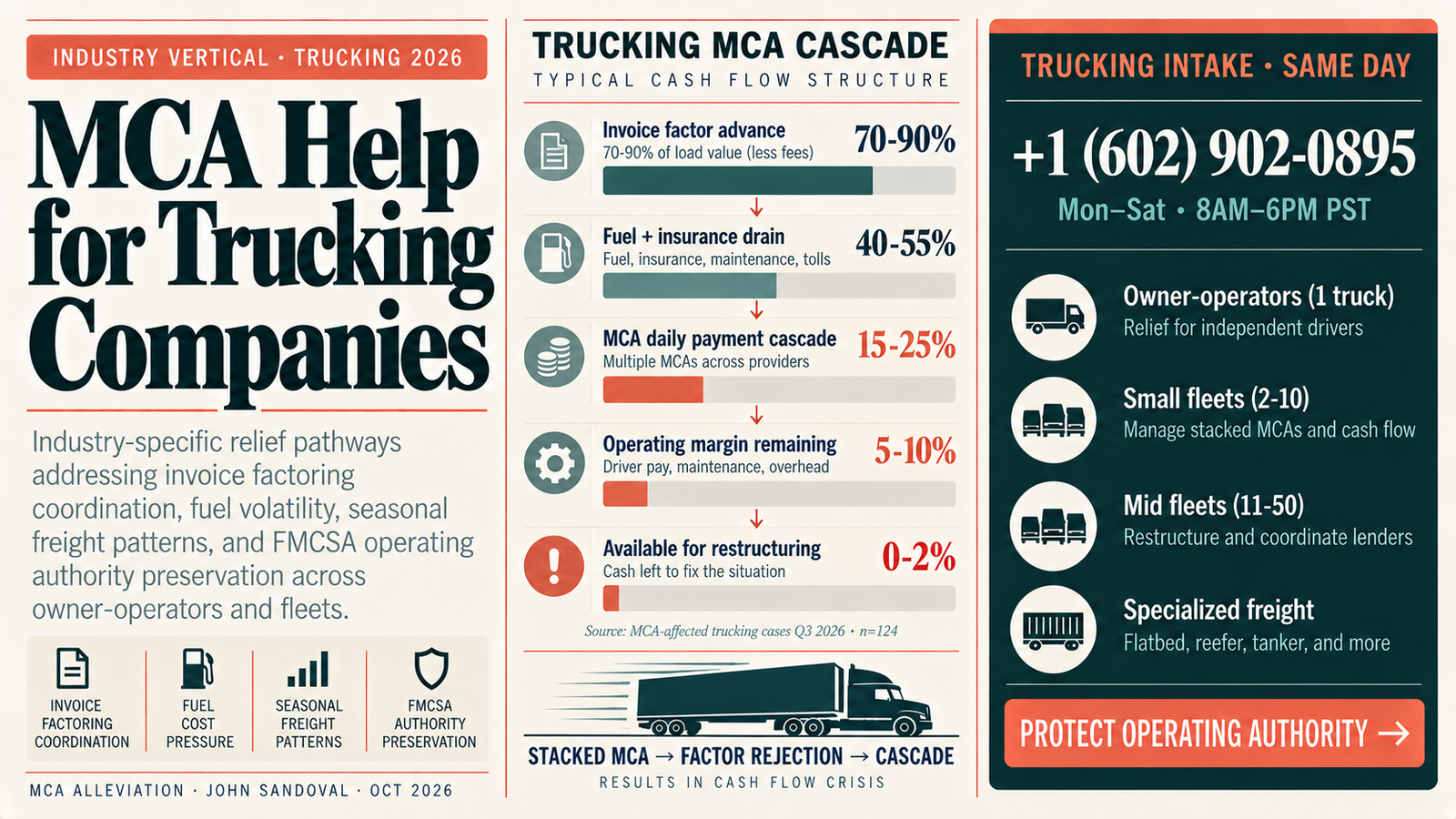
Trucking MCA cases run differently from every other industry because nearly every trucking operation uses invoice factoring, and the factor sits in first-priority UCC-1 position above any MCA. Below is the trucking-specific framework — factor coordination as the critical first move, fuel volatility and seasonal freight patterns affecting settlement timing, FMCSA operating authority preservation through the recovery process — and the four relief pathways adapted for owner-operators, small fleets, mid fleets, large fleets, and specialized freight carriers. Same-day trucking intake at +1 (602) 902-0895.
Trucking MCA case? Factor coordination comes first — before anything else.
The 15-minute confidential intake reviews your invoice factoring agreement covenants, MCA position(s), FMCSA operating authority status, and current cash flow to identify which of the four trucking-specific pathways fits your case. No documents required to begin. Placement organization — not legal representation.
If your trucking company is dealing with MCA debt, the most important thing to know is this: trucking MCA cases run differently from every other industry because of invoice factoring. Approximately 99 percent of trucking operations use freight bill factoring as their primary working capital mechanism, which means the factor holds a first-priority UCC-1 position above any MCA. Factor coordination is not a step to add to the standard MCA workout — it's the foundation the entire relief pathway sits on.
This guide walks the trucking-specific framework (invoice factoring UCC-1 priority, fuel volatility and seasonal freight patterns, FMCSA operating authority preservation), the four relief pathways adapted for trucking operations, the segments served (owner-operators, small fleets, mid fleets, large fleets, specialized freight), and the cascade pattern to prevent. Read it in eight minutes, or call for same-day trucking intake at +1 (602) 902-0895 and get the analysis for your specific factor arrangement and MCA position(s) in fifteen minutes.
MCA help for trucking companies requires industry-specific pathways that coordinate with invoice factoring (the primary working capital mechanism for approximately 99 percent of trucking operations), address diesel fuel volatility affecting settlement timing, and preserve FMCSA operating authority (USDOT and MC numbers) through the recovery process. Four trucking-specific pathways apply: (1) Factor coordination workout with senior UCC leverage — negotiated amendment to the factoring agreement that resolves the MCA position; (2) Fuel advance restructuring aligned with seasonal freight cycles; (3) MCA reverse consolidation for trucking aggregate haul cycle cash flow smoothing; (4) Subchapter V bankruptcy (11 U.S.C. § 362 automatic stay) with FMCSA operating authority preservation. Segments served include owner-operators, small fleets (2-10 trucks), mid fleets (11-50 trucks), large fleets (51+ trucks), and specialized freight (reefer, flatbed, heavy haul, tanker). Same-day trucking intake +1 (602) 902-0895.
Why trucking MCA cases are structurally different.
Trucking has three structural realities that make MCA cases materially different from every other industry. A trucking MCA relief pathway that ignores these three realities isn't trucking relief — it's generic MCA workout applied to a case that will cascade before the first settlement call. Understanding the trucking-specific framework is what separates workable outcomes from factor termination and lost operating authority.
Reality 1: Invoice factoring sits above every MCA in UCC-1 priority
Approximately 99 percent of trucking operations use invoice factoring (also called freight bill factoring) as their primary working capital mechanism. The factor advances 70 to 95 percent of each invoice at the time of load delivery, holds the invoice as collateral, and collects from the shipper or broker on a 30 to 60 day cycle. The factor files a UCC-1 financing statement on all accounts receivable, which places it in first-priority position on the trucking company's primary asset class. Any MCA funded after the factoring agreement sits structurally below the factor in priority, and almost always violates covenants in the factoring agreement that prohibit additional secured financing without factor consent. The practical consequence: factor coordination is the critical first move in trucking MCA relief, not a step to add later.
Reality 2: Fuel volatility drives cash flow variance even in healthy operations
Diesel fuel represents 20 to 30 percent of operating cost for most trucking companies, and diesel prices can swing 15 to 25 percent across a single quarter. A trucking company that structured its operating budget around $3.50/gallon diesel can face operating cash flow compression at $4.25/gallon that has nothing to do with lost freight volume or missed loads. Many trucking MCA cases start not with lost revenue but with a fuel price cycle that compressed operating margin below the aggregate MCA payment threshold. The fuel-cycle dynamic affects both the diagnosis (why the MCA default happened) and the settlement timing (lump-sum offers negotiated during a fuel cycle high typically settle less favorably than offers timed to a cycle low). Standard MCA workout templates don't account for the fuel-cycle variable; trucking-specific pathways do.
Reality 3: FMCSA operating authority preservation is non-negotiable
FMCSA regulates interstate trucking operations through USDOT numbers and MC (motor carrier) operating authority. Operating authority can be suspended through two debt-driven pathways: (1) lapsed insurance filings, where cash flow problems cause missed premium payments and the carrier's BOC-3 insurance filing lapses, triggering FMCSA suspension typically within 30 days of the lapse; (2) pattern of compliance filing failures or safety violations, where operational problems from debt pressure cause missed inspections or filing deadlines, triggering FMCSA review. Loss of operating authority typically ends the trucking business — once a carrier cannot legally haul interstate loads, the operating cash flow that MCA relief is trying to preserve collapses immediately. Trucking MCA relief must include operating authority preservation as an express case objective, which is why the Subchapter V pathway (11 U.S.C. § 362 automatic stay) is often selected over out-of-court settlement for trucking cases with active enforcement pressure.
Reality 4: Seasonal freight rate patterns affect workout timing
Freight rates vary materially across the year by freight category — produce reefer rates spike in late spring and summer, dry van rates compress in Q1, flatbed rates follow construction cycles, heavy haul follows infrastructure and energy sector capital spending. Trucking MCA settlement timing can be structured to align with the freight rate cycle for the carrier's specific operation, maximizing cash flow during settlement negotiation and lump-sum offer windows. This isn't a reason to delay critical intervention when enforcement is active — it's a reason to coordinate settlement timing when the facts allow a defensible delay to maximize outcome.
Reality 5: Owner-operator vs fleet cash flow structures differ fundamentally
An owner-operator running under their own authority has one truck, one driver (the owner), and one factor relationship — case complexity is bounded and relief pathways are typically focused on a single workout. A small fleet (2 to 10 trucks) has multiple drivers (employees or lease-op), typically one factor, and often one or two MCAs — the most common trucking MCA cascade segment. Mid fleets (11 to 50 trucks) frequently have multiple factor relationships, SBA 7(a) loan or ABL facility layering, and may have fuel advance programs separate from factoring. Large fleets (51+ trucks) typically have senior commercial bank relationships, formal credit facilities, and MCA activity concentrated in specific operational segments rather than across the entire fleet. The relief pathway must match the fleet structure, not apply a generic template.
The honest read: trucking MCA cases require industry-specific pathways built around factor coordination, fuel volatility, FMCSA preservation, and segment-appropriate structure. Generic MCA workout templates applied to trucking cases typically produce factor termination within the first weeks — the operational cost of which usually exceeds the entire MCA balance under workout. Same-day trucking intake at +1 (602) 902-0895 walks the trucking-specific framework for your specific case.
The intake reviews your factoring agreement covenants before any MCA move.
What percentage advance does your factor pay? What are the covenant restrictions on additional secured financing? Has the factor seen the MCA activity yet? Is your BOC-3 insurance filing current? Each answer changes which pathway fits. The 15-minute trucking intake walks that analysis and identifies the operative path.
4 relief pathways adapted for trucking operations.
Every MCA relief pathway operates differently for trucking companies because the factor-first structure, fuel volatility, and FMCSA preservation requirements change both the sequence of moves and the structure of the final resolution. The four pathways below are the trucking-adapted versions of standard MCA relief, with factor coordination and operating authority preservation integrated into each pathway rather than treated as afterthoughts.
The trucking-specific starting point for most cases. The approach involves direct negotiation with the invoice factoring company to amend the factoring agreement in a way that acknowledges the MCA position, preserves the factor's first-priority UCC-1 status, and establishes a workout structure that resolves the MCA without triggering factor termination. The factor's senior UCC leverage is often the single most powerful tool in trucking MCA relief because the factor's economic interest in continuing the relationship aligns with the trucking company's need to continue operating. Timeline: 14 to 45 days. Cost: typically contingency on MCA settlement savings. Best for: trucking companies where factor relationship is still viable and MCA was stacked after the factoring agreement (99% of cases).
Trucking companies frequently have fuel advance programs separate from invoice factoring — fuel card programs with weekly or monthly advances against anticipated loads, or dedicated fuel finance products that work in parallel with freight bill factoring. When MCA activity disrupts the fuel advance program, the pathway involves restructuring the fuel advance arrangement in coordination with the factor and the MCA relief to maintain diesel purchasing capacity through the recovery timeline. This pathway is often a supporting element rather than a standalone solution, but for operations where fuel advance disruption is the proximate cause of MCA default, restoring the fuel program is the operational priority. Timeline: 7 to 21 days once factor coordination is in place. Best for: operations where fuel program disruption triggered the cascade.
Reverse consolidation for trucking operations works similarly to the general framework (new advance that takes daily aggregate payments and pays out to existing MCAs on a slower schedule), with trucking-specific adaptations: aggregate payment structure aligned with freight haul cycles (weekly rather than daily for operations where load settlement is weekly), factor coordination built into the structure so the reverse consolidation does not violate factoring agreement covenants, and timing coordinated with diesel price cycles when possible. Restores 40 to 60 percent of daily cash flow immediately, buying 6 to 12 months of runway. Best for: operations that are fundamentally sound once the MCA aggregate payment is reduced, where settlement is not viable and bankruptcy is disproportionate to the situation. Timeline: 14 to 30 days.
Subchapter V bankruptcy (11 U.S.C. §§ 1181-1195) for trucking operations invokes the 11 U.S.C. § 362 automatic stay, halting MCA enforcement actions on the day of filing. The trucking-specific adaptation integrates FMCSA operating authority preservation as an express case objective — the plan must demonstrate ability to maintain insurance filings (BOC-3 continuity), FMCSA compliance obligations, and operational cash flow to serve existing freight contracts through plan confirmation. The April 2026 Subchapter V debt ceiling is $3,424,000 in noncontingent liquidated debts, which fits most owner-operator and small/mid fleet trucking cases. Cost: $15,000 to $50,000 through plan confirmation (6 to 9 months). Best for: cases where factor termination has already occurred or is imminent, MCA enforcement is active, or multiple stacked MCAs make out-of-court resolution impossible.
The four pathways are often sequenced rather than exclusive — factor coordination workout as the foundation, with fuel advance restructuring, reverse consolidation, or Subchapter V filing layered on top depending on case severity. Which combination fits depends on the specific trucking segment, factor relationship status, FMCSA compliance posture, and whether MCA enforcement has escalated beyond collections to active legal action. Same-day trucking intake at +1 (602) 902-0895 walks the sequencing analysis for your specific case.
The intake places you with counsel who knows factor coordination.
Trucking MCA cases require counsel who understands invoice factoring UCC-1 priority, FMCSA operating authority preservation under Subchapter V, and the fuel-cycle timing considerations for settlement negotiation. Placement with trucking-experienced counsel in your federal bankruptcy district or state court jurisdiction.
Trucking segments served for MCA relief.
MCA Alleviation serves trucking companies across every segment and all 50 U.S. states, with pathway selection calibrated to the specific operational structure of each segment. The five segments below account for substantially all trucking MCA case volume, each with distinct factor relationship patterns, cash flow structures, and regulatory considerations that affect which relief pathway fits.
Structure: owner is also the driver, operating under own USDOT and MC numbers, typically one factor relationship (usually a smaller regional factor or an owner-operator-focused factoring company). Case profile: most owner-operator MCA cases involve one or two MCAs stacked after the factor relationship was established; cases usually resolve through factor coordination workout plus settlement of the one or two MCA positions. Timeline from intake to resolution: 30 to 90 days typical. Key consideration: FMCSA operating authority preservation is critical because the owner-operator has one truck — losing authority ends operations immediately.
Structure: owner typically still driving or operating as fleet manager, with 1 to 9 employee or lease-op drivers. Usually one primary factor plus occasional secondary factor or fuel advance arrangement. Case profile: the most common trucking MCA cascade segment — stacked MCAs frequently appear in small fleets because operational cash flow pressure outpaces owner-operator attention bandwidth, leading to successive MCA funding without a complete picture of aggregate payment obligations. Early intervention produces the best outcomes; late intervention often requires Subchapter V. Key consideration: payroll for employee drivers creates immediate pressure if cash flow collapses, so pathway timing must preserve weekly or bi-weekly payroll cycles.
Structure: owner typically no longer driving, operating as fleet manager with full-time drivers (employees), dispatch operation, and formal operational infrastructure. Frequently uses multiple factors across different freight categories or geographic lanes, and may have an SBA 7(a) loan or ABL credit facility. Case profile: mid-fleet MCA cases typically have higher balances per MCA and multiple creditor relationships that require coordinated workout; the Subchapter V pathway is often selected because the operational complexity makes out-of-court resolution with 3+ MCAs structurally difficult. Key consideration: coordination across multiple factors is required — a workout that satisfies Factor A but violates covenants with Factor B can collapse the entire operation.
Structure: formal management team including CFO or controller, senior commercial bank relationships, ABL or SBA facilities, often multiple operating subsidiaries. MCA activity typically concentrated in specific operational segments (new terminal, specialized equipment acquisition) rather than across the entire fleet. Case profile: large-fleet MCA cases often arise from operational expansion that outpaced underwritten revenue projections; the pathway typically involves senior lender workout coordination with MCA settlement rather than Subchapter V, because large-fleet operations frequently exceed the $3,424,000 Subchapter V debt ceiling. Key consideration: MCA activity may violate senior credit facility covenants independently, so cleaning up the MCA position is often necessary to preserve the senior relationship.
Structure: trucking operations in specialized segments including reefer (refrigerated), flatbed, heavy haul, tanker (chemical, petroleum, food-grade), auto hauler, and dedicated contract carriage. Equipment finance obligations are typically more significant than in dry van operations because specialized trailers (reefer units, heavy-haul permits, tanker certifications) require capital. Case profile: seasonal revenue patterns are more pronounced in specialized segments (reefer peaks summer, flatbed follows construction, heavy haul follows energy and infrastructure capital cycles), which makes settlement timing more important. Equipment finance obligations may be at risk if MCA pressure causes payment lapses on specialized equipment. Key consideration: pathway sequencing often involves coordinating equipment finance obligations with factor relationships and MCA settlement to preserve specialized operational capacity through the recovery timeline.
Every trucking segment is served — the list above describes case profiles and pathway tendencies, not exclusive coverage. Same-day trucking intake at +1 (602) 902-0895 identifies the segment-appropriate pathway sequencing for your specific operation.
From owner-operator to large fleet — segment-specific pathway sequencing.
Single-truck owner-operator with one factor and two MCAs? Mid fleet with multi-factor coordination and 5 stacked MCAs? Large fleet with SBA 7(a) and ABL layered over factoring? Specialized reefer carrier with seasonal rate volatility? Each segment requires calibrated pathway sequencing. Same-day intake identifies the right one.
How to prevent the MCA cascade for trucking companies.
The MCA cascade for trucking companies has a specific pattern that repeats across hundreds of cases: fuel price spike or seasonal rate compression compresses operating margin, trucking company funds first MCA to cover the gap, aggregate daily payment pressure compresses margin further, trucking company funds second MCA, factor identifies MCA activity on bank statements and begins to tighten (reducing advance rate, slowing invoice processing, requesting additional reserves), trucking company funds third MCA to replace the lost factor liquidity, factor either terminates or imposes workout conditions, and the operation collapses within one or two invoice cycles. Three prevention measures interrupt the cascade pattern.
Prevention 1: Never stack MCAs while factoring is active
The single most important rule for trucking companies is: never fund an MCA while an invoice factoring relationship is active without factor consent in writing. This rule has no exceptions. Every MCA stacked onto an active factoring arrangement almost certainly violates covenants in the factoring agreement and starts the cascade clock. Brokers calling the trucking company offering "trucking-specific" MCA products are describing products that, in nearly every case, will trigger factor consequences. If an MCA appears necessary, the first call is to the factor to request structural accommodation (increased advance rate, factor-approved secondary financing, or temporary bridge from the factor) — not to the MCA broker. Same-day trucking intake at +1 (602) 902-0895 can advise on factor conversation framing before any MCA move.
Prevention 2: Coordinate with the factor before any MCA action
Once an MCA has been funded onto an active factoring arrangement, the second critical rule is: coordinate with the factor before taking any further action on the MCA. Reconciliation requests, settlement negotiations, bank account changes, and payment deferrals all affect the factor's position and may violate factoring agreement covenants. Factor coordination early in the process — ideally before the factor independently identifies the MCA activity — can transform the factor from an adversary (if they feel ambushed) into a workout ally (if they are approached first with a credible structural plan). Factor relationship preservation is often the difference between a workable trucking MCA relief case and a factor-terminated operation that cannot continue hauling.
Prevention 3: FMCSA operating authority preservation checklist
Through any MCA relief process, trucking companies must maintain FMCSA compliance obligations as a non-negotiable operational priority. The checklist: (1) BOC-3 insurance filing continuity — liability insurance premiums paid even if other obligations are deferred, because insurance lapse triggers operating authority suspension within 30 days. (2) UCR (Unified Carrier Registration) renewal current — annual renewal requirement with payment deadline tied to the registration year. (3) IFTA (International Fuel Tax Agreement) filings current — quarterly filings and payment obligations maintained even during cash flow compression. (4) Driver qualification files maintained for every active driver — DOT medical cards, drug and alcohol testing compliance, hours of service documentation. (5) Equipment inspection and maintenance records current — DOT annual inspections and periodic preventive maintenance documented. Loss of operating authority through FMCSA suspension typically ends the trucking business — the cash flow MCA relief is trying to preserve collapses the moment the carrier cannot legally haul interstate loads.
The MCA Alleviation position: trucking MCA relief must integrate factor coordination from the first week, operating authority preservation as an express case objective, and cascade prevention as the operational discipline that makes recovery possible. Same-day trucking intake at +1 (602) 902-0895 covers all three in the initial fifteen minutes.
Get the trucking-specific analysis for your factor, MCAs, and FMCSA posture.
Factoring agreement covenant review. MCA position(s) assessment. FMCSA operating authority status check. Fuel cycle and seasonal timing considerations. All four in fifteen minutes. Serving owner-operators through large fleets across all 50 U.S. states.
Three things every trucking owner should know.
Factor coordination comes first — before any other MCA move.
Approximately 99 percent of trucking operations use invoice factoring as their primary working capital mechanism, and the factor holds a first-priority UCC-1 position above any MCA. Every MCA stacked onto an active factoring arrangement almost certainly violates factoring agreement covenants that prohibit additional secured financing without factor consent. Factor coordination is not a step to add to the standard MCA workout — it is the foundation the entire relief pathway sits on. Attempting MCA settlement without factor coordination can trigger factor termination, which collapses operating cash flow within one invoice cycle. Same-day trucking intake at +1 (602) 902-0895.
FMCSA operating authority preservation is non-negotiable.
Trucking MCA relief must preserve USDOT and MC operating authority through the recovery process because loss of operating authority typically ends the trucking business. Operating authority can be suspended through two debt-driven pathways: (1) BOC-3 insurance filing lapse causes FMCSA suspension within 30 days; (2) pattern of compliance filing failures or safety violations triggers FMCSA review. The Subchapter V pathway (11 U.S.C. § 362 automatic stay) halts most creditor enforcement that would drive these outcomes, which is why Subchapter V is often selected for trucking cases with active enforcement pressure. Insurance filings, UCR renewals, IFTA filings, driver qualification files, and equipment inspection records must be maintained even during cash flow compression. Same-day intake at +1 (602) 902-0895.
Four trucking-specific pathways · segment-appropriate sequencing.
The four trucking relief pathways are sequenced rather than exclusive. (1) Factor coordination workout — the trucking-specific starting point, direct negotiation with the factor to amend the agreement in a way that resolves the MCA without triggering termination. (2) Fuel advance restructuring — aligned with seasonal freight cycles and diesel price trajectory, supporting element rather than standalone solution. (3) MCA reverse consolidation for trucking — aggregate payment structure aligned with freight haul cycles, factor coordination built in. (4) Subchapter V bankruptcy with FMCSA operating authority preservation — automatic stay halts enforcement, April 2026 $3,424,000 debt ceiling fits most owner-operator and small/mid fleet cases. Segments served include owner-operators, small fleets (2-10), mid fleets (11-50), large fleets (51+), and specialized freight (reefer, flatbed, heavy haul, tanker). Same-day trucking intake at +1 (602) 902-0895.
Frequently asked questions.
Why are MCA cases different for trucking companies?
Trucking companies have three structural realities that make MCA cases materially different from any other industry. First, approximately 99 percent of trucking operations use invoice factoring (freight bill factoring) as their primary working capital mechanism — the factor holds a first-priority UCC-1 position above any subsequent MCA, which means factor coordination is the critical first move in trucking MCA relief. Second, trucking has structural fuel volatility that creates cash flow variance even in healthy operations, so MCA default often starts with a fuel price spike rather than lost revenue. Third, FMCSA regulatory requirements (USDOT number, MC operating authority, insurance filings) can be suspended if debt-driven operational problems trigger safety or financial responsibility inquiries, which means MCA relief for trucking must preserve operating authority through the recovery process. Same-day trucking intake at +1 (602) 902-0895.
Will MCA settlement affect my invoice factoring arrangement?
Potentially yes, and the question is critical to answer correctly before any MCA action. Most trucking invoice factoring agreements include covenants prohibiting the trucking company from entering additional secured financing without the factor's written consent. An MCA that was stacked onto a factored operation almost always violated those covenants, which means the factor's ongoing agreement to purchase invoices may already be legally at risk. A well-designed MCA relief pathway coordinates with the factor from the first week — either an amendment to the factoring agreement that acknowledges and resolves the MCA position, or a factor-approved workout structure that preserves the factoring relationship. Attempting MCA settlement without factor coordination can trigger factor termination, which collapses operating cash flow within one invoice cycle. Factor coordination is the foundation of trucking MCA relief at +1 (602) 902-0895.
Can MCA debt cause me to lose my FMCSA operating authority?
Not directly, but indirectly yes through two pathways. First, if MCA-driven cash flow problems cause a lapse in insurance filings (FMCSA requires continuous proof of liability insurance on file through the BOC-3 process), operating authority can be suspended within 30 days of the lapse. Second, if debt-driven operational problems cause a pattern of safety violations, missed inspections, or compliance filing failures, FMCSA can initiate an operating authority review. The Subchapter V automatic stay (11 U.S.C. § 362) halts most creditor enforcement that would drive these outcomes, which is why the Subchapter V pathway for trucking companies often includes operating authority preservation as an express case objective. A properly structured trucking MCA relief case preserves USDOT and MC numbers through the recovery timeline. Same-day intake at +1 (602) 902-0895.
What trucking segments does MCA Alleviation serve?
MCA Alleviation serves trucking companies across every segment and all 50 U.S. states, with the top five by case volume being: (1) Owner-operators running a single truck — typically cases with one or two MCAs and factor coordination as the primary workout. (2) Small fleets (2 to 10 trucks) — most common segment for stacked MCA cascade and where early intervention produces the best outcomes. (3) Mid-sized fleets (11 to 50 trucks) — typically multi-factor arrangements with complex coordination requirements. (4) Large fleets (51+ trucks) — SBA 7(a) loans and ABL facilities layered over factoring, creating senior lender hierarchies that require coordinated workout. (5) Specialized freight carriers including reefer (refrigerated), flatbed, heavy haul, tanker, and auto hauler operations — segment-specific cash flow patterns affect pathway selection. Same-day trucking intake at +1 (602) 902-0895.
How does fuel price volatility affect MCA settlement for trucking?
Materially, in both directions. Diesel fuel typically represents 20 to 30 percent of operating cost for trucking companies, and diesel prices can swing 15 to 25 percent across a single quarter. A trucking company that funded an MCA when diesel was at a cycle low may face settlement negotiation during a cycle high, when operating margin has compressed and settlement funding is harder to assemble. Conversely, settlement timing during a cycle low can produce substantially better outcomes because operating cash flow is temporarily stronger. Properly structured trucking MCA relief factors the diesel price cycle into settlement timing when the facts allow — not as a reason to delay critical intervention, but as a reason to coordinate the timing of lump-sum offers to maximize funder acceptance probability. Same-day intake walks the fuel-cycle analysis for your specific case at +1 (602) 902-0895.
Should I keep running my trucks while working on MCA relief?
In most cases yes, with specific operational constraints. The trucking business runs on continuous revenue (loads moved, invoices factored, cash converted) — stopping operations typically collapses the cash flow that MCA relief is trying to preserve, and starts the clock on FMCSA operating authority at risk if insurance filings or compliance obligations lapse. The exception is cases where continuing operations would create new fraudulent transfer exposure, or where the factor has already terminated the factoring agreement and no replacement financing is available for operating cash. In most trucking MCA relief cases, operations continue through the recovery process with specific guardrails — no new MCAs under any circumstances, factor coordination before any settlement move, and FMCSA compliance filings maintained even if operational decisions require deferring other payments. Same-day trucking intake at +1 (602) 902-0895.
Trucking company facing MCA debt? Factor coordination first — then everything else.
The confidential intake reviews your factoring agreement covenants, MCA position(s), FMCSA operating authority status, and current cash flow to identify which of the four trucking-specific pathways fits your case — factor coordination workout, fuel advance restructuring, MCA reverse consolidation for trucking, or Subchapter V with FMCSA preservation. Same-day, confidential, no documents required to begin, no obligation to engage anyone afterward. Serving owner-operators through large fleets across all 50 U.S. states from Phoenix, Arizona. Placement organization — not legal representation.