Subchapter V vs Chapter 11, side by side — pick the bankruptcy pathway that fits.
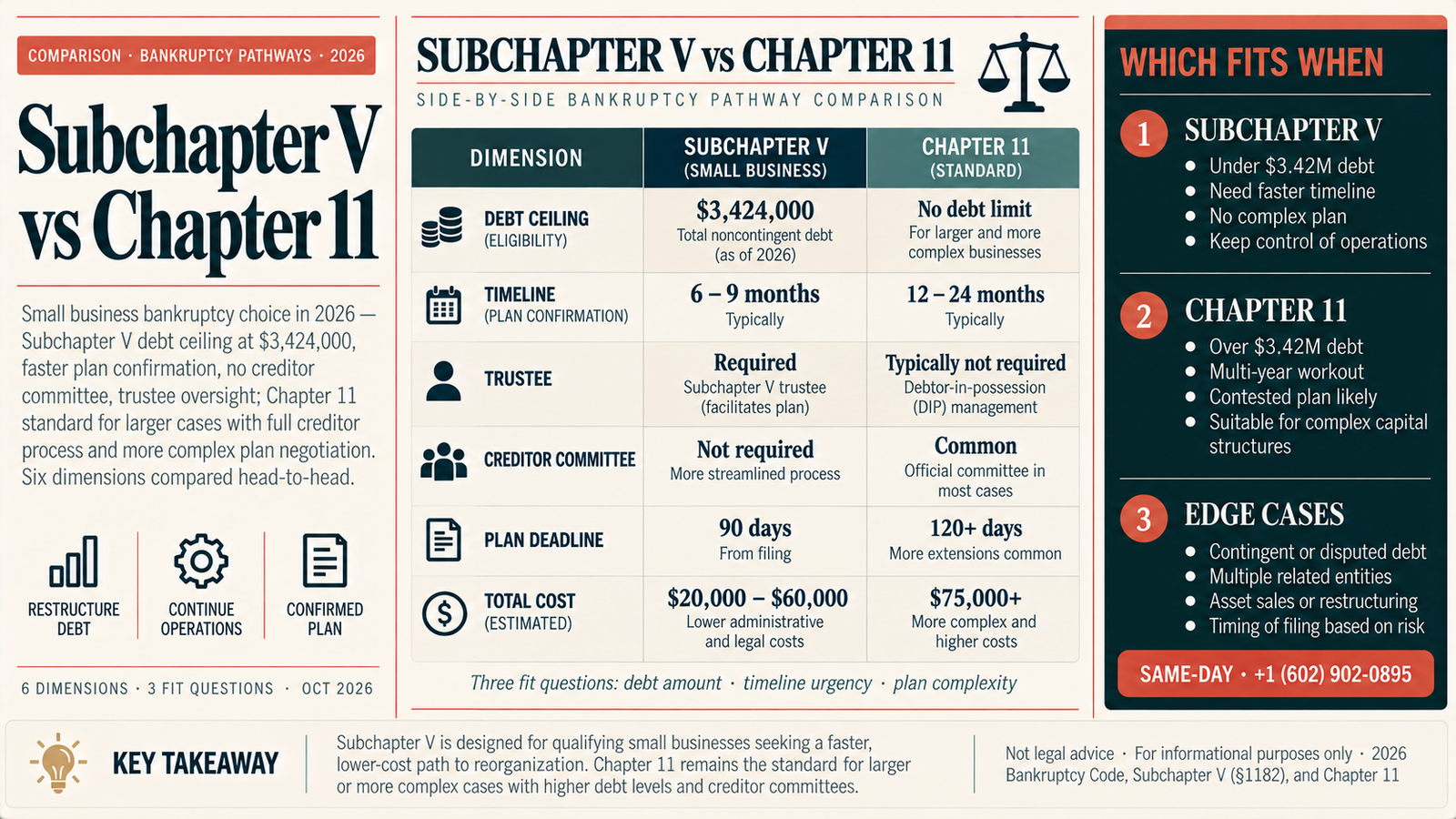
Subchapter V and standard Chapter 11 are the two bankruptcy pathways available to small business owners seeking reorganization under the Bankruptcy Code — Subchapter V as a specialized track added by the Small Business Reorganization Act of 2019 with debt ceiling and simplified process, standard Chapter 11 as the full reorganization chapter without debt limits. Most owners default into whichever pathway becomes available when enforcement forces the filing rather than making an informed choice about which fits their specific situation, which costs tens of thousands of dollars and months of unnecessary timeline. Below is the honest side-by-side across six dimensions (debt ceiling, timeline, trustee requirement, creditor committee, plan filing deadline, total cost), a three-question decision framework to pick the right one, and the edge case analysis for contingent debt, related entity aggregation, and SBRA sunset timing. Same-day diagnostic at +1 (602) 902-0895.
Subchapter V or Chapter 11? The diagnostic answers which fits your debt structure.
The 15-minute confidential diagnostic walks the three fit questions — total noncontingent liquidated debt relative to the $3,424,000 Subchapter V ceiling, timeline urgency given enforcement status, expected plan complexity — and identifies whether Subchapter V qualification exists, whether standard Chapter 11 is the only option, and routes to the correct federal bankruptcy district for your business. No documents required to begin. Placement organization — not legal representation.
The question of Subchapter V vs Chapter 11 is one most owners end up defaulting into rather than choosing — whichever pathway becomes available when enforcement forces the filing is the one they use, regardless of whether it fits their situation. The default costs tens of thousands of dollars and months of unnecessary timeline. "Which is cheaper?" is the right question to start with but the wrong question to end with — Subchapter V is materially cheaper ($20,000 to $60,000 vs $75,000 and up for Chapter 11) but only if your debt qualifies under the $3,424,000 ceiling and your plan complexity fits the streamlined process. "Which is faster?" is also partially right — Subchapter V's 6-to-9-month timeline beats Chapter 11's 12-to-24-month timeline materially — but speed matters less when the plan complexity requires the full Chapter 11 creditor committee process to produce a confirmable plan.
This guide walks what each pathway actually is under the Bankruptcy Code (Subchapter V under SBRA at 11 USC Sections 1181 through 1195; standard Chapter 11 at Sections 1101 through 1174), the honest side-by-side comparison across six dimensions (debt ceiling, timeline, trustee requirement, creditor committee, plan filing deadline, total engagement cost), the three-question decision framework for identifying which pathway fits your case, and the edge cases around contingent debt treatment, related entity aggregation under Section 1182(1)(A), and SBRA debt ceiling timing considerations. Read it in eight minutes, or call for a 15-minute diagnostic at +1 (602) 902-0895 and get the pathway identified for your specific debt structure in real time.
Subchapter V and standard Chapter 11 are two distinct small business bankruptcy reorganization pathways with different qualification criteria, procedural requirements, and costs. Subchapter V was added by the Small Business Reorganization Act of 2019 (11 USC Sections 1181 through 1195) as a specialized track within Chapter 11 with a $3,424,000 debt ceiling (April 2026), 90-day plan filing deadline under Section 1189, required Subchapter V trustee under Section 1183, no creditor committee requirement, simplified confirmation under Section 1191, 6-to-9-month typical timeline, and $20,000 to $60,000 total engagement cost. Standard Chapter 11 reorganization (11 USC Sections 1101 through 1174) has no debt ceiling, 120-day exclusivity period for plan filing under Section 1121, creditor committee commonly appointed under Section 1102, full disclosure statement requirement under Section 1125, confirmation under Section 1129 with absolute priority rule and cramdown analysis, 12-to-24-month typical timeline, and $75,000 and up total engagement cost. Three questions determine the fit: (1) does total noncontingent liquidated debt exceed $3,424,000, (2) how urgent is the plan confirmation timeline, (3) how complex is the expected plan negotiation. Same-day diagnostic +1 (602) 902-0895.
Subchapter V vs Chapter 11 — the statutory framework.
Before any comparison makes sense, both pathways need to be understood on their own terms. Subchapter V and standard Chapter 11 are often discussed as if they were separate chapters of the Bankruptcy Code, but Subchapter V is actually a specialized track within Chapter 11 — added by the Small Business Reorganization Act of 2019 (SBRA) specifically to address the fact that standard Chapter 11 was too expensive and too slow for most small business reorganizations. The two pathways share the same bankruptcy chapter but operate under materially different procedural rules.
Subchapter V · Statutory framework (11 USC §§ 1181-1195)
Subchapter V was created by the Small Business Reorganization Act of 2019, which took effect February 19, 2020, and added Sections 1181 through 1195 to Chapter 11 of the Bankruptcy Code. The statutory structure provides a streamlined reorganization process available to small business debtors who qualify under the debt ceiling and elect Subchapter V treatment at filing. The debt ceiling as of April 2026 is $3,424,000 in aggregate noncontingent liquidated debts, adjusted periodically under 11 USC Section 104 to reflect inflation. The ceiling was temporarily raised to $7,500,000 under COVID-era legislation that has since expired, which is why April 2026's $3,424,000 figure is the current operative amount for most small business MCA cases.
Key procedural features: a Subchapter V trustee is appointed in every case under Section 1183, with the trustee's role to facilitate plan development and oversee the case rather than take over operations (the debtor remains in possession). The debtor must file a plan within 90 days of petition filing under Section 1189, extendable only for circumstances for which the debtor should not justly be held accountable. No creditor committee is required under Section 1181(b), eliminating the committee attorney fees that drive up standard Chapter 11 costs materially. Confirmation under Section 1191 can occur consensually (with all impaired classes accepting) or by cramdown over objecting classes using the disposable income test rather than the full absolute priority rule analysis. Timeline from petition to plan confirmation typically runs 6 to 9 months. Total engagement cost (debtor's attorney fees plus trustee fees plus filing fees plus credit counseling plus post-confirmation administration) typically runs $20,000 to $60,000 depending on complexity.
Standard Chapter 11 · Statutory framework (11 USC §§ 1101-1174)
Standard Chapter 11 is the full reorganization chapter of the Bankruptcy Code, available to any business regardless of debt size, structured around debtor-in-possession operation and creditor negotiation leading to a confirmed plan of reorganization. The chapter has no debt ceiling, making it the only available reorganization pathway for businesses whose debt exceeds the Subchapter V $3,424,000 limit (or whose structure disqualifies them from Subchapter V for other reasons). The procedural framework is substantially more complex than Subchapter V because it was designed for larger reorganizations with substantial creditor negotiation.
Key procedural features: the debtor has a 120-day exclusivity period under Section 1121 to file a plan, with extensions available for cause (and typically granted in cases requiring extended negotiation). An unsecured creditors committee is commonly appointed by the US Trustee under Section 1102, with committee attorneys paid from the bankruptcy estate as administrative expenses — this is one of the largest cost drivers of standard Chapter 11 because committee attorneys often match or exceed debtor's attorney fees. A disclosure statement must be approved by the court under Section 1125 before the debtor can solicit creditor votes on the plan, adding time and complexity (and attorney fees for drafting the disclosure statement). Confirmation under Section 1129 requires full compliance with the absolute priority rule for objecting classes, meaning that cramdown over objecting unsecured creditors requires either new value or specific satisfaction of the rule's requirements. Timeline from petition to plan confirmation typically runs 12 to 24 months. Total engagement cost typically runs $75,000 and up, frequently reaching $150,000 to $500,000 for complex cases with multiple creditor classes, contested matters, and extended negotiation.
The real difference: calibration to case size and complexity
The fundamental distinction is this: Subchapter V is calibrated for small business reorganizations where the debt is modest and the plan is relatively straightforward, while standard Chapter 11 is calibrated for larger reorganizations where the debt is substantial and the plan negotiation is complex. The SBRA was explicitly intended to make reorganization accessible to small businesses that could not afford standard Chapter 11, and the procedural simplifications (no committee, trustee facilitation, simplified confirmation) directly address the cost drivers that made standard Chapter 11 impractical for cases under a few million dollars in debt. Owners whose businesses fit the Subchapter V profile (debt under $3,424,000, relatively simple creditor structure, timeline urgency) should use it. Owners whose businesses exceed the ceiling or require the full creditor negotiation process should use standard Chapter 11. The pathway choice depends on debt size and plan complexity — not on which pathway sounds better in a conversation.
The diagnostic identifies Subchapter V qualification vs standard Chapter 11 requirement.
Total noncontingent liquidated debt at or below $3,424,000 and relatively simple plan structure? Subchapter V path. Total debt exceeding the ceiling, or complex plan structure with multiple creditor classes and contested matters? Standard Chapter 11 path. Close to the ceiling with prepetition structuring options to qualify for Subchapter V? Pre-filing strategy analysis. The 15-minute diagnostic walks that analysis for your specific debt structure.
Settlement vs consolidation across six dimensions.
The honest comparison runs across six dimensions, not two or three. Each dimension matters differently depending on the specific case — a dimension that is dispositive for one owner (debt ceiling qualification) may be irrelevant for another (if the owner's debt is well under the ceiling). The grid below is the complete comparison; the relative weight of each dimension depends on the case.
Subchapter V: $3,424,000 cap on aggregate noncontingent liquidated debts as of April 2026, adjusted periodically under 11 USC Section 104 for inflation. The ceiling applies to the aggregate of all debts of the debtor and affiliated entities under Section 1182(1)(A). Chapter 11: no debt ceiling. Available to businesses of any size regardless of total debt. Difference: this is the dispositive first-filter question. If total noncontingent liquidated debt exceeds $3,424,000, Subchapter V is not available and standard Chapter 11 is the only reorganization pathway. If total debt is at or below the ceiling, Subchapter V election is available and the next dimensions determine whether it fits.
Subchapter V: 6 to 9 months from petition to plan confirmation typical. The 90-day plan filing deadline under Section 1189 drives early-case momentum; 341 meeting of creditors within 30 to 60 days; confirmation hearing typically 4 to 6 months after plan filing. Chapter 11: 12 to 24 months from petition to plan confirmation typical. The 120-day exclusivity for debtor plan filing under Section 1121 (with extensions) sets a longer initial period; creditor committee negotiation runs several months; disclosure statement approval adds months; plan voting and confirmation hearing add additional months. Difference: Subchapter V is roughly 2x faster than standard Chapter 11, which matters when enforcement pressure is active or when operations cannot sustain extended bankruptcy proceedings.
Subchapter V: Subchapter V trustee is required in every case under 11 USC Section 1183. The trustee facilitates plan development, monitors operations, provides independent assessment of plan feasibility at confirmation, and acts as mediator between debtor and creditors. Trustee is billed at $300 to $500 per hour typically, totaling $5,000 to $15,000 through plan confirmation, paid from the estate as administrative expense. Chapter 11: no trustee required in standard cases. Debtor remains in possession (debtor-in-possession) and operates the business, with US Trustee providing basic oversight. A Chapter 11 trustee can be appointed under Section 1104 for cause (fraud, dishonesty, incompetence, or similar) but this is rare. Difference: Subchapter V always has trustee costs; standard Chapter 11 typically does not (but has creditor committee costs instead — see Dimension 4).
Subchapter V: no creditor committee requirement under Section 1181(b). This eliminates the committee attorney fees that drive up standard Chapter 11 costs materially. Creditors represent their own interests individually in Subchapter V without the collective committee structure. Chapter 11: unsecured creditors committee commonly appointed by the US Trustee under Section 1102, with committee of typically 3 to 7 unsecured creditors who oversee the case. Committee attorneys and financial advisors are paid from the bankruptcy estate as administrative expenses, often matching or exceeding debtor's attorney fees in the case. Difference: Subchapter V has no committee cost; standard Chapter 11 typically has substantial committee costs. This is one of the largest cost drivers of the overall cost difference between the two pathways.
Subchapter V: 90-day plan filing deadline under 11 USC Section 1189. The deadline is extendable only for circumstances for which the debtor should not justly be held accountable — a narrower standard than the general extensions available in standard Chapter 11. The short deadline drives early-case preparation and forces plan development to begin almost immediately after petition filing. Chapter 11: 120-day exclusivity period for debtor plan filing under Section 1121 (plus 60 additional days to solicit acceptances), extendable up to 18 months for cause. The longer initial period allows extended creditor negotiation before plan filing commits to specific terms. Difference: Subchapter V requires rapid plan development; standard Chapter 11 allows extended plan negotiation. Which is better depends on whether the case needs speed or needs negotiation time.
Subchapter V: $20,000 to $60,000 total engagement cost typical through plan confirmation. Breakdown: debtor's attorney fees $15,000 to $45,000 (retainer plus hourly structure typical), Subchapter V trustee fees $5,000 to $15,000, filing fees $338 plus credit counseling $50-$200, post-confirmation administration minimal. Chapter 11: $75,000 and up total engagement cost typical through plan confirmation, frequently reaching $150,000 to $500,000 for complex cases. Breakdown: debtor's attorney fees $50,000 to $300,000+, creditor committee attorney fees $25,000 to $150,000+ (paid from estate), disclosure statement drafting and approval, extended plan negotiation hours, post-confirmation administration. Difference: standard Chapter 11 costs materially more than Subchapter V across every category, driven primarily by committee costs and extended timeline.
The side-by-side above holds the dimensions constant to make the comparison direct. In practice, dimension weight varies — a business with $5 million in debt has Dimension 1 (debt ceiling) as dispositive before any other dimension matters, forcing standard Chapter 11. A business with $2 million in debt and relatively simple creditor structure fits Subchapter V across every dimension and should use it. The three-question decision framework in Section 03 walks the dimension weighting for your specific case. Same-day diagnostic at +1 (602) 902-0895.
The diagnostic weighs the six dimensions against your specific debt structure.
Total debt under $3,424,000 or over the ceiling? Simple creditor structure or complex multi-class plan? Timeline urgency driven by active enforcement or operations able to sustain extended proceedings? Each answer changes which dimensions are decisive. The 15-minute diagnostic walks the dimension weighting for your case and identifies the operative pathway (Subchapter V, standard Chapter 11, or prepetition structuring to qualify for Subchapter V).
Three questions that pick the pathway.
The six-dimension comparison in Section 02 lays out the full picture; the three questions below compress that picture into a decision framework. Each question has a clear answer that points toward one pathway or the other, and in most cases the three answers point consistently to a single pathway. Question 1 is the dispositive first filter — the Subchapter V debt ceiling is a hard limit that controls availability of the pathway regardless of other factors.
What counts in the debt calculation: all noncontingent liquidated debts of the debtor plus all affiliated entities aggregated under 11 USC Section 1182(1)(A). MCA balances currently in payment status, outstanding loan principal, trade payables, equipment finance obligations, and other debts that are currently owed and have a fixed determinable amount all count. What doesn't count: contingent debts (personal guarantees not yet called, disputed claims that are unliquidated), insider debts between affiliated entities (though affiliated entity aggregation can still apply — see edge cases Section 04), certain classes of debt specified in the statute. If total exceeds $3,424,000, Subchapter V is not available and standard Chapter 11 is the only pathway. If total is at or below the ceiling, Subchapter V election is available and Questions 2 and 3 determine fit. The ceiling may be adjusted by Congress or by inflation adjustment under Section 104 — current amount should be verified at filing.
High timeline urgency factors: active enforcement (MCA lawsuits filed, Confession of Judgment entries pending, restraining notices served), operational cash flow unable to sustain extended bankruptcy proceedings (DIP financing not viable, customer concentration risk during extended proceedings), market timing where industry conditions make rapid emergence from bankruptcy critical, personal guarantor exposure that benefits from faster resolution. Low timeline urgency factors: operations can sustain extended bankruptcy proceedings with normal operating financing, no active enforcement forcing rapid timeline, plan complexity genuinely requires extended creditor negotiation to produce a confirmable outcome, major restructuring (sale of divisions, equity recapitalization, complex secured creditor negotiation) requires time. If high urgency: Subchapter V favored (if debt qualifies). If low urgency: standard Chapter 11 is viable even where debt would qualify for Subchapter V, especially where Dimension 3 complexity favors the fuller process.
Simple plan indicators (Subchapter V fits): few creditor classes (secured lender, MCAs, trade payables), MCA debt dominant with no significant other secured creditor disputes, no absolute priority rule analysis required (consensual plan or simple disposable income cramdown), no complex corporate reorganization (operating structure maintained through plan), no litigation claims that need to be resolved as part of the plan. Complex plan indicators (standard Chapter 11 fits): multiple creditor classes with competing interests (several secured lenders, complex trade payables, pension or benefit obligations, litigation claims), absolute priority rule analysis required (equity holders retaining value over objecting unsecured creditors), complex corporate restructuring (division sales, equity recapitalization, management changes), active litigation claims that need to be resolved as part of the plan, substantial contested matters likely during the case (relief from stay motions, adequate protection disputes, avoidance actions). If simple: Subchapter V is the better pathway when available. If complex: standard Chapter 11 may be the better pathway even when Subchapter V would be technically available.
Reading the three answers together: if Q1 is YES (debt exceeds $3,424,000), standard Chapter 11 is the only pathway regardless of Q2 and Q3. If Q1 is NO (debt at or below ceiling), the Q2 and Q3 answers decide: both pointing toward Subchapter V means use it; one toward each means the case needs the full 15-minute conversation to resolve; both toward standard Chapter 11 means the fuller process is worth the added cost and timeline. Same-day diagnostic at +1 (602) 902-0895 walks the three questions for your specific case.
The diagnostic walks all three questions in a single confidential conversation.
Total noncontingent liquidated debt analysis against the $3,424,000 Subchapter V ceiling (including affiliated entity aggregation under § 1182(1)(A)). Timeline urgency assessment tied to enforcement status and operational cash flow sustainability. Expected plan complexity based on creditor structure and contested matter forecasting. Three answers that identify Subchapter V qualification, standard Chapter 11 requirement, or prepetition structuring opportunities in 15 minutes.
Three edge cases that complicate the pathway choice.
The three-question decision framework in Section 03 handles substantially all straightforward cases. The three edge cases below cover the complications that arise in less typical fact patterns — contingent debt treatment that affects ceiling calculation, related entity aggregation under § 1182(1)(A) that can push a business over the ceiling, and SBRA debt ceiling timing considerations where legislative action affects filing timing.
Edge case 1: Contingent and unliquidated debt treatment
The Subchapter V debt ceiling applies to "noncontingent liquidated debts" — not to all debts of the debtor. The distinction matters materially in MCA cases because many MCA-adjacent obligations are contingent or unliquidated at the time of filing. Personal guarantees that have not been called by the creditor are contingent (the guarantor is not currently liable; liability depends on the primary obligor's default). Disputed claims where the amount owed is in dispute are unliquidated (no fixed amount has been determined). Pending lawsuit claims are typically both contingent and unliquidated. These categories of debt are excluded from the Subchapter V ceiling calculation, which can bring businesses below the ceiling that would otherwise appear over it based on total nominal exposure. The analysis is fact-specific: a personal guarantee that has been called with a demand letter from the creditor becomes noncontingent and liquidated at the time of the demand; a disputed MCA balance where the creditor has filed suit and obtained judgment becomes liquidated at judgment. Same-day diagnostic walks the contingent/unliquidated analysis for your specific debt structure.
Edge case 2: Related entity aggregation under § 1182(1)(A)
The Subchapter V debt ceiling applies to the aggregate of all debts of the debtor and all affiliated entities under 11 USC Section 1182(1)(A). This can push businesses over the ceiling that would appear to qualify based on single-entity debt analysis. Affiliated entity rules follow Bankruptcy Code Section 101 definitions, which include entities under common ownership (greater than 20 percent voting control), subsidiaries, parents, and certain related insider entities. In practice, this matters when a business operates through multiple related entities (operating company plus holding company, several related LLCs for different lines of business, parent-subsidiary structures) — each entity's noncontingent liquidated debts are combined for the ceiling calculation. The analysis matters because businesses that organize operations through multiple entities to limit liability sometimes find that the Subchapter V ceiling applies to the aggregated debt rather than the single filing entity's debt. Prepetition restructuring to simplify entity structure before filing can sometimes resolve this, but requires specific analysis of ownership structures and timing. Same-day diagnostic walks the related entity aggregation analysis.
Edge case 3: SBRA debt ceiling timing considerations
The Subchapter V debt ceiling is set by statute (11 USC Section 1182) and adjusted periodically for inflation under Section 104, with Congress also able to make legislative adjustments. The ceiling was temporarily raised to $7,500,000 under COVID-era legislation (CARES Act and extensions), which has since expired, returning the ceiling to the inflation-adjusted base amount of $3,424,000 as of April 2026. Congressional action to raise the ceiling permanently or temporarily has been proposed in multiple sessions but not enacted. The timing of filing matters when businesses are near the current ceiling — filing before potential legislative changes locks in the ceiling in effect at filing. For businesses genuinely considering Subchapter V but near or slightly over the ceiling, three timing-related strategies exist: (1) prepetition restructuring to bring debt below the ceiling (settlement of specific positions, aggressive reconciliation on specific MCAs, prepayment of certain obligations), (2) prepetition disposition of certain non-core debts that can be resolved outside bankruptcy, (3) timing of filing to monitor pending legislative or regulatory action that might adjust the ceiling. The analysis is highly fact-specific and typically requires coordination with Subchapter V-experienced counsel. Same-day diagnostic identifies which timing strategy may apply to your specific situation.
When the edge cases combine: the full-complexity analysis
Many cases involve more than one of the three edge cases — a business operating through related entities with contingent personal guarantees in an industry where SBRA ceiling timing matters. In these situations, the pathway analysis cannot be reduced to a simple three-question framework and requires a full diagnostic review with counsel experienced in SBRA Subchapter V practice. The signal that the full-complexity analysis is needed: when the straightforward Q1 answer appears to be YES (over the ceiling) but the business operates through multiple related entities, or when contingent debts form a material portion of the total nominal exposure, or when the business is close to the current ceiling in a period of potential legislative activity. The MCA Alleviation position: the three-question framework handles the typical case; the full-complexity analysis handles the exceptional case. Same-day diagnostic at +1 (602) 902-0895 identifies which analysis your case needs.
Get the pathway identified — Subchapter V, standard Chapter 11, or prepetition structuring.
Three fit questions (debt ceiling qualification, timeline urgency, plan complexity). Edge case analysis for contingent debt, related entity aggregation, SBRA ceiling timing. Prepetition structuring strategies for cases close to the ceiling. Federal bankruptcy district routing to the correct jurisdiction. All of it in fifteen confidential minutes. Serving all 50 U.S. states from Phoenix.
Three things to remember before filing.
The debt ceiling is the dispositive first filter — everything else follows.
Subchapter V has a hard statutory debt ceiling of $3,424,000 in aggregate noncontingent liquidated debts as of April 2026, adjusted periodically under 11 USC Section 104 for inflation. If total debt (including affiliated entity aggregation under Section 1182(1)(A), excluding contingent and unliquidated debts) exceeds the ceiling, Subchapter V is not available regardless of any other factor and standard Chapter 11 is the only reorganization pathway. If total debt is at or below the ceiling, Subchapter V election is available and the next questions determine whether it fits. The ceiling calculation is more nuanced than it appears — contingent debts (uncalled personal guarantees), unliquidated debts (disputed claims), and certain other debt categories are excluded, which can bring businesses below the ceiling that appeared over it on nominal exposure. Same-day diagnostic at +1 (602) 902-0895 walks the ceiling analysis.
Six dimensions · Three decisive questions.
The honest side-by-side comparison runs across six dimensions (debt ceiling, timeline, trustee requirement, creditor committee, plan filing deadline, total engagement cost), and the three-question decision framework compresses that into the practical choice. Question 1 — does total noncontingent liquidated debt exceed $3,424,000? If yes, standard Chapter 11 is required. Question 2 — how urgent is the plan confirmation timeline? Subchapter V delivers 6-9 months, standard Chapter 11 delivers 12-24 months. Question 3 — how complex is the expected plan negotiation? Subchapter V handles simple plans, standard Chapter 11 handles complex multi-class plans with cramdown analysis. Consistent answers across the three point to a clear pathway; split answers typically indicate an edge case requiring the full-complexity analysis. Same-day diagnostic at +1 (602) 902-0895.
Cost difference is material — Subchapter V saves $50K to $400K+.
Where Subchapter V is available, the cost difference versus standard Chapter 11 is material and worth protecting. Subchapter V total engagement cost typically runs $20,000 to $60,000 through plan confirmation (debtor's attorney fees, Subchapter V trustee fees, filing fees, administrative costs); standard Chapter 11 typically runs $75,000 and up, frequently reaching $150,000 to $500,000 for complex cases (debtor's attorney fees, creditor committee attorney fees paid from the estate, extended plan negotiation, disclosure statement drafting and approval). For businesses near but over the Subchapter V ceiling, prepetition structuring to bring debt below the ceiling (settlement of specific positions, aggressive reconciliation on specific MCAs, affiliated entity restructuring) can produce six-figure cost savings over the alternative of defaulting into standard Chapter 11. Same-day diagnostic identifies whether prepetition structuring is viable for your case. +1 (602) 902-0895.
Frequently asked questions.
What is the difference between Subchapter V and Chapter 11?
Subchapter V is a specialized track within Chapter 11 added by the Small Business Reorganization Act of 2019 (SBRA, 11 USC Sections 1181 through 1195) that provides a faster, cheaper, and simpler bankruptcy reorganization process specifically for small businesses that qualify under the debt ceiling. The key differences from standard Chapter 11: (1) Debt ceiling — Subchapter V has a $3,424,000 cap on noncontingent liquidated debts as of April 2026, while standard Chapter 11 has no debt limit. (2) Timeline — Subchapter V typically completes in 6 to 9 months through plan confirmation, while standard Chapter 11 typically runs 12 to 24 months. (3) Trustee — Subchapter V requires appointment of a Subchapter V trustee under Section 1183 (billed at $300 to $500 per hour) who oversees the case and facilitates plan negotiation; standard Chapter 11 typically has no trustee (debtor-in-possession). (4) Creditor committee — Subchapter V has no creditor committee requirement; standard Chapter 11 typically has a Section 1102 unsecured creditor committee. (5) Plan deadline — Subchapter V requires plan filing within 90 days under Section 1189; standard Chapter 11 provides 120-day exclusivity under Section 1121 with extensions available. (6) Total cost — Subchapter V typically runs $20,000 to $60,000 total engagement; standard Chapter 11 runs $75,000 and up. Same-day diagnostic at +1 (602) 902-0895 identifies which fits.
Which is better for my MCA case — Subchapter V or Chapter 11?
Neither is universally better — they fit different situations. Three questions determine the right pathway: (1) Does your total noncontingent liquidated debt exceed $3,424,000? If yes, Subchapter V is not available and standard Chapter 11 is the only option. If no, both are available and the next two questions decide the fit. (2) How urgent is the plan confirmation timeline? Subchapter V's 90-day plan filing deadline and 6-to-9-month total timeline fit cases where enforcement is active or operations are cash-flow stressed; standard Chapter 11's 120-day exclusivity and 12-to-24-month timeline fit cases where plan complexity requires extended negotiation and operations can sustain longer process. (3) How complex is the expected plan negotiation? Simple plans with few creditor classes, straightforward MCA debt, and limited contested matters fit Subchapter V's streamlined process; complex plans with multiple creditor classes, cramdown over objecting classes, complex absolute priority rule analysis, or significant contested matters fit standard Chapter 11's full creditor committee process. Same-day diagnostic at +1 (602) 902-0895 walks the three questions for your specific case.
What is the Subchapter V debt ceiling and how is it calculated?
The Subchapter V debt ceiling as of April 2026 is $3,424,000 in aggregate noncontingent liquidated debts. The ceiling is adjusted periodically to reflect inflation under 11 USC Section 104, and the April 2026 figure is the current operative amount. Three components of the calculation matter in MCA cases: (1) Noncontingent — the debt must be currently owed and not conditional on future events; MCA balances currently in payment status are noncontingent. (2) Liquidated — the amount must be fixed and determinable; MCA remaining balances per the contract are typically liquidated. (3) Aggregate — all debts of all affiliated entities are combined for the ceiling calculation under Section 1182(1)(A), which can complicate qualification for businesses operating through multiple related entities. Debts that are excluded from the calculation include contingent debts (personal guarantees that have not been called, disputed claims that are unliquidated), insider debts between affiliated entities (though these can still affect related entity aggregation analysis), and certain classes of debt specified in the statute. If total noncontingent liquidated debt exceeds the ceiling, standard Chapter 11 is required. If total is at or below, Subchapter V election is available. Same-day diagnostic at +1 (602) 902-0895 walks the debt ceiling analysis for your specific debt structure.
What does the Subchapter V trustee do and how much does the trustee cost?
The Subchapter V trustee is appointed under 11 USC Section 1183 in every Subchapter V case and performs several specific functions: (1) Facilitates plan development and negotiation between the debtor and creditors, often acting as a mediator for contested plan provisions. (2) Reviews the debtor's financial projections, operating budget, and plan feasibility assertions, providing an independent assessment to the court at confirmation. (3) Monitors post-petition operations to ensure the debtor is complying with reporting requirements and administering the estate properly. (4) In contested or converted cases, may take over operations as a traditional Chapter 11 trustee. The Subchapter V trustee is distinct from the debtor's own attorney — the trustee represents the integrity of the bankruptcy process, not the debtor's interests. Trustee fees are billed separately from debtor's attorney fees at typically $300 to $500 per hour depending on trustee seniority and complexity of the matter, usually totaling $5,000 to $15,000 through plan confirmation for a typical Subchapter V case. The trustee fee is paid from the bankruptcy estate as an administrative expense, which means it reduces what is available for creditor distributions and affects plan feasibility. Standard Chapter 11 typically has no trustee (debtor-in-possession), which eliminates the trustee fee but adds the creditor committee cost (committee attorneys are paid from the estate as administrative expenses, often matching or exceeding Subchapter V trustee fees). Same-day diagnostic at +1 (602) 902-0895.
What happens if my business debt exceeds the Subchapter V ceiling?
If your total noncontingent liquidated debt exceeds $3,424,000 (as of April 2026), Subchapter V is not available and standard Chapter 11 is the only reorganization pathway (assuming you want to reorganize rather than liquidate under Chapter 7). Standard Chapter 11 provides the same automatic stay protection under 11 USC Section 362 that halts all enforcement including MCA lawsuits, Confession of Judgment entries, restraining notices, and judgment collection. The key differences from Subchapter V: (1) Longer timeline — typically 12 to 24 months through plan confirmation versus 6 to 9 months for Subchapter V. (2) Higher cost — typically $75,000 and up total engagement, often reaching $150,000 to $500,000 for complex cases, versus $20,000 to $60,000 for Subchapter V. (3) Creditor committee — an unsecured creditors committee is typically appointed under Section 1102 and has substantial leverage in plan negotiation; committee attorneys are paid from the estate as administrative expenses. (4) Full disclosure statement — a formal disclosure statement must be approved by the court under Section 1125 before plan solicitation, adding time and complexity. (5) Absolute priority rule — plan confirmation under Section 1129 requires full compliance with the absolute priority rule for objecting classes, requiring new value or specific cramdown analysis. For businesses just over the Subchapter V ceiling, debt restructuring options to bring debt below the ceiling before filing (prepetition partial settlement of specific positions, aggressive reconciliation on specific MCAs) may make Subchapter V qualification possible. Same-day diagnostic at +1 (602) 902-0895.
How long does the Subchapter V vs Chapter 11 decision take?
The pathway decision itself takes 15 minutes with a diagnostic intake that walks the three fit questions (total noncontingent liquidated debt relative to the $3,424,000 Subchapter V ceiling, timeline urgency given enforcement status and operational cash flow, expected plan complexity based on creditor structure and contested matters) and reviews the current MCA position structure, senior lender posture, and jurisdictional considerations for routing to the correct federal bankruptcy district. Once the pathway is identified, Subchapter V execution takes 6 to 9 months from petition filing through plan confirmation (90-day plan filing deadline, 341 meeting of creditors within 30 to 60 days, confirmation hearing typically 4 to 6 months after plan filing). Standard Chapter 11 execution takes 12 to 24 months from petition through plan confirmation (120-day exclusivity for plan filing with extensions available, creditor committee formation and negotiation, disclosure statement approval, plan voting, confirmation hearing). Delaying the pathway decision is the single most expensive move — cases that identify the correct bankruptcy pathway early can prepetition structure debt and operations to optimize for that specific pathway (bringing debt below the Subchapter V ceiling where close to it, timing filing to align with cash flow cycles, coordinating with senior lenders before petition) while cases that delay often default into whatever pathway becomes available when enforcement forces the filing. Same-day intake at +1 (602) 902-0895 initiates the diagnostic.
Subchapter V or Chapter 11? The diagnostic answers which fits your debt structure.
The confidential diagnostic walks the three fit questions — total noncontingent liquidated debt relative to the $3,424,000 Subchapter V ceiling (including affiliated entity aggregation under § 1182(1)(A)), timeline urgency given enforcement status and operational cash flow, expected plan complexity based on creditor structure — and identifies whether Subchapter V qualification exists, whether standard Chapter 11 is required, or whether prepetition structuring could bring debt below the ceiling to qualify for the simpler pathway. Edge case analysis for contingent debt treatment, related entity aggregation, and SBRA ceiling timing considerations. Same-day, confidential, no documents required to begin, no obligation to engage anyone afterward. Serving all 50 U.S. states from Phoenix, Arizona. Placement organization — not legal representation.